👉 Try MindtrixAI’s Free LLMs.txt Generator, AI Humanizer Tool & AI Paraphrasing Tool Now →
Two agencies once quoted the same startup $38,000 and $210,000 for the exact same app brief. Neither was dishonest. One assumed a template build with junior offshore developers and no QA budget. The other assumed a senior cross-platform team, a discovery phase, custom UI, and 60 days of post-launch support.
That gap is the real answer to how much it costs to make an app in 2026. The global mobile app market generated $167 billion in revenue in 2025, with total app market revenue projected to reach $739 billion in 2026. Every business wants a piece of it. But before you build, you need to understand exactly what your money buys.
In this guide you will how much does it cost to build an app yourself, or if you hire someone to build one for you, costing between iOS and android apps, hidden costs and what can you do to reduce those costs.
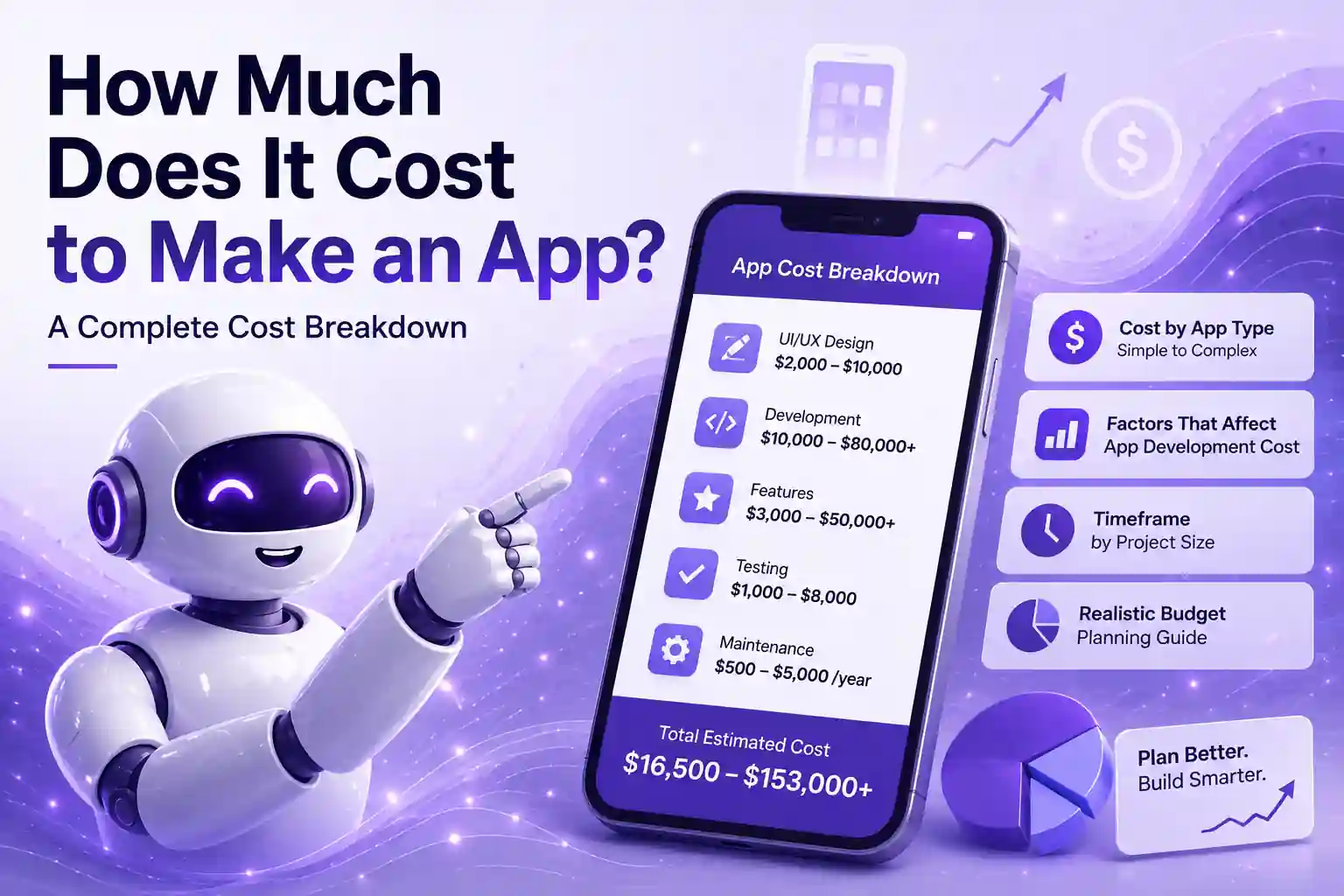
How Much Does It Cost to Make an App? Quick Answer
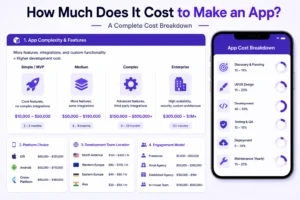
| App type | Typical cost | Build method | Timeline |
|---|---|---|---|
| No-code / AI builder | $0–$500/month | Self-build | Days to weeks |
| Simple / MVP | $10,000–$60,000 | Freelancer | 2–4 months |
| Medium complexity | $50,000–$180,000 | Freelancer or small agency | 4–8 months |
| Complex | $150,000–$500,000+ | Agency | 9–12 months |
| Enterprise | $300,000–$1,000,000+ | Agency or in-house | 12+ months |
- Three things no cost table tells you: Developer location moves the price by 50–70%. The same medium app costs $60,000 in Eastern Europe and $160,000 in the US.
- Development is only 40–55% of your total budget. Discovery, design, QA, and deployment make up the rest.
- Budget 15–25% of your build cost every year just to keep the app running after launch. On a $100,000 app, that is $15,000–$25,000 annually before any new features.
- Industry data from over 5,000 app development projects puts the average cost of custom mobile app development at $171,450 in 2025–2026, though most small to mid-size apps fall between $50,000 and $120,000.
What Kind of App Are You Building? (Start Here)
Before any cost number makes sense, identify exactly what you are building. Two founders can both say “I want to build an app” and need completely different budgets.
Mobile app vs web app vs both
A mobile app lives on a phone, downloaded from the App Store or Google Play. A web app runs in a browser with no download needed. Building both costs significantly more.
If you are validating a new idea, a web app MVP is almost always cheaper and faster. Add native mobile once you have proof people want what you are building.
| Type | Cost range | Best for |
|---|---|---|
| Web app only | $8,000–$80,000 | MVPs, SaaS tools, internal dashboards |
| Mobile app (one platform) | $10,000–$150,000 | Consumer apps, on-demand services |
| Mobile app (iOS + Android) | $20,000–$300,000+ | Wider reach, established product |
| Web + mobile combined | $30,000–$400,000+ | Full product launch |
iOS vs Android: which platform should you launch on first?
Launch on iOS first if your audience is in the US, UK, or Australia. iOS accounts for 68% of global app consumer spending despite a smaller device user base.
Launch on Android first if your audience is in India, Southeast Asia, Latin America, or Africa. Android holds 72.55% of the global smartphone market.
Go cross-platform from day one if budget is tight and you need both audiences. Flutter and React Native save 30–40% compared to building separate native apps. Android apps typically cost 10–20% more to test than iOS due to device fragmentation.
| Platform | Cost range | Notes |
|---|---|---|
| iOS only | $60,000–$120,000 | Higher-spending users, faster App Store review |
| Android only | $50,000–$110,000 | Largest global reach, more device testing needed |
| Cross-platform (Flutter/React Native) | $40,000–$160,000 | One codebase, 30–40% cheaper than building both natively |
| Native iOS + Android separately | $100,000–$300,000+ | Best performance, highest cost, two codebases |
How much does it cost to make an app by category?
| App category | Cost range | What drives the cost up |
|---|---|---|
| Fitness app | $20,000–$150,000 | Wearable integrations, AI coaching, compliance |
| Ecommerce app | $30,000–$200,000 | Inventory sync, payment gateways, AR previews |
| Marketplace (two-sided) | $80,000–$300,000+ | Two user flows, trust features, escrow, admin panel |
| Service booking app | $25,000–$120,000 | Scheduling, payments, push notifications, maps |
| SaaS / B2B tool | $40,000–$250,000 | Custom logic, integrations, enterprise security |
| Social app | $60,000–$300,000+ | Real-time feeds, messaging, content moderation |
| On-demand (Uber-style) | $100,000–$400,000+ | Real-time geolocation, multi-role, logistics, payouts |
| Healthcare / telemedicine | $100,000–$400,000+ | HIPAA compliance, EHR integration, video, verification |
A basic fitness tracker costs $20,000–$50,000. Add AI coaching, wearable integrations, and a subscription paywall and you are looking at $80,000–$150,000. Features drive the number, not the category label.
How Much Does It Cost to Build an App Yourself?
Building without hiring a developer is now a legitimate route. No-code and AI app builders allow functional app launches for a few hundred dollars a month or even free.
No-code and AI app builders ($0–$500/month)
Platforms like Bubble, Adalo, Glide, and Base44 let you build using drag-and-drop tools and AI prompts with no code. You pay a monthly subscription instead of a large upfront fee.
| Platform tier | Monthly cost | Best for |
|---|---|---|
| Free plan | $0 | Testing and validating ideas |
| Starter / launch plan | $16–$60/month | Simple MVPs, small user bases |
| Growth plan | $60–$200/month | Growing products with more users |
| Team / business plan | $200–$550/month | Larger teams, higher usage volumes |
You can build: internal tools, dashboards, booking systems, simple marketplaces, basic ecommerce apps, subscription content platforms.
You cannot easily build: apps requiring high performance at scale, hardware integrations like Bluetooth or sensors, complex real-time features, or HIPAA-level healthcare compliance.
Many founders start on no-code to validate with real users, then move to a custom build once they have revenue to fund it. This is the smartest sequencing strategy for budget-constrained founders — and often saves $30,000–$50,000 in wasted development on unproven ideas.
When DIY stops working: You hit the ceiling when your app needs to handle large data volumes at speed, requires deep custom logic, or needs to scale beyond what the platform supports. Rebuilding on a custom stack at that point is the cost of starting over.
How Much Does It Cost to Hire Someone to Build Your App?
There are three hiring routes: freelancers, agencies, and in-house developers.
Freelancers ($5,000–$50,000)
Best for simple, well-defined projects where the scope is clear before work begins.
| Freelancer Pros | Freelancer Cons |
|---|---|
| ✅ Lower cost than agencies ✅ Direct communication, no middleman ✅ Flexible engagement model ✅ Best for simple, well-scoped projects |
❌ Single point of failure — no backup if they disappear ❌ No built-in PM, QA engineer, or designer ❌ Offshore disappearing developer risk is real and documented ❌ Code quality varies widely without vetting |
The “disappearing developer” problem is real and well-documented in founder communities. An e-commerce founder hired a freelancer to build a store with payment integration. Two months in, the developer stopped responding entirely. The founder had a half-built product and no access to hosting registered under the freelancer’s credentials. Recovery cost more than a milestone-contracted agency would have charged from the start.
Always: use milestone contracts, never pay more than 30% upfront, ensure IP transfer is written into every milestone payment. Find vetted freelancers on Toptal, Arc.dev, Clutch, or Upwork.
App development agencies ($50,000–$500,000+)
| Agency Pros | Agency Cons |
|---|---|
| ✅ Full team: PM, designer, frontend, backend, QA ✅ Structured delivery with milestone accountability ✅ Post-launch support included or clearly priced ✅ Best for medium-to-complex builds |
❌ Higher cost than freelancers ❌ Some agencies over-promise in sales and under-deliver ❌ Less day-to-day flexibility ❌ Sales team vs delivery team mismatch risk |
In-house developers ($100,000–$133,000/year per developer)
According to Indeed.com, hiring a US-based mobile app developer costs around $110,000/year. Only makes sense for long-term product companies needing continuous development post-launch. This is not a cost-saving route — it is a long-term team investment.
What is the payment model with an app development company?
This question appears constantly in Quora and Reddit threads and almost no guide answers it clearly. There are three main payment structures:
| Payment model | Best for | Risk |
|---|---|---|
| Fixed price | Simple, well-scoped projects | Change orders charged as expensive extras |
| Time and materials (T&M) | Complex or evolving requirements | Final bill often significantly higher than estimate |
| Dedicated team | Ongoing product development | Monthly cost regardless of output |
| Milestone-based ✅ Recommended | Any project type | Lowest — you control when payment releases |
Typical milestone split: 20–30% upfront, then payments tied to design delivery, development stages, testing completion, and launch. Never pay more than 30% before seeing approved, deliverable work.
How Much Does It Cost to Build an App by Complexity Level?
Simple app: $10,000–$60,000
What you get: Basic login, one or two core features, simple backend, one platform. Team: 1–2 full-stack developers, part-time designer, part-time QA. Timeline: 2–4 months. Examples: Calculator, note-taking app, basic booking tool, simple fitness tracker.
What $30,000 actually buys: One platform, user login, one primary feature, a simple backend, and basic testing. Every additional feature pushes you to the medium tier.
Medium complexity: $50,000–$180,000
What you get: Custom UI, user accounts, payment processing, push notifications, third-party API integrations, admin dashboard, multi-platform. Team: 1 PM, 1 designer, 2–3 developers, 1 dedicated QA engineer. Timeline: 4–8 months. Examples: Ecommerce app, fitness app with subscriptions, service marketplace, booking platform.
What $80,000 actually buys: Custom iOS and Android app, user login and profiles, Stripe payment integration, push notifications, basic analytics, and an admin panel. No real-time features, no AI, no complex multi-role logic.
Complex app: $150,000–$500,000+
What you get: Real-time features, multiple user roles and permissions, scalable cloud backend, 30+ screens, deep integrations, complex business logic. Team: 2+ PMs, 2–3 designers, 4–6 developers, 2 QA engineers, DevOps. Timeline: 9–12 months. Examples: Uber-style on-demand platform, two-sided marketplace, telemedicine app, fintech app.
Enterprise app: $300,000–$1,000,000+
What you get: High-level security, regulatory compliance (HIPAA, SOC 2, GDPR), complex enterprise system integrations, advanced data architecture, multi-market support. Team: Full product team including architects, compliance specialists, and dedicated security engineers. Timeline: 12+ months. Examples: Banking platform, healthcare network portal, large-scale SaaS product.
| Complexity | Cost range | Team size | Timeline | Example |
|---|---|---|---|---|
| Simple | $10k–$60k | 2–3 people | 2–4 months | Booking app, basic tracker |
| Medium | $50k–$180k | 4–6 people | 4–8 months | Ecommerce, fitness with payments |
| Complex | $150k–$500k+ | 6–10 people | 9–12 months | Marketplace, on-demand platform |
| Enterprise | $300k–$1M+ | 10+ people | 12+ months | Banking platform, healthcare portal |
How Does Developer Location Affect the Cost of Your App?
Where your developer is based moves the price of the same app more than almost any other single factor.
| Region | Hourly rate | Cost: medium complexity app |
|---|---|---|
| US / Canada | $100–$200/hr | $120,000–$200,000 |
| Western Europe / UK | $80–$150/hr | $90,000–$160,000 |
| Eastern Europe | $40–$80/hr | $50,000–$100,000 |
| India / Southeast Asia | $20–$50/hr | $25,000–$70,000 |
| Latin America | $30–$70/hr | $35,000–$90,000 |
Offshore hiring from Eastern Europe or South Asia can cut costs by 50–70% without major quality loss when hiring from reputable, vetted platforms. Eastern Europe is widely considered the best balance of cost, quality, and communication for Western founders.
If hiring offshore, use an agency structure rather than a solo freelancer. Always structure payments by milestone with code ownership explicitly written into the contract.
How Much Does Each Stage of App Development Cost?
Understanding the stage breakdown helps you evaluate whether any quote you receive is complete or missing key components. A quote with one lump-sum number and no stage breakdown is a warning sign.
| Stage | % of budget | Cost on $100k app | What it covers |
|---|---|---|---|
| Discovery & planning | 10–15% | $10,000–$15,000 | Research, wireframes, project scoping |
| UI/UX design | 15–20% | $15,000–$20,000 | Visual design, user flows, prototypes |
| Development | 40–55% | $40,000–$55,000 | Coding, database, integrations |
| Testing & QA | 10–15% | $10,000–$15,000 | Bug fixing, device testing, security checks |
| Deployment | 5–10% | $5,000–$10,000 | App store submission, launch, handover |
Which App Development Company Is Right for Your Budget?
Under $50,000 — boutique studios and vetted freelancers
Look for small studios specializing in MVPs. Clutch, Toptal, and Arc.dev let you filter by budget and read verified client reviews.
Red flags: No portfolio, requests 50%+ upfront, vague QA process, resistance to signing an NDA.
$50,000–$150,000 — mid-tier agencies
Expect a full team: PM, designer, at least two developers, QA engineer. Agencies specializing in your industry often outperform generalists.
Red flags: Promising large scope for suspiciously low price, no discovery phase in their process, vague milestone structure.
$150,000+ — full-service agencies
Verify case studies, speak to previous clients directly, and confirm which specific team members will work on your project before signing anything.
Red flags: Sales manager sells you, junior team delivers. No IP ownership clause in the contract.
Enterprise — specialist firms
For healthcare, fintech, or government builds, you need firms with proven compliance experience in your specific regulatory environment. Generic agencies can build the app. Specialist firms have already done the HIPAA audits and SOC 2 processes.
| Budget | Company type | Where to find them |
|---|---|---|
| Under $50k | Boutique studio or vetted freelancer | Clutch, Toptal, Arc.dev |
| $50k–$150k | Mid-tier agency | Clutch, AppFutura, GoodFirms |
| $150k–$500k | Full-service agency | Clutch Top 1000, direct referrals |
| $500k+ | Specialist firm or in-house team | Industry referrals, direct search |
How Much Does It Cost to Build an iOS App vs an Android App?
Native iOS only: $60,000–$120,000. Consistent hardware, faster App Store approval, higher average user spending. iOS accounts for 68% of global app consumer spending.
Native Android only: $50,000–$110,000 listed, but often 10–20% more in practice due to the variety of device models, screen sizes, and OS versions requiring proper testing.
Cross-platform (Flutter or React Native): $40,000–$160,000 for both platforms from one codebase. Saves 30–40% versus building natively for both. The right choice for most MVPs and medium complexity apps.
| Approach | Cost | Pros | Cons |
|---|---|---|---|
| iOS only | $60k–$120k | Fastest to ship, premium users | Misses 72% of global devices |
| Android only | $50k–$110k | Largest global reach | More device testing needed |
| Cross-platform | $40k–$160k | Both platforms, lower cost | Minor native feature limitations |
| Native both | $100k–$300k+ | Best performance | Highest cost, two codebases to maintain |
Should you launch on just one platform first? Yes, if budget is any concern. Build on iOS for US/UK/Australia. Build on Android for India, Southeast Asia, and emerging markets. Add the second platform after validating the product with real users.
“The best app development investment is not the most expensive one. It is the one with the clearest scope, the most honest quote, and a team that tells you exactly what your budget buys.”
How Much Does It Cost to Build an AI-Powered App?
Building an AI-powered app means paying for the base app build plus AI features on top. The AI layer carries ongoing usage costs that grow directly with your user base.
Most AI features in 2026 use third-party APIs from OpenAI, Google, or Anthropic rather than custom-built models. You pay per use — so AI costs scale with traffic.
| AI feature | Build cost to add | Monthly ongoing cost |
|---|---|---|
| AI chatbot / assistant | $5,000–$20,000 | $50–$500+ depending on usage volume |
| Personalized recommendations | $10,000–$30,000 | $100–$1,000+ |
| Image recognition | $8,000–$25,000 | Per image processed |
| Voice recognition / TTS | $5,000–$15,000 | Per-minute API costs |
| AI content generation | $5,000–$20,000 | Token-based API costs |
| Custom fine-tuned model | $30,000–$150,000+ | Hosting + inference costs |
For startups: Add one AI feature via an existing API tied to your core user value. Do not build a custom model. Building from scratch only makes sense when you have proprietary training data and a dedicated AI budget above $100,000 — just for the AI layer alone.
Real Case Studies: What Actually Happens When Founders Build Apps
✅ Success: Uber — one feature, one city, $1–1.5M MVP
In 2009, Travis Kalanick and Garrett Camp launched UberCab in San Francisco testing one hypothesis: will people pay a premium to summon a car from their phone? No app. No surge pricing. No ratings. Just a text message to request a black car from a handful of drivers.
The MVP cost an estimated $1–1.5 million, reflecting GPS dispatch infrastructure and a dual-sided platform. By February 2011, Uber was valued at $60 million.
“Lesson: Answer one question before building everything else. Uber’s entire v1 existed to test one assumption in one market before scaling anything.”
✅ Success: Airbnb — $240 in revenue before writing product code
Brian Chesky and Joe Gebbia targeted one event, one city, three guests. Their first MVP had no date selection, no pricing engine, no reviews. Three people paid $80/night — $240 total — proving strangers would rent space in someone’s home.
Airbnb grew from $1M revenue in 2009 to $100M in 2012 on the back of that single validated assumption. Today it is valued at over $93 billion.
“Lesson: Validate the idea before building the product. A manual, human-powered test is more valuable than a polished app that nobody wants.”
❌ Failure: Builder.ai — $445M raised, filed for bankruptcy May 2025
Builder.ai marketed itself as an AI-powered app development platform, raised $445M, and reached a $1.3B valuation backed by Microsoft. Investigations revealed most “AI” development was performed by hundreds of offshore human developers. Internal audits slashed revenue projections by 75%. When lenders seized $37M of the company’s $42M in cash, it was over.
“Lesson for founders hiring development services: verify what you are actually buying. Impressive AI claims warrant more due diligence, not less. Always ask for proof behind the pitch.”
❌ Failure: The offshore developer who disappeared mid-project
A documented community case: an e-commerce founder hired a freelancer who went silent two months in. The founder had a half-built store and no access to hosting registered under the freelancer’s credentials. Recovery cost more than a milestone-contracted agency would have charged from the start. Missed launch window cost six weeks of revenue.
“Lesson: Own your hosting credentials and code repository from day one. Never pay more than 30% upfront. IP transfer must be written into every single milestone payment.”
Key Insights: What the Data Actually Shows
- Scope creep is the number one budget killer: PMI research found 52% of projects experience scope creep, up from 43% in 2018. McKinsey and Oxford found large IT projects run 45% over budget on average while delivering 56% less value than predicted.
- Most founders underestimate post-launch costs: Around 70% of software projects exceed their initial budget, with an average overrun of 27%.
- The cheapest quote produces the most expensive outcome: The top causes of failure are unclear requirements (39%), scope creep (33%), and inadequate planning (29%) — none of which are technical failures (Standish Group 2024).
- AI features are now mainstream: 63% of mobile app developers now integrate AI features, making AI-powered apps the fastest-growing build category in 2026.
- Quote variance is structural, not random: The same brief routinely returns a 3x to 10x price range from different agencies — because each quote makes completely different assumptions about team seniority, QA coverage, and what “done” actually means.
Why Did You Get Quotes of $20,000 and $180,000 for the Same App?
This happens to nearly every founder who shops around. It is not a sign that one agency is dishonest. It is a sign they are quoting completely different products.
A very low quote for a medium complexity app almost always assumes: a template build, no QA budget, junior developers in a very low-cost region, minimal scope, and no project management included. You may get a working app. You will not get a maintainable, scalable product.
How to know if a quote is fair
Ask these five questions before signing anything:
- Is this quote broken down by stage and feature?
- What is explicitly excluded from this quote?
- How are change requests priced and approved?
- Who owns the code if the contract ends early?
- Can I speak to a previous client who built a similar app with your team?
If an agency cannot answer all five questions clearly in writing, keep looking.
Good vs bad: same app, two completely different outcomes
| ❌ Bad approach | ✅ Good approach |
|---|---|
| Accepted a $22,000 fixed-price quote for a marketplace app. Scope was defined in three bullet points. Every feature request during development became a paid change order. Final invoice: $67,000. Launch: nine months late. No QA documentation provided. | Paid $5,000 for a standalone discovery phase first. Got detailed wireframes, a feature specification, and a milestone-based contract. The build came in at $85,000, three weeks under timeline, with zero surprise charges. The discovery fee was credited toward the build invoice. |
The discovery phase is not overhead. It is the cheapest protection you can buy before a six-figure commitment. A 2–4 week paid discovery phase costing $5,000–$15,000 prevents the most common and expensive cause of budget overrun: unclear requirements discovered mid-build.
What Does Your App Development Quote Not Include?
Most quotes cover the cost of building the app. They do not cover what it costs to keep the app running after launch. This is where most first-time founders get an unpleasant surprise.
| Ongoing cost | Annual range |
|---|---|
| Apple Developer account | $99/year |
| Google Play (one-time) | $25 |
| App store commission | 15–30% of all in-app purchase revenue |
| Cloud hosting / infrastructure | $600–$24,000+/year |
| Third-party APIs (Maps, Stripe, etc.) | $1,000–$20,000+/year |
| Bug fixes and routine maintenance | $1,000–$5,000/year |
| Security updates | $1,000–$2,500/year |
| iOS and Android OS compatibility updates | $5,000–$30,000/year |
⚠️ Budget 15–25% of your original build cost every year just to keep the app running. On a $100,000 app, that is $15,000–$25,000 annually before adding a single new feature. QA testing, app store fees, infrastructure, and first-year maintenance typically add 30–40% on top of your development quote.
A freemium model requires subscription management and a paywall. An in-app purchase model requires purchase flows and receipt validation. A marketplace requires payment splitting and automated payouts. These features are not small additions and are routinely missing from early-stage quotes.
How Can You Reduce the Cost of Building Your App?
| ✅ What smart teams do | ❌ What most teams get wrong |
|---|---|
| ✅ Start with an MVP — if you can describe your app in 10 screens, launch that version first✅ Use Flutter or React Native — saves 30–40% vs native builds on both platforms
✅ Build in phases — fund phase two with actual revenue, not assumptions ✅ Use existing APIs (Stripe, Firebase, Google Maps) — saves tens of thousands in development hours ✅ Use fixed-price milestone contracts — prevents runaway T&M bills ✅ Consider Eastern European agencies — $40,000–$60,000 savings on a $100k app with comparable quality |
❌ Try to build everything in v1 before validating the core idea❌ Build native iOS and Android separately from day one without a budget for both
❌ Accept a time and materials contract without a defined scope ceiling ❌ Build custom payment, auth, or maps instead of using proven APIs ❌ Accept a very cheap quote without specifically asking what is excluded ❌ Skip the discovery phase to save $5,000 — then pay $40,000+ in change orders |
Explore More Helpful Guides!
- How Startups, SMEs and Agencies Can Generate Leads Using n8n: Turn Manual Prospecting into an Automated Lead Generation System
- Best AI Visibility Tools: Compare the Top Platforms for Tracking Brand Mentions in AI Search
- 12 Best Character AI Alternatives: Find Better AI Chatbots for Roleplay, Storytelling & Conversations
- AI Smart Glasses vs Privacy: What Every Buyer Should Know Before Wearing AI Glasses
- Best AI Coding Tools: Compare Features, Pricing & Which One Is Worth Paying For
FAQs
Can I build an app for under $1,000?
Why is app development so expensive?
How much does a fitness app cost to build?
How much does a marketplace app cost to build?
Is React Native cheaper than building native iOS and Android apps separately?
Is Flutter cheaper than React Native?
Is outsourcing app development worth it?
Can I build an app for under $10,000?
Should I hire freelancers or an agency?
Can one person build an app?
Is app development tax deductible?
Can I finance app development?
How much does it cost to publish an app?
What happens if my build goes over budget?
How much does it cost to add AI features to an existing app?
What is a fair price to pay an app development agency?
Do I pay an agency upfront or in milestones?
Conclusion: What Should You Actually Do With This Information?
The cost to make an app in 2026 is not one number. It is the product of five decisions made before writing a single brief: what type of app you are building, which platform you launch on first, who you hire to build it, where that team is based, and how tightly you define scope before signing anything.
Most founders who go over budget do not lose money because development is expensive. They lose it because they signed a vague contract, accepted the cheapest quote without understanding what was excluded, or tried to build everything at once before validating the core idea.
If you are just starting out: validate on no-code first. Build on one platform. Keep your MVP to 10 screens or fewer.
If you have $50,000–$150,000: find a mid-tier agency with verified reviews in your category. Run a paid discovery phase. Use cross-platform frameworks to reduce cost.
If you have $150,000+: invest in a full-service agency with direct client references. Define compliance requirements before scoping. Build modularly so phase two does not require a complete rebuild.
Bottom line: The average custom app costs $171,450. Most MVPs land between $25,000–$70,000. Your build method, developer location, and scope discipline matter more than any other variable. Budget 15–25% of your build cost every year for maintenance. Never pay more than 30% upfront. Start small. Validate first. Build the rest.
Cost data compiled from 5,000+ app development projects across Cynoteck, DashDevs, Clutch, BusinessOfApps, and industry reports. Pricing verified as of July 2026. This is a fast-moving market — verify directly with agencies before committing to any budget.