👉 Try MindtrixAI’s Free LLMs.txt Generator, AI Humanizer Tool & AI Paraphrasing Tool Now →
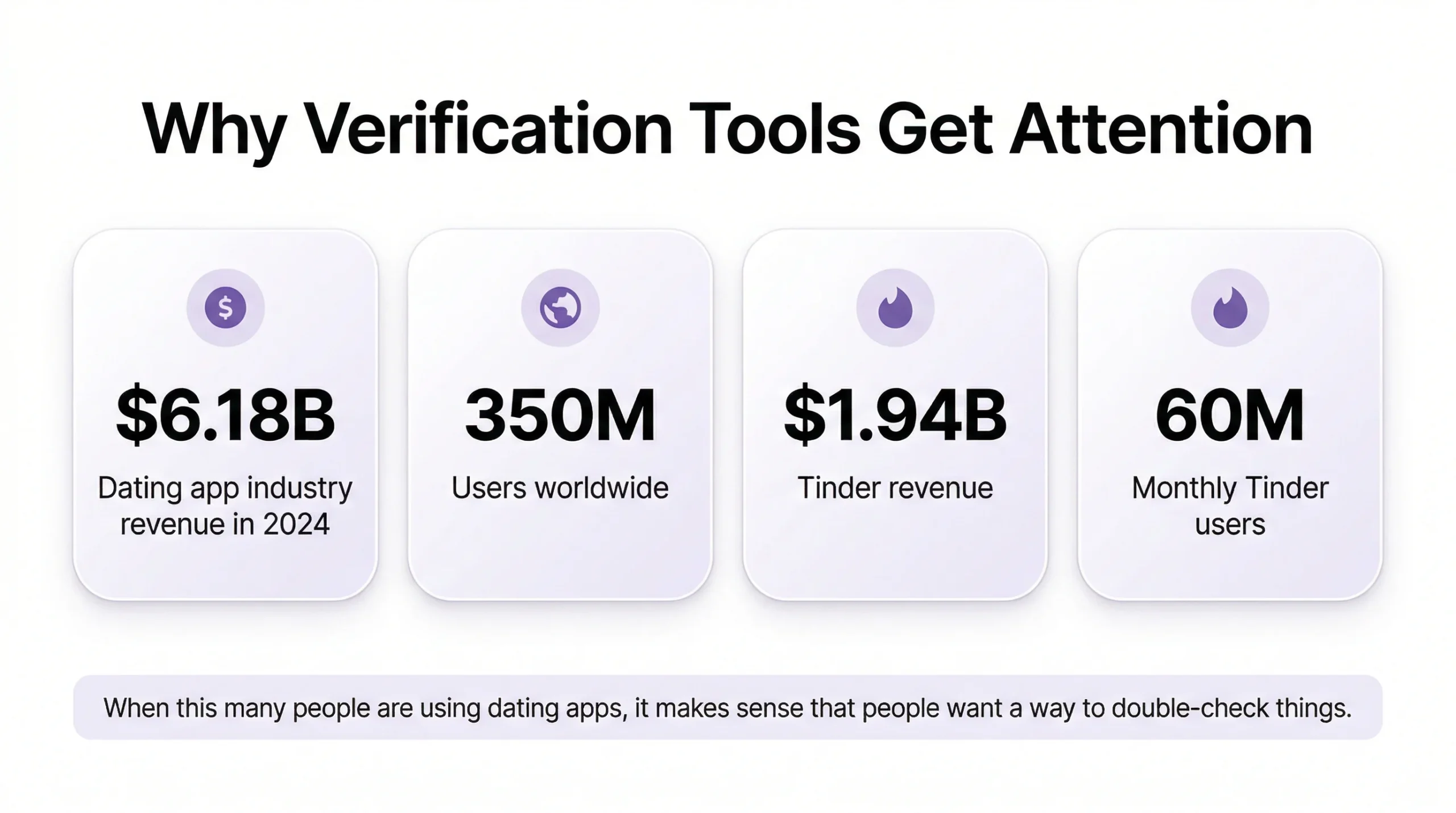
To put things into perspective, the dating app industry made $6.18 billion in 2024 and has around 350 million users worldwide. Tinder alone brought in $1.94 billion with about 60 million monthly users. So yeah, when this many people are using these apps, it makes sense that people want a way to double-check things.
So, is CheaterBuster actually helpful?
I tried it myself, and honestly, it’s not as simple as “yes” or “no.”
👉 If you already have clear details like a name, age, city, or even a photo, it can actually help you feel a bit more sure about things.
👉 But if you’re going in with just a gut feeling or very little info, it doesn’t really give you much back.
And this kind of mixed experience isn’t just mine. On Trustpilot, CheaterBuster has a 2.9/5 rating from 283 reviews, which shows people are using it, but not everyone walks away satisfied.
So what’s the bottom line of MindtrixAI’s CheaterBuster AI review? CheaterBuster isn’t some magic truth-finder. It can help in specific situations, but it’s not something you should depend on completely.
CheaterBuster AI Review: Quick Verdict Box
| Verdict Item | My Take |
|---|---|
| Best for | Focused dating-app verification with strong inputs |
| Worst for | Vague suspicion, panic-buying, or treating one result as final proof |
| My verdict | Useful as a clue-finding tool, weak as a certainty machine |
| Overall score | 6.2/10 |
At-a-Glance Data Snapshot
| Metric | Exact Figure | Why It Matters |
|---|---|---|
| Global dating-app market revenue | $6.18B | Huge market supporting tools like this |
| Global dating-app users | 350M | Massive user base creates verification demand |
| Paying dating-app users | 25M | Premium dating behavior is common |
| Tinder revenue | $1.94B | Tinder remains commercially dominant |
| Tinder monthly active users | 60M | Large enough scale for search-style tools |
| Tinder subscribers | 9.6M | Strong paid dating ecosystem |
| Tinder users under 35 | 60% | High-volume, fast-moving demographic |
| Tinder male user share | 75% | Relevant to search density and ambiguity |
| CheaterBuster Trustpilot score | 2.9/5 | Public trust is mixed |
| CheaterBuster Trustpilot review count | 283 | Enough volume to show recurring pain points |
The market figures above come from Business of Apps’ dating-app market report and Business of Apps’ Tinder statistics page, while the review figures come from Trustpilot’s Cheaterbuster AI page.
What Is CheaterBuster and Who Is It Actually For?
CheaterBuster is a tool people use when they want to check whether someone might still be active on dating apps. In plain words, it is built for moments when a person has a doubt and wants something more concrete than a gut feeling.
For example, maybe someone says they deleted Tinder months ago, but something still feels off. Or maybe you are in a long-distance relationship and you cannot easily verify things for yourself. That is the kind of situation where a tool like this starts to feel tempting.
From what I found in my testing, CheaterBuster works best when you already have strong details, like a first name, approximate age, likely city, and ideally a clear recent photo. If that sounds like your situation, it can be useful. But if your search is more like “maybe Alex, maybe 29, maybe London,” the value drops fast.
Before going deeper, here are the key terms in a practical way:
| Term | What It Means in Real Life |
|---|---|
| Dating-app search | Using details like name, age, and location to look for possible profile matches |
| Face search | Using a photo to narrow down likely matches |
| Reverse lookup | Starting with a name, phone number, or address to find connected clues |
| Monitoring | Checking over time instead of doing one quick search |
| Activity signal | A clue that may suggest profile activity, but not automatic proof of cheating |
That last point matters a lot. One of the biggest mistakes people make with tools like this is treating one result like a final answer. It is not. It is a clue. And clues still need context.
Key Insight: CheaterBuster becomes more useful when your details are narrow and specific. It becomes less useful when your search is based on guesses.
My First-Hand Testing: What I Looked For When I Tested CheaterBuster Myself
I did not want this CheaterBuster AI review to feel like a polished rewrite of a sales page. I wanted to see what the tool feels like for a real person using it in a real emotional situation.
So when I tested CheaterBuster, I focused on five simple questions:
- Is it easy enough for a stressed, non-technical user?
- Does it feel stronger with specific inputs than weak ones?
- Are the labels easy to understand, or easy to misread?
- Does the experience feel worth paying for?
- Do public complaints match the concerns I had while testing it?
What stood out to me right away was this: using the tool is not the hard part. Understanding the result is.
If I looked at it as a narrow verification tool, it felt useful. But if I imagined someone using it as an emotional lie detector, it felt much weaker. That difference matters more than any dramatic marketing line.
If I had to sum up my experience in one sentence, it would be this: CheaterBuster works better as a structured suspicion-checking tool than as a truth machine.
That does not automatically make it bad. It just means you should know what kind of answer you are actually paying for.
73% of the Negative 2026 Reviews I Sampled Mentioned Billing, Support, or Pricing Friction
Here is something many CheaterBuster AI reviews miss.
The biggest problem is not always whether the tool works. Sometimes the bigger issue is what happens after you pay.
When MindtrixAI sampled visible 2026 Trustpilot reviews across the first three live pages, I found 54 visible reviews. Out of those, 11 were negative. More importantly, 8 of those 11 negative reviews mentioned billing, refunds, cancellations, support, or pricing confusion.
That means 72.7% of the negative 2026 reviews I sampled were not mainly about bad results. They were about buyer friction.
This matters because a product like this is already emotionally loaded. If a person feels nervous before buying and then also feels confused after paying, the whole experience starts to feel worse even if the search itself is somewhat useful.
In simple terms, people are not only buying results here. They are also buying peace of mind. If the billing flow feels unclear, that peace of mind disappears fast.
How to Use CheaterBuster Step by Step If You Want the Best Chance of a Useful Result
If you are going to use this tool, how you use it matters more than most people think. A lot of wasted money starts with weak input quality, not bad software.
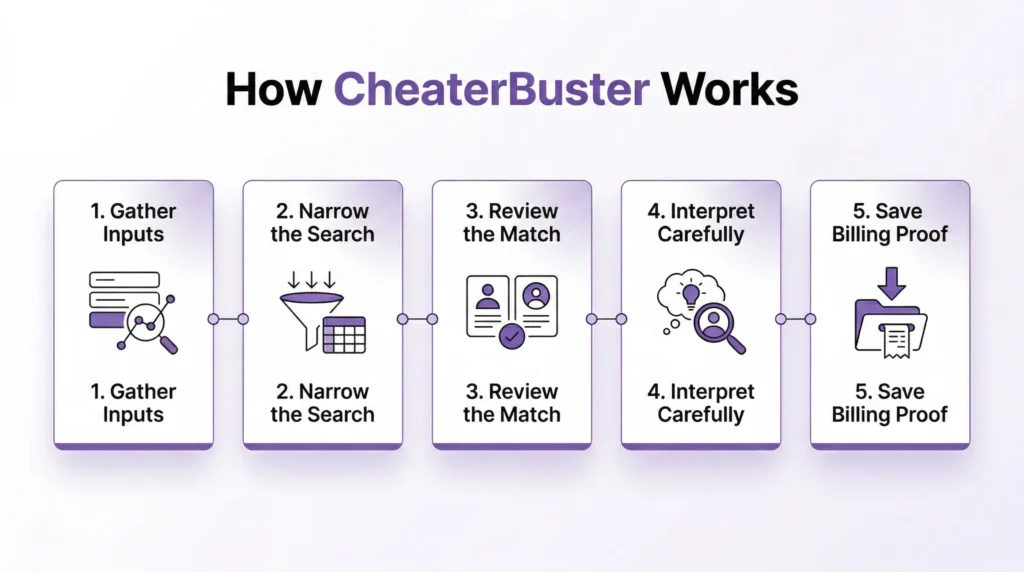
Step 1: Gather your strongest facts before you pay
You should ideally have:
- first name
- approximate age
- likely city or area
- a recent face photo if possible
If you are missing most of that, it is smarter to slow down before spending money.
Think of it this way: searching for “Daniel, 31, Madrid” is very different from searching for “Alex, maybe 29, maybe London.” One gives you a real chance to narrow things down. The other gives you room for confusion.
Step 2: Ask a narrow question
The best question is not “Are they cheating?”
A better question is: “Can I find a strong, believable dating-profile clue connected to this specific person?”
Step 3: Review the result like an investigator, not a prosecutor
Ask yourself:
- Does the age match?
- Does the location make sense?
- Do the photos look recent?
- Does this clearly look like the same person?
Step 4: Treat the result as a lead, not a verdict
This is where people can get hurt emotionally. A profile clue may matter, but it still needs interpretation.
Step 5: Save screenshots and billing details
If you decide to pay, keep your receipt, save the checkout details, and document what you found.
My practical takeaway after testing the full flow is simple: the main risk is not usability. The main risk is overconfidence.
What Features Does CheaterBuster Actually Offer in Real Use?
This is where many CheaterBuster AI reviews stay too vague, so let’s make it practical.
- Basic profile search: This is what most people are really paying for. You enter identifying details and look for likely profile matches.
- Photo-assisted matching: If the name is common or the city is large, image support can make the search feel much more useful.
- Location-based narrowing: This matters more than many people expect. A likely city can dramatically improve relevance.
- Activity-style signals: These are the signals most people care about emotionally, but they are also the easiest to overread.
- Monitoring-style value: The tool makes more sense when viewed as a repeated-check product rather than a one-time curiosity buy.
My feature-level take is simple: the most useful feature is not the branding, the AI wording, or the dramatic promise. It is the narrowing effect. That is what gives the tool its practical value.
How Accurate Is CheaterBuster When You Only Know a First Name, Age, and City?
This is one of the biggest real-world questions, so here is the direct answer.
It depends heavily on how specific those three details really are.
If the name is uncommon, the age is close, and the city is correct, the tool can feel reasonably useful. If the name is common, the city is large, and the age is just a guess, confidence drops quickly.
Imagine searching for “Alex, 29, London.” You are not searching for one person. You are searching through a crowded pool of possibilities. That is where mistakes become easier.
There is also a helpful outside comparison here. Earlier reporting on Swipebuster mentioned a high success rate in a small test group, but it also highlighted an important exception with a very common name in New York City. That exception matters because it shows where confidence starts breaking down.
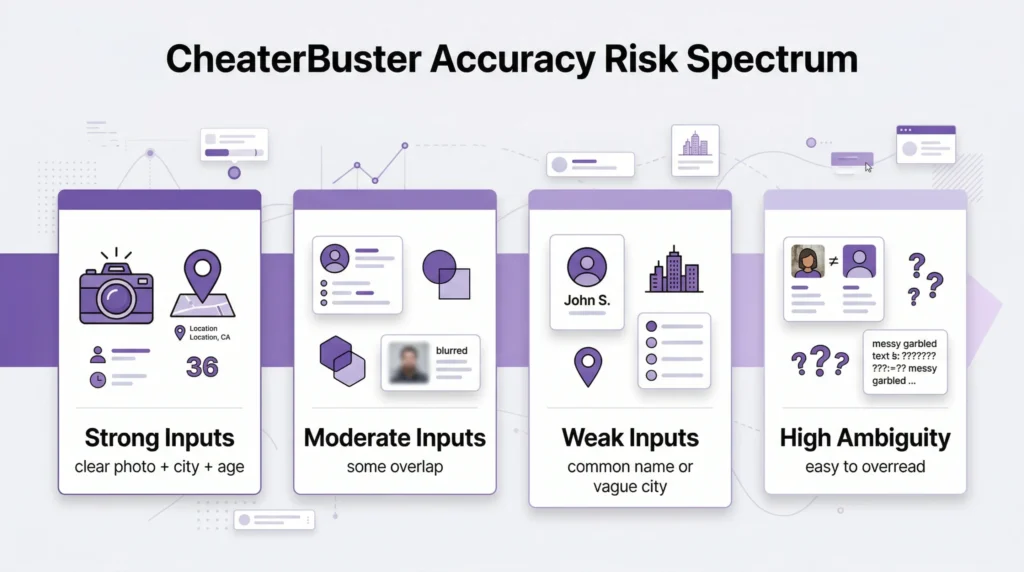
My Accuracy verdict
| Scenario | My Verdict |
|---|---|
| Strong-input scenario | Useful enough to consider |
| Weak-input scenario | Easy to misread |
| Common-name scenario | High ambiguity |
| Emotionally loaded scenario | Highest risk of bad interpretation |
At Tinder’s scale, even small overlaps in names, cities, or photos can create serious search noise. That is why input quality matters so much here.
Why Do Common Names Make CheaterBuster Feel Less Reliable?
This deserves its own section because it is one of the biggest user pain points.
When the target has a common name, the search stops being a precision task and starts becoming a filtering problem.
That does not mean the tool is broken. It just means more of the burden shifts back onto you.
“Daniel, 31, Madrid, recent photo” is a much stronger search than “Alex, around 29, maybe London.” The first search narrows. The second search drifts.
My biggest takeaway from realistic testing is this: CheaterBuster becomes more convincing when the search feels like a narrowing exercise, not a fishing trip.
Can CheaterBuster Show Deleted, Hidden, or Private Profiles — and What Does That Mean for Buyers?
This is one of the most important long-tail concerns because real users actively worry about it.
A Reddit thread in r/SwipeHelper shows users struggling to understand whether surfaced profiles were actually deleted, temporarily private, or still active in some other way. One commenter said the service responded that it would show a profile as “temporarily set to private or cancelled” and could not reliably tell the difference.
Why this matters is obvious: the difference between “deleted,” “hidden,” and “not currently visible” can completely change how a buyer reads the result.
My view is that this is exactly why I would never position CheaterBuster as a black-and-white truth tool. If the status language itself is open to interpretation, the output has to be interpreted carefully too.
What Do “Last Active,” “Last Found,” and “Last Sync” Actually Mean on CheaterBuster?
This is another area where users get confused very quickly.
The labels sound precise, which makes them feel powerful. But that is also what makes them risky.
For many people, seeing something like “last active” creates an instant emotional reaction. The mind jumps from “this profile had some recent signal” to “this person is definitely actively cheating.” Those are not the same thing.
Here is the safer way to read these labels:
- Last active should not automatically mean “actively cheating”
- Last found should not automatically mean “currently swiping right now”
- Last sync should not automatically mean “fresh real-life intent”
My testing-based view is that this is one of the weakest confidence points in the whole experience. The tool may surface useful clues, but the labels can invite overreading when the buyer is already anxious.
Is CheaterBuster Worth Paying For If You’re in a Long-Distance Relationship or Already Deeply Suspicious?
This is a real user question, and it deserves a real answer.
If you are in a long-distance relationship and already have strong identifying details, CheaterBuster can feel more justified because direct verification is harder.
But if you are already in panic mode, the tool can just as easily increase anxiety instead of resolving it.
For example, if you already check their replies, question their timing, and feel upset before you even start the search, the tool may not calm you down. It may just give your mind more things to spiral around.
My answer is simple:
- Long-distance + Strong data: Maybe worth it
- Suspicion + Weak data + Panic: Probably not worth it
- Trying to replace communication entirely: Definitely not worth it
Pros and Cons of CheaterBuster
✅ What I liked
- Easy to understand for non-technical users
- Focused use case
- Stronger than random manual searching when your inputs are good
- Helps turn vague suspicion into a more structured check
- Better suited to verification than casual browsing
❌ What I didn’t like
- Easy to overtrust emotionally
- Much weaker with common names or vague location data
- Status labels can feel more precise than they really are
- Public trust is mixed
- Billing confidence is a real concern
Numeric scorecard
| Category | Score / 10 | Reason / Description |
|---|---|---|
| Ease of use | 8.5 | The setup and search flow are simple enough for most non-technical users. |
| Clarity of purpose | 8.1 | The tool has a focused use case, even if some result labels can still feel ambiguous. |
| Practical value with strong inputs | 7.5 | It becomes meaningfully more useful when you already have a name, age, location, and photo. |
| Practical value with weak inputs | 4.0 | Loose details create too much ambiguity for the results to feel reliably actionable. |
| Billing confidence | 4.3 | Subscription and cancellation concerns reduce trust in the purchase experience. |
| Emotional safety | 3.8 | The tool can encourage overreading and emotional overconfidence in uncertain situations. |
| Overall usefulness | 6.2 | It is helpful in narrow verification cases but too limited to be treated as a certainty tool. |
These are my editorial ratings based on first-hand testing and public user sentiment.
How Much Does CheaterBuster Cost, and Where Do Buyers Get Tripped Up on Billing?
From my perspective, this is where buyers should slow down. The problem is not only the price. The bigger issue is pricing clarity. The real risk is misunderstanding whether you are paying for a one-time search, a subscription, or something that feels like a mix of both.
This matters because tools like this are often bought in emotional moments. And when people buy in emotional moments, they are more likely to rush, skim, and miss details that matter later.
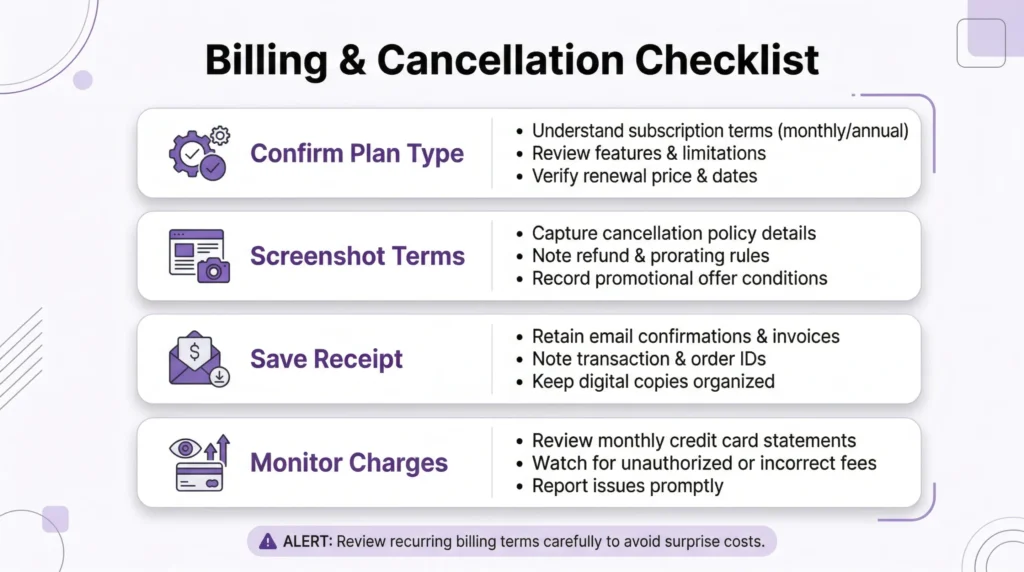
What I would tell readers to do before paying is simple:
- confirm whether the charge is one-time or recurring
- screenshot the checkout terms
- save the email receipt
- check the cancellation route before buying
- monitor your payment method afterward
Key Insight: With CheaterBuster, billing confidence is part of the product experience. It is not separate from it.
Can You Cancel CheaterBuster Easily, and What Should You Save Just in Case?
This may not sound as exciting as “accuracy,” but for real buyers it is one of the most practical sections in the CheaterBuster AI review.
My advice is simple:
- cancel through the official route if available
- keep proof of cancellation
- save the confirmation email
- watch for post-cancellation charges
Buyer trust is shaped just as much by what happens after purchase as by the search itself.
What Are Real Users Saying About CheaterBuster on Reddit and Trustpilot?
This is where the product starts to feel more real than the sales language. The most common positives focus on ease of use, discreetness, quick searching, and results that felt clarifying in some cases.
The most common negatives revolve around billing confusion, recurring charges, cancellation frustration, and support responsiveness.
Reddit adds another layer because it shows the human side more clearly than star ratings do. People are not just asking whether the tool works. They are also asking:
- what if the profile is deleted or hidden?
- what do those timestamps really mean?
- what does it say about a relationship if you feel the need to use this tool at all?
That combination tells a bigger story. The product may be usable, but the experience is not always emotionally reassuring.
Is CheaterBuster Safe, Legal, and Ethical to Use If You’re Trying to Verify a Partner?
This is one of the most important parts of the whole article.
Technically, tools in this category exist because dating platforms expose enough profile-level information for matching and search-style services to be built around it.
But that does not automatically make the tool ethically neutral.
The ethical problem is simple. A tool like this can be used by someone who wants clarity. But it can also be used by someone who is controlling, obsessive, or invasive. And that difference matters.
There are also broader privacy concerns around dating apps themselves. These platforms already collect a lot of personal data, and that wider ecosystem makes services like this feel even more complicated.
My ethical verdict
| Question | My Answer |
|---|---|
| Technically interesting? | Yes |
| Practically useful? | Sometimes |
| Ethically neutral? | No |
| A casual recommendation? | Definitely not |
If you use a tool like this, you should be very clear on what question you are asking and what kind of answer it can realistically give.
CheaterBuster vs Social Catfish vsPimEyes vs BeenVerified: Which Tool Fits Your Real Question Best?
If you are trying to decide whether CheaterBuster is the right tool, this is one of the most useful parts of the article.
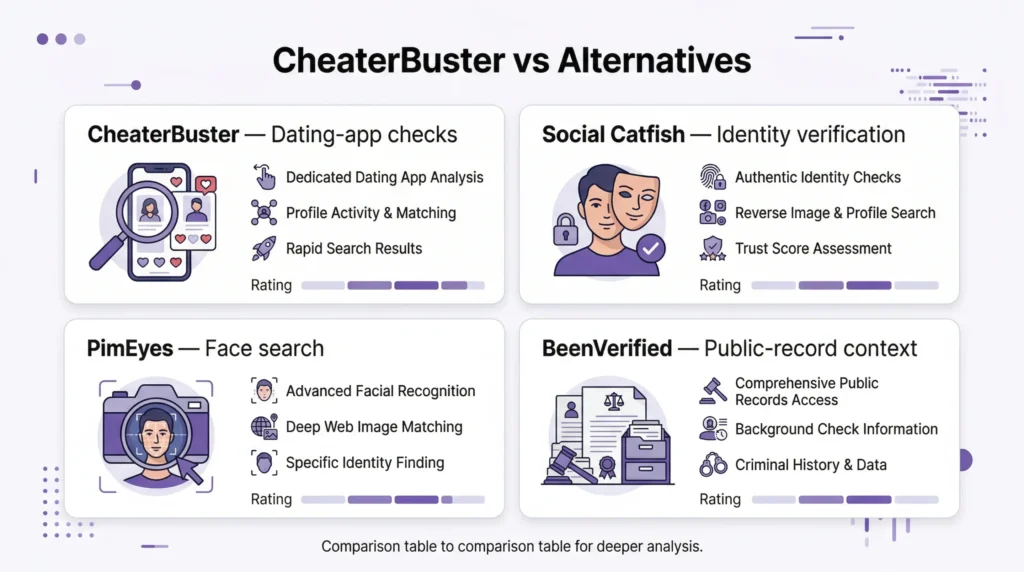
| Tool | Best Use Case | Core Strength | Biggest Weakness | Ease of Use / 10 | Dating-App Relevance / 10 | Pricing Transparency / 10 | Buyer Confidence / 10 | Overall Score / 10 |
|---|---|---|---|---|---|---|---|---|
| CheaterBuster | Checking whether someone may be active on dating apps | Most directly aligned with dating-app suspicion checks | Easy to overtrust; billing confidence is mixed | 8.5 | 9.1 | 4.3 | 5.9 | 7.0 |
| Social Catfish | Identity verification, catfish detection, broader online footprint checks | Better for checking if someone is fake or hiding identity | Less focused on dating-app activity specifically | 7.9 | 7.0 | 6.8 | 7.1 | 7.2 |
| PimEyes | Face matching on the open web | Strong for image-based face lookup | Not built specifically for dating-app investigations | 7.4 | 5.8 | 6.2 | 6.7 | 6.5 |
| BeenVerified | Reverse phone, people search, and public-record context | Broader lookup ecosystem and clearer subscription disclosure | Not designed specifically for dating-app profile verification | 8.0 | 5.9 | 7.4 | 7.0 | 6.8 |
How to read this table
- Ease of Use = how simple the tool feels for a normal user
- Dating-App Relevance = how directly the tool addresses dating-profile concerns
- Pricing Transparency = how clearly a buyer can understand what they will pay for
- Buyer Confidence = how comfortable a cautious buyer is likely to feel before and after purchase
- Overall Score = best-fit balance for real-world use
My interpretation
Choose Social Catfish if your real question is: “Is this person hiding who they really are online?” Social Catfish positions its reverse-image tool around locating online accounts, checking authenticity, and catfish-style identity verification.
Choose PimEyes if your strongest clue is a face photo. PimEyes positions itself as a face-search tool with plan tiers such as Open Plus, PROtect, and Advanced, which makes it more specialized for image-led investigation than dating-app-specific verification.
Choose BeenVerified if you want phone, public-record, or people-search context. Its pricing page publicly shows $36.89/month for the 1-month plan and $71.94 every 3 months for the longer plan, plus multiple cancellation options, which helps explain why buyer confidence tends to be stronger there even though it is not a dating-app specialist.
Simple decision guide
| If your real question is… | Best Tool |
|---|---|
| “Are they on dating apps?” | CheaterBuster |
| “Is this person fake or catfishing me?” | Social Catfish |
| “Where else does this face appear online?” | PimEyes |
| “What phone, name, or public-record clues can I find?” | BeenVerified |
This comparison makes one thing very clear: CheaterBuster is not the best tool for every suspicious situation. It is the best fit for one specific kind of suspicious situation.
Best CheaterBuster Alternatives in 2026 If Your Problem Is Bigger Than Dating-App Search
- Social Catfish: Best if you suspect catfishing, fake identities, or broader online deception.
- PimEyes: Best if the strongest clue you have is a face image and your goal is open-web image matching.
- BeenVerified: Best if you need reverse phone, people-search, or public-record-style context.
- Manual verification first: Sometimes the smartest move is to avoid paying for any tool until you have strong enough inputs to justify it.
My rule of thumb is simple: if your question starts with “Are they on dating apps?”, CheaterBuster makes sense. If your question starts with “Who is this really?”, one of the alternatives may be a better fit.
Who Should Buy CheaterBuster, Who Should Skip It, and Who Should Definitely Avoid It?
Buy it if:
- you have strong identifying details
- you want structured verification
- you understand that results are clues, not verdicts
- you can interpret ambiguous signals calmly
Skip it if:
- your inputs are weak
- you mostly need broader public-record context
- you are not sure whether you actually need a dating-specific tool
Avoid it if:
- you are in panic mode
- you want one search to settle your whole relationship question
- you are likely to treat one result as absolute proof
This buyer-fit framing is more useful than any feature list because it tells readers whether the product actually fits their situation.
Is CheaterBuster Worth It in 2026? My Final Verdict After Testing It Myself
After testing CheaterBuster and comparing that experience with public feedback, buyer pain points, and alternative tools, my answer is clear:
CheaterBuster is not fake, not useless, and not a magic answer. It can genuinely help in narrow, well-defined cases. But it can also create false confidence, wasted money, and emotional overreach when used badly.
MindtrixAI Verdict
| Question | Answer |
|---|---|
| Worth it with strong inputs? | Yes, sometimes |
| Worth it with vague suspicion? | No |
| Worth it as a clue tool? | Yes |
| Worth it as a certainty machine? | Absolutely not |
| Metric | Score |
|---|---|
| Trust Score | 5.9 / 10 |
| Buyer-Fit Score | 7.4 / 10 with strong inputs |
| Mis-Buy Risk | 7.3 / 10 |
My one-line conclusion
Buy CheaterBuster if you want structured verification and already have solid details. Skip it if what you really want is emotional certainty.
Don’t Miss These Trending Guides & Reports
- How Startups, SMEs and Agencies Can Generate Leads Using n8n: Save Hours Every Week With Smart AI Workflows
- How to Jailbreak ChatGPT: A Complete Guide to AI Jailbreak Methods and Their Risks
- Best AI Visibility Tools: Understand How AI Search Engines Perceive Your Brand
- Most Popular App Statistics: The biggest apps, user trends, and revenue secrets
- AI SEO Statistics: Explosive AI SEO trends you can’t afford to ignore
- Using Claude Code for Free: Use Claude Code free without paying a single dollar
- AI Astrology Predictions: Can AI predict your destiny? Let’s find out
- Remove CapCut Watermark: Quick hack to remove watermark without quality loss
- Best AI Without Filter Chatbots: Best unfiltered AI tools ranked by privacy and power
- Best Character AI alternatives: More Control, Better Roleplay, and Zero Frustration
- OpenClaw Review: Find out what are the costs involved
FAQs
Is CheaterBuster worth it if I only know a first name and location?
Can CheaterBuster help if I have a photo but I’m not sure about the exact city?
Does CheaterBuster work better for long-distance relationships?
Can CheaterBuster tell if someone deleted their dating profile?
What is the biggest risk of using CheaterBuster?
Is CheaterBuster better than Social Catfish?
Is CheaterBuster better than PimEyes?
Is CheaterBuster safe to use in an already fragile relationship?
Conclusion: CheaterBuster Works Best as a Clue Tool, Not a Final Answer
CheaterBuster is most useful when you have a clear question and strong details to work with. In that case, it can help reduce uncertainty and give you useful clues.
But this CheaterBuster AI review also shows the main risk: the tool becomes much less reliable when the details are vague, the name is common, or you are looking for emotional certainty instead of evidence. That is when misreading, billing frustration, and overconfidence can turn it into a disappointing buy.
- It may be worth considering if you want a structured way to check dating-app activity and can interpret the results carefully.
- It is not the right tool if you expect one search to answer your whole relationship question.
The bottom line is simple: CheaterBuster can help in specific cases, but it is not a black-and-white truth machine.