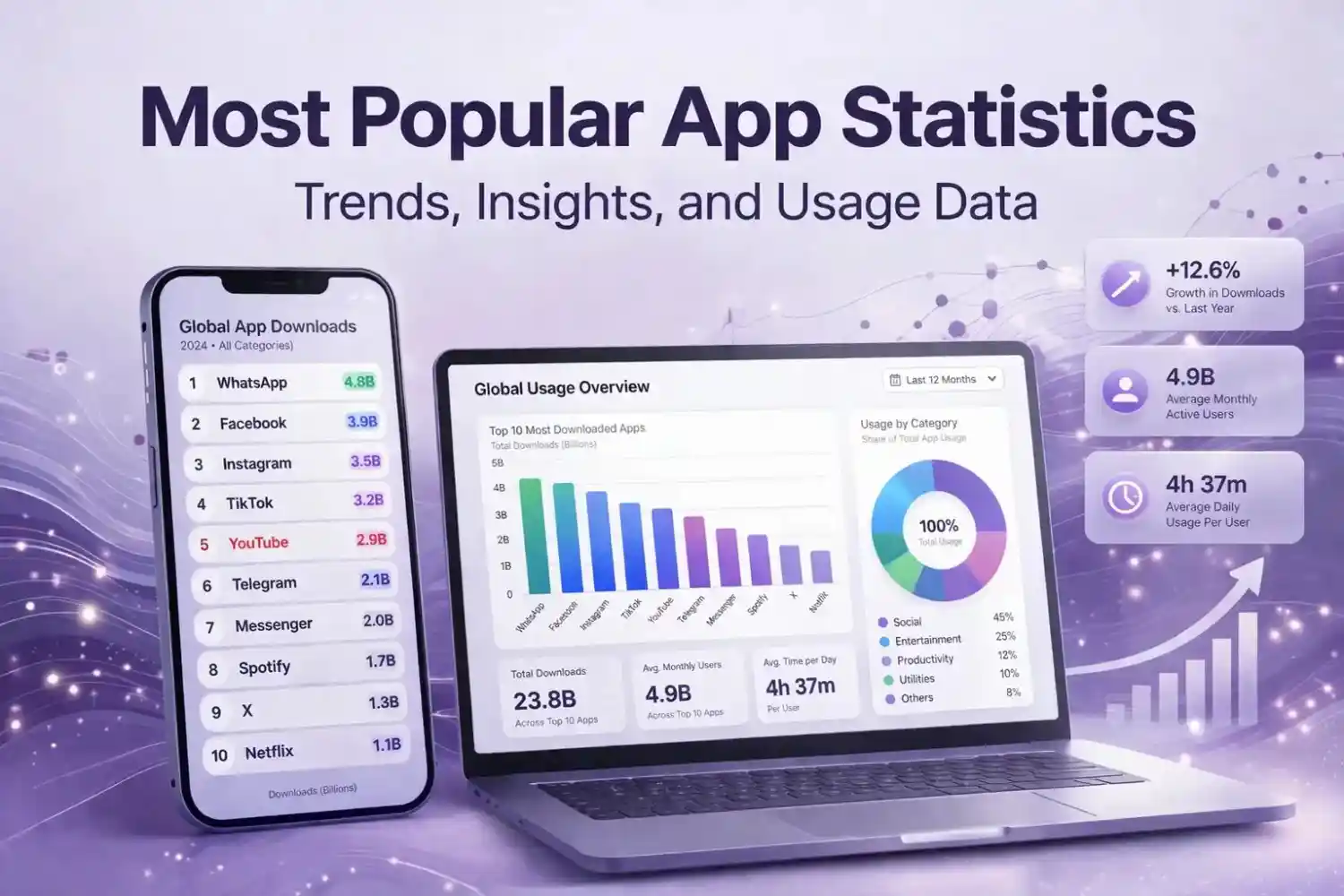
👉 Try MindtrixAI’s Free LLMs.txt Generator, AI Humanizer Tool & AI Paraphrasing Tool Now →
The latest most popular apps statistics show that while scale remains massive, growth is shifting toward AI apps, short-form video, and daily-use platforms.
According to DataReportal, there were 5.66 billion social media user identities globally as of October 2025, a 4.87% increase year over year. That means over two-thirds of the world now uses social platforms each month.
The real change isn’t just user growth, but how people spend their time, with AI and habit-forming apps gaining momentum fast.
Jump to which apps are popular worldwide to see how AI apps are moving into the mainstream.
Key Findings:
-
- Facebook leads globally with 3.07 billion MAUs, while WhatsApp and Instagram are close behind at 3 billion each.
- ChatGPT dominates downloads, ranking #1 globally with 56M installs (Jan 2026) and 51M (Feb 2026).
- TikTok leads app revenue, generating around $286 million in Feb 2026, ahead of YouTube and ChatGPT.
- YouTube remains unmatched, with 2.58 billion ad reach and 200 billion Shorts views daily.
- AI apps are now mainstream, hitting 1.7B downloads in H1 2025, while ChatGPT crossed 800M+ weekly users.
- Asia drives scale, with India reporting 500M YouTube users, 481M Instagram users, and 403M Facebook users.
- App revenue keeps growing, with $150B consumer spend in 2024 despite ~136B downloads.
- Gen Z shapes trends, with U.S. teens using YouTube (90%), TikTok (63%), Instagram (61%), and Snapchat (55%).
Note: These figures are referenced from DataReportal, Appfigures, YouTube Press, Sensor Tower. and PEWResearch.
What Are the Most Popular Apps in the World Right Now?
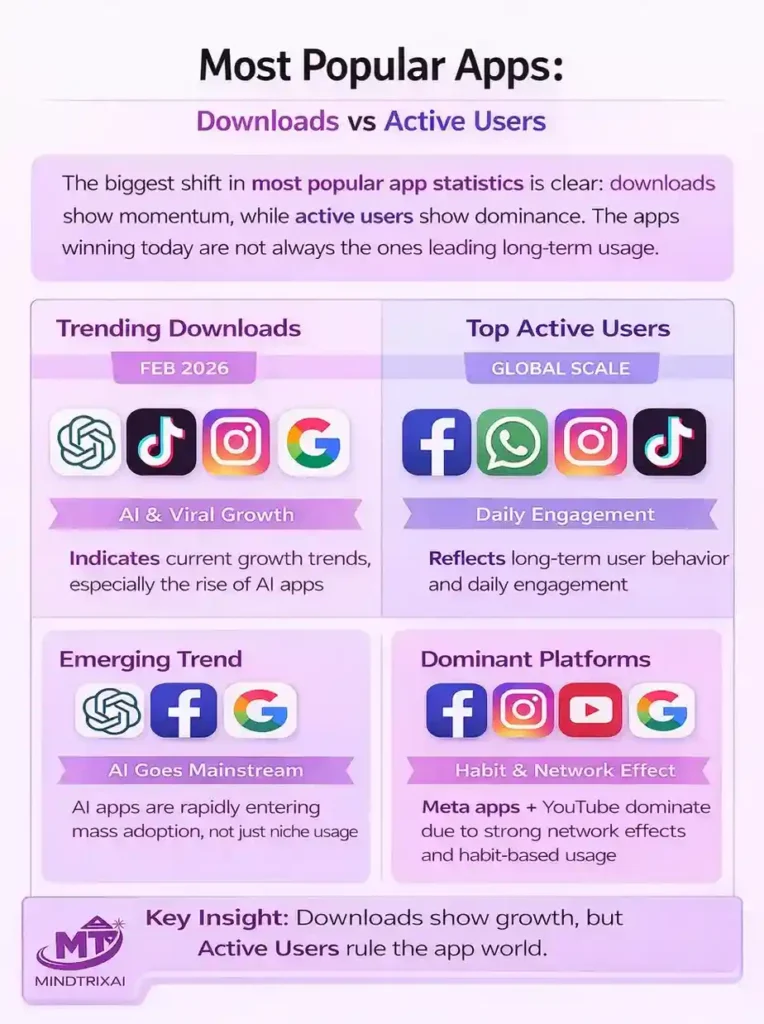
The global app ecosystem is now dominated by a small group of platforms that control billions of users, with social, messaging, and video apps leading overall usage.
The key insight here is how different metrics define “popularity”. Some apps lead in monthly active users, while others dominate reach or engagement.
This is why the most-used apps are not always the most-downloaded. Understanding this difference helps identify which platforms truly hold long-term user attention.
Which apps have the highest number of users globally?
| App | Metric | User | Source |
|---|---|---|---|
| Monthly Active Users | 3.07B | DataReportal | |
| Monthly Active Users | 3.0B | DataReportal | |
| Monthly Active Users | 3.0B | DataReportal | |
| YouTube | Ad Reach | 2.58B | DataReportal |
| TikTok | Ad Reach | 1.59B | DataReportal |
| Telegram | Monthly Active Users | 1.0B | Company Data |
| Snapchat | Monthly Active Users | 946M | Investor Reports |
| Spotify | Monthly Active Users | 751M | Company Data |
| X (Twitter) | Ad Reach | 586M | DataReportal |
| Monthly Active Users | ~580M–600M+ | Company Data |
Note: These figures combine MAU and ad reach since platforms report different metrics publicly. The Sources of Data Reportal is mentioned under Key Findings.
Which apps have the most downloads worldwide?
Here’s a quick snapshot of the February 2026 statistics
| Rank | App | Estimated Downloads | Source |
|---|---|---|---|
| 1 | ChatGPT | 51M | Appfigures |
| 2 | TikTok | 40M | Appfigures |
| 3 | 38M | Appfigures | |
| 4 | 31M | Appfigures | |
| 5 | Gemini | 27M | Appfigures |
The biggest shift in app download trends is the rise of AI. ChatGPT not only led February with 51M installs but also hit 56M downloads in January 2026, marking its strongest month ever.
What are the top 10 most used apps globally?
This list reflects real usage scale, not short-term downloads, showing which apps dominate long-term user attention:
- Facebook — 3.07B MAU
- WhatsApp — 3.0B MAU
- Instagram — 3.0B MAU
- YouTube — 2.58B reach + billions of logged-in users
- TikTok — 1.59B reach
- Telegram — 1.0B MAU
- Snapchat — 946M MAU
- Spotify — 751M MAU
- Pinterest — 600M+ MAU
- X (Twitter) — 586M reach
Fun fact: There are now 7 platforms with over 1 billion users and 16 with 500M+, highlighting how competitive the global app ecosystem has become.
Which Apps Have the Highest Daily and Monthly Active Users?
The daily engagement is now the real battleground. While scale matters, apps like YouTube, WhatsApp, and Snapchat dominate through high-frequency usage and habit-driven behavior.
Not all platforms report data the same way, so instead of forcing direct comparisons, it’s more useful to look at daily activity signals alongside monthly scale.
What are the top apps by daily active users (DAU)?
| App | Daily Metric | Latest Figure | Source |
|---|---|---|---|
| Snapchat | Daily Active Users | 477M | Investor Reports |
| Daily Active Uniques | 121.4M | Investor Reports | |
| YouTube Shorts | Daily Views | 200B+ | Company Data |
| Snapchat AR | Daily AR Engagement | 350M+ | Company Data |
| Avg. Opens per User/Day | 20+ | DataReportal |
Note: Daily metrics vary by platform, so figures represent engagement indicators rather than direct comparisons.
Which apps lead in monthly active users (MAU)?
Social and messaging apps still dominate monthly active users globally, showing their long-term grip on user behavior:
- Facebook — 3.07B MAU
- WhatsApp — 3.0B MAU
- Instagram — 3.0B MAU
- Snapchat — 946M MAU
- Spotify — 751M MAU
- Pinterest — 600M+ MAU
How much time do users spend on the most popular apps?
User attention is reaching record highs, reinforcing the importance of engagement over installs:
- 4.2 trillion hours spent on mobile apps globally in 2024 (~3.5 hours/day)
- 18h 36m per week spent on social and video platforms by online adults
- 41 hours/month average viewing time on Netflix (ad-supported users in the U.S.)
“The next wave of technology shifts, including AI and new interfaces, will reshape how people discover and experience media.”
— Daniel Ek, Founder and Executive Chairman, Spotify
What Are the Most Popular Apps by Category?
App dominance is now split by category: social platforms lead in scale, messaging apps dominate daily communication, streaming apps control attention, and AI apps are the fastest-growing segment.
Instead of one global winner, the mobile ecosystem is now defined by category leaders, each owning a different type of user behavior.
What are the most popular social media apps?
Social media apps still dominate global reach, with a few platforms controlling billions of users:
- Facebook still has the widest disclosed base at 3.07B MAU.
- Instagram sits at 3.0B MAU.
- TikTok had 1.59B ad reach in January 2025.
- Snapchat reached 946M MAU in Q4 2025.
- X reached 586M users in ad tools in January 2025.
Which messaging apps are used the most globally?
Messaging apps lead in daily active usage, making them some of the most habit-driven platforms:
- WhatsApp remains the clear leader with 3.0B MAU.
- Telegram passed 1 billion monthly active users in 2025.
Insight: Over 54% of global users use aged 16+ WhatsApp monthly, highlighting its dominance in everyday communication (Source:GWI’s global survey)
What are the top entertainment and video apps?
| App | Latest Figure | Why It Matters |
|---|---|---|
| YouTube | 200B+ Shorts views/day | The biggest daily short-form video engine |
| Netflix | 94M+ ad-tier users | Strong viewer growth and monetization |
| Spotify | 751M MAU | Leading global audio platform |
Which AI apps are growing the fastest?
AI apps are now the fastest-moving category in mobile app growth trends:
- ChatGPT — 800M+ weekly users
- 470M downloads in H1 2025 (3.7× competitors)
- 1.7B total AI app downloads in H1 2025
- $1.9B in AI app revenue during the same period
- Fastest app ever to reach 1B downloads
Insight: AI apps are shifting from experimentation to mass adoption at unprecedented speed.
What are the most used finance and payment apps?
Finance apps are becoming essential infrastructure for digital transactions:
- PayPal says its network includes up to 400M active accounts, including 92M+ active Venmo customers.
- Cash App reported 58M monthly transacting actives and 26M Cash App Card actives as of late 2025. Block
Trend: Digital wallets now account for over 50% of online transactions and one-third of in-person payments globally.
Which Apps Are Growing the Fastest in 2026?
MindtrixAI’s analysis shows that AI apps are leading growth in 2026, with ChatGPT dominating downloads, Gemini staying in the global top tier, and new content formats like short-drama apps gaining traction fast.
Growth in today’s app ecosystem is best tracked through downloads, emerging apps, and Gen Z behavior, which together signal where attention is shifting next.
What apps gained the most users this year?
The clearest indicator of app growth trends is download volume:
- ChatGPT: 56M downloads in January 2026 and 51M in February 2026.
- TikTok: 43M in January and 40M (February 2026).
- Instagram: 42M in January and 38M (Feb 2026).
Insight: AI apps are now competing directly with social media giants in monthly installs.
Which new apps are trending globally?
New entrants are breaking into the charts faster than before:
- FreeReels — 21M downloads (Feb 2026), top 10 globally
- Grok — 7M downloads (Jan 2026), entered App Store top 10
- DeepSeek — fastest early growth among generative AI apps
Insight: The barrier to breakout success is shrinking, especially for AI and short-form content apps.
What apps are dominating Gen Z usage?
| App | Teen Usage | “Almost Constant” Use |
|---|---|---|
| YouTube | 90% | 15% |
| TikTok | 63% | 16% |
| 61% | 12% | |
| Snapchat | 55% | 13% |
Insight: Gen Z continues to favor video-first and visually immersive platforms, shaping future app growth patterns. Source
Key trend shaping 2026 growth
TikTok reports a 57% rise in sports content viewership in Southeast Asia, alongside a 365% increase in publisher uploads, showing how niche communities can scale rapidly.
What Are the Most Popular Apps by Country and Region?
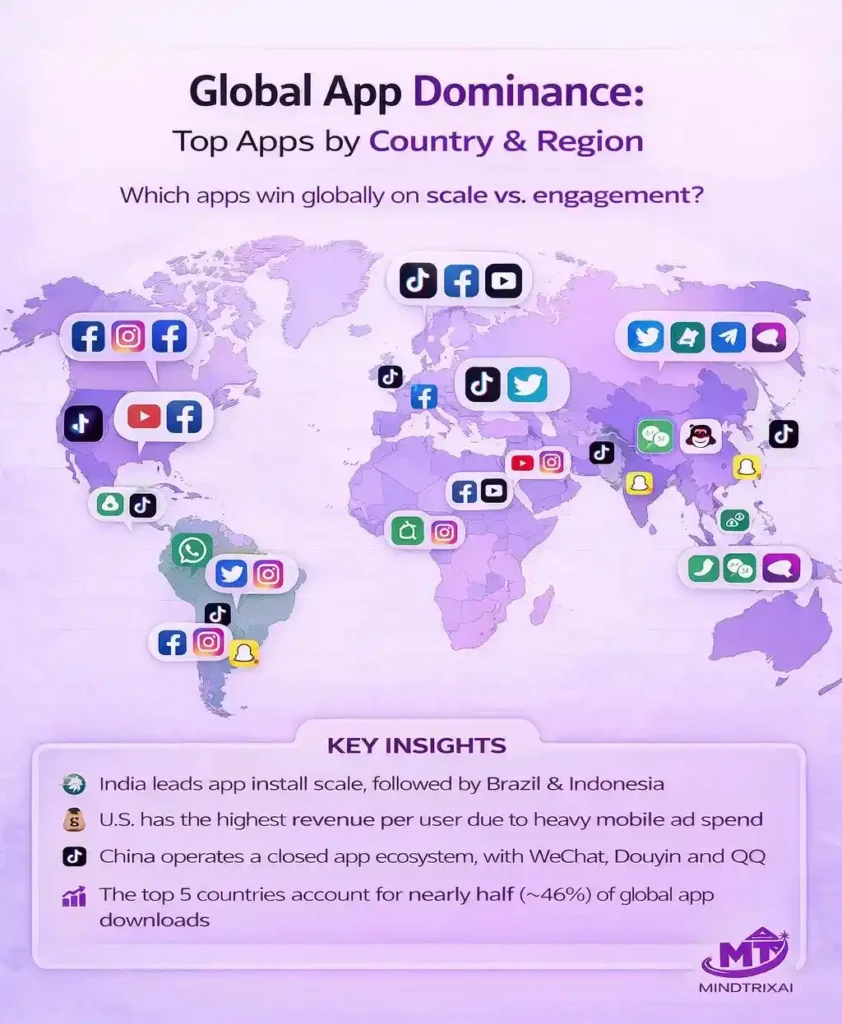
MindtrixAI’s analysis shows that global app usage splits into three forces: high-value engagement markets (U.S., Canada), mass-scale markets (India, Southeast Asia, Brazil), and regional ecosystems (China, Russia) where local platforms dominate.
Global app trends are shaped by population size, mobile-first adoption, and local platform ecosystems.
What apps are most used in the United States and Canada?
North America is a high-engagement, high-revenue market, where users spend more per app and use fewer apps more intensely.
| Platform | U.S. Users | Canada (Est.) |
|---|---|---|
| YouTube | 254M | 30M+ |
| 198M | 24M+ | |
| 182M | 20M+ | |
| TikTok | 153M (18+) | ~14M+ |
| Snapchat | 104M | ~12M+ |
| X (Twitter) | 99M | ~8M+ |
Source: DataReportal
Insight: North America leads in ARPU (revenue per user), not just scale, making it one of the most valuable app ecosystems globally.
Which apps dominate Europe, China, Japan, and Russia?
These regions show how local ecosystems compete with global platforms.
- Europe — TikTok (200M+ users), YouTube, Instagram dominate cross-border usage
- China — WeChat, Douyin (TikTok China), Alipay dominate due to restricted Western apps
- Japan — LINE, YouTube, X (Twitter) remain top platforms
- Russia — VK (VKontakte), Telegram, and local apps dominate usage
Highlight: Unlike the West, regions like China and Russia operate in closed digital ecosystems, where local apps replace global giants.
What are the most popular apps in Asia and emerging markets?
Asia leads the world in mobile-first growth and app adoption, driven by population scale and affordability.
| Country | Key Apps | Scale Highlights |
|---|---|---|
| India | YouTube, Instagram, Facebook, Snapchat | 500M+ YouTube users, 481M Instagram |
| Indonesia | TikTok, WhatsApp, YouTube | Part of 460M Southeast Asia TikTok users |
| Vietnam | Facebook, TikTok, YouTube | 70M TikTok users |
| Thailand | TikTok, LINE, Facebook | 50M TikTok users |
Bonus Fact: Asia-Pacific holds the largest share of the global app market (~33%), making it the biggest growth engine.
What are the most popular apps in South America?
South America is one of the fastest-growing app regions, with Brazil leading adoption.
| Country | Key Apps | Scale Highlights |
|---|---|---|
| Brazil | WhatsApp, Instagram, YouTube, TikTok | 144M social media users |
| Mexico | WhatsApp, Facebook, TikTok | Top 5 global download market |
| Argentina | WhatsApp, Instagram, YouTube | High social media penetration |
Source: DataReportal Brazil
Interesting tidbit: Countries like Brazil are among the top global app download markets, driven by mobile-first usage.
What are the most popular apps in the Middle East?
The Middle East is a high-engagement, mobile-first region with strong social and messaging adoption.
- WhatsApp — dominant messaging platform
- YouTube — leading video platform
- Instagram & TikTok — high engagement among younger users
- Snapchat — strong presence in Saudi Arabia
Note: The region has one of the highest daily app usage rates globally, driven by mobile-first internet behavior.
Global macro trend: where scale vs value lives
- India — largest app download market (19.1B installs)
- U.S. — second-largest downloads but highest revenue per user
- Brazil & Indonesia — fastest-growing adoption markets
- China — largest closed app ecosystem
Quick Fact: The top 5 countries account for ~46% of global app downloads, showing how concentrated growth has become.
Which Apps Generate the Most Revenue Worldwide?
App revenue is now dominated by three forces: short-form video, AI subscriptions, and streaming. TikTok leads mobile monetization, while ChatGPT is redefining subscription revenue, and YouTube continues to scale across ads and watch time.
Revenue is no longer tied just to downloads. The biggest earners combine high engagement, subscription models, and in-app purchases (IAP).
What are the highest-grossing mobile apps?
February 2026 snapshot
| Rank | App | Estimated Net Revenue | Source |
|---|---|---|---|
| 1 | TikTok | $286M | Appfigures |
| 2 | ChatGPT | $194M | Appfigures |
| 3 | YouTube | $142M | Appfigures |
| 4 | Google One | $99M | Appfigures |
| 5 | Tinder | $90M | Appfigures |
Insight: TikTok has built the strongest monetization engine in mobile apps, while ChatGPT shows how quickly AI subscriptions can scale revenue.
Trend: January 2026 showed a similar pattern, with TikTok ($284M) and ChatGPT ($224M) maintaining top positions.
Which apps earn the most from in-app purchases?
AI is now one of the fastest-growing IAP revenue categories:
- ChatGPT — $330M+ revenue in Q1 2025 (top 10 globally)
- $3B+ total consumer spend across mobile platforms
- 10–12M paying subscribers estimated globally
Insight: Subscription-driven AI apps are shifting the revenue model from ads to recurring monetization.
How does revenue compare across app categories?
| Category View | Latest Figure | Source |
|---|---|---|
| Global app IAP revenue (2024) | $150B | Sensor Tower |
| Non-game app revenue growth | +23% YoY | Sensor Tower |
| Mobile game revenue | $81B | Sensor Tower |
| Q1 2025 non-game IAP | $19.4B | Sensor Tower |
| Q1 2025 game IAP | $20.6B | Sensor Tower |
| AI app revenue (H1 2025) | $1.9B | Sensor Tower |
Quick pointer: Non-gaming apps, especially AI and streaming, are rapidly closing the gap with traditional mobile gaming revenue.
Case study: attention → revenue conversion
Netflix scaled its ad-supported plan from 40M to 94M+ users in one year, while TikTok and ChatGPT converted attention into direct revenue growth.
Takeaway: The winning apps are those that turn user attention into predictable monetization.
How Do the Top Apps Compare Against Each Other?
MindtrixAI’s findings show that the app landscape is now split by function: TikTok dominates monetized engagement, Instagram leads social scale, YouTube owns watch time, and WhatsApp dominates messaging utility.
TikTok vs Instagram vs YouTube user statistics
| App | Scale Signal | Monetization / Downloads | Source |
|---|---|---|---|
| TikTok | 1.59B ad reach | 40M downloads + $286M revenue (Feb 2026) | DataReportal, Appfigures |
| 3.0B MAU / 1.74B reach | 38M downloads (Feb 2026) | DataReportal, Appfigures | |
| YouTube | 2.58B reach | $142M revenue + 200B Shorts views/day | DataReportal, YouTube Press |
Key takeaway: TikTok wins revenue intensity, Instagram wins social scale, and YouTube wins reach + watch time depth.
WhatsApp vs Telegram vs Messenger usage comparison
| App | Latest Figure | Source |
|---|---|---|
| 3.0B MAU | DataReportal | |
| Telegram | 1.0B MAU | Telegram Press |
| Messenger | 38.4% global usage | DataReportal |
Insight: WhatsApp remains the default global messaging platform, while Telegram continues to scale as the strongest alternative.
Which app has the highest engagement rates?
Instead of one winner, engagement varies by usage type. The strongest apps dominate specific behaviors:
- YouTube Shorts — 200B+ daily views (YouTube Press)
- Netflix (ad tier, U.S.) — 41 hours/month average viewing (Netflix About)
- WhatsApp — 20+ opens per day per user (DataReportal)
- Instagram Reels — engagement up 25% since Q4 2021 (GWI)
Key observation: Engagement is now fragmented across formats, with video, messaging, and short-form content leading daily usage patterns.
What Are the Latest Trends in App Usage and Downloads?
There is a clear shift: downloads have plateaued, but time spent, subscriptions, AI usage, and in-app revenue continue to grow rapidly. The app economy is now driven by engagement, not installs.
This shift marks a transition from growth in quantity to growth in depth and monetization.
How many apps are downloaded globally each year?
Global app downloads have now entered a phase of maturity and saturation, with growth stabilizing after the pandemic surge.
Over the past five years, the trend shows a clear plateau:
- 2020: 143B downloads (pandemic-driven peak)
- 2021: ~143.6B downloads (flat growth)
- 2022: 142B downloads (slight decline begins)
- 2023: ~137–140B (continued normalization trend)
- 2024: 136B downloads (−1% YoY)
Insight: The app economy has shifted from user acquisition to user retention. Downloads are no longer the main growth lever; engagement, subscriptions, and monetization now define success.
Trend shift: While installs have flattened, time spent and revenue continue to grow, signaling a transition to a “depth over scale” mobile economy.
What is the global mobile app market size?
The app economy continues to expand through spending and monetization models:
- $150 billion global consumer spend in 2024
- $40 billion in Q1 2025 alone (record quarter)
Insight: Revenue growth is being driven by subscriptions, AI tools, and premium content, not just downloads.
How does app usage differ by age group and demographics?
App usage today is highly segmented by age, gender, behavior, and platform preference, creating very different engagement patterns.
Age-based differences
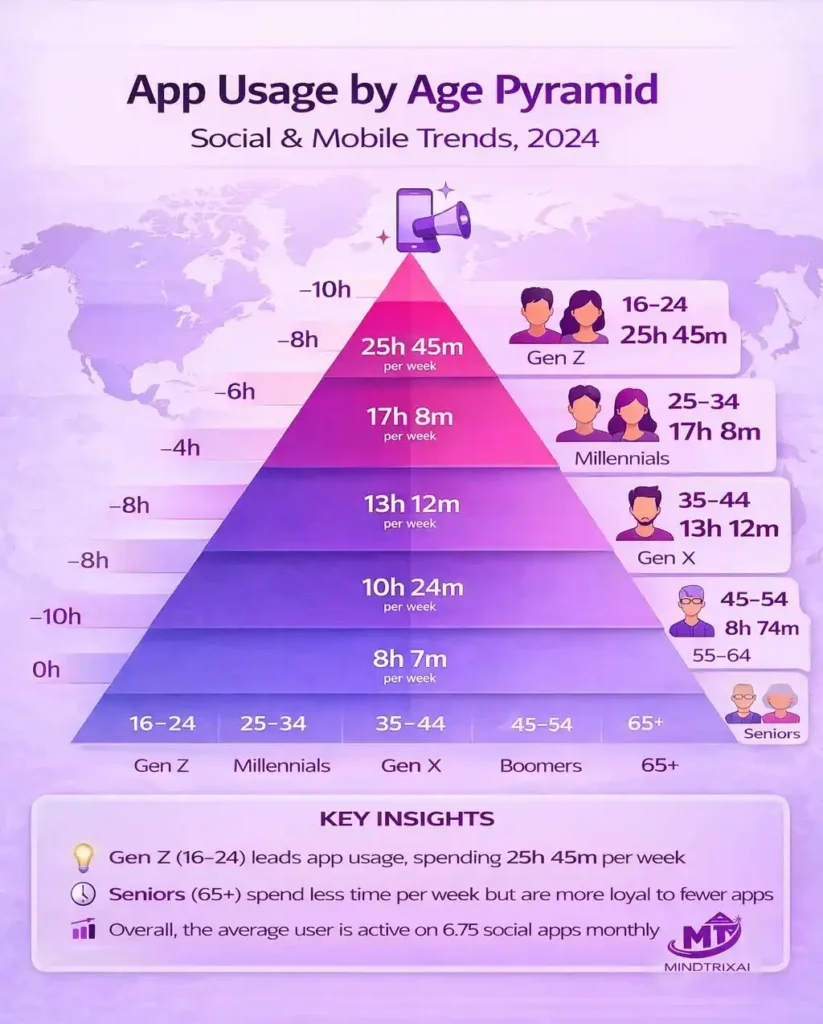
- Users aged 16–24 spend over 3× more time on social apps than users aged 65+
- Gen Z (16–24) averages 25h 45m per week on social + video platforms
- Older users (45+) spend significantly less time but show higher loyalty to fewer apps
Platform preference by age (U.S.)
- Younger users (18–29): TikTok, Instagram, Snapchat, Reddit dominate
- Mid-age users (30–49): YouTube, Facebook, Instagram
- Older users (50+): Facebook and YouTube lead heavily
Gender-based engagement trends
- Women (16–24) spend the most time on social and video platforms globally
- Platforms like Pinterest and Instagram skew more female in usage
- Reddit and X (Twitter) show higher male user concentration
Multi-platform behavior
- The average user now actively uses 6.75 social platforms per month
- Users frequently switch between apps, creating a fragmented attention ecosystem
Behavioral trends (global usage patterns)
- Short-form video dominates (TikTok, Reels, Shorts)
- Messaging apps drive daily habit (WhatsApp, Messenger)
- AI apps are rising fastest in both downloads and engagement
- Streaming apps dominate long-session engagement (Netflix, YouTube)
Important note: The modern user doesn’t rely on one app. Instead, behavior is split across content (video), communication (messaging), and utility (AI/tools).
References: DataReportal, Pew Research Center, Sensor Tower
Which apps are expected to dominate in the future?
Here is the clearest evidence-based view of the future based on the data analysis above:
- Meta’s core apps will remain massive because Facebook, WhatsApp, and Instagram still control unmatched global user scale.
- YouTube should stay dominant in reach and attention because it already pairs huge logged-in scale with unmatched daily video volume.
- ChatGPT looks like the most important new platform force because it combines elite downloads, fast revenue growth, and massive weekly usage.
- TikTok remains the app to beat on monetized engagement.
What do Gen Z and regional patterns reveal about the next app winners?
The future app winners will be the platforms that localize well, travel across age groups, and convert young attention into long-term habit.
Regional scale is now impossible to ignore. In the latest public market snapshots, DataReportal’s India report shows 500 million YouTube users, 481 million Instagram users, and 403 million Facebook users, while the U.S. report shows 254 million YouTube users, 198 million Facebook users, and 182 million Instagram users.
That means India is no longer just a growth market. For several major apps, it is one of the scale centers of gravity.
| Platform | United States | India | Read |
|---|---|---|---|
| YouTube | 254M | 500M | India is roughly 2x the U.S. in platform reach. |
| 182M | 481M | Instagram’s center of mass is increasingly global, not Western only. | |
| 198M | 403M | Legacy platforms remain huge when measured outside the U.S. | |
| TikTok | 153M (18+) | n/a in same source set | Use regional reporting carefully because publishers do not disclose every country equally. |
Age still matters too. According to the Pew teens social media fact sheet, 90% of U.S. teens use YouTube, 63% use TikTok, 61% use Instagram, and 55% use Snapchat. For adults, YouTube leads at 84%, followed by Facebook at 71%, Instagram at 50%, and TikTok at 37%.
The pattern is simple: YouTube crosses generations best, while TikTok, Instagram, and Snapchat remain stronger youth attention engines.
The generational picture becomes even clearer in GWI’s 2026 social media statistics roundup, which puts YouTube and Instagram near the top for Gen Z, while Facebook and YouTube remain dominant with Gen X and Boomers.
This tells brands and publishers something important: the most popular app overall is not always the most influential app for a specific age segment.
What does our original analysis of public discussions show?
What MindtrixAI assessed that public conversation about big apps is no longer centered only on popularity; it is increasingly centered on friction, trust, and whether the product still feels worth opening every day.
How did we analyze this?
To add an original layer beyond publisher and investor reporting, we coded a small directional sample of 21 surfaced public Reddit thread titles across app communities tied to ChatGPT, Instagram, YouTube, WhatsApp, Telegram, Netflix, and Spotify.
We also used publicly surfaced Google Play snippets for apps such as Instagram, TikTok, YouTube, and WhatsApp. This is a directional sample, not a full sentiment study, but it still shows where user attention is clustering.
What did the Reddit sample reveal?
In our coded sample of 21 surfaced Reddit thread titles, 13 threads, or 61.9%, focused on interface pain, UX frustration, or product annoyance. Another 7 threads, or 33.3%, focused on utility, feature trade-offs, or network effects, which is a technical term meaning a product becomes more valuable as more people use it.
Only 1 thread, or 4.8%, centered mainly on trust or authenticity concerns. That split suggests a mature app market where people rarely ask whether the app matters, but often ask whether it still feels good to use.
What did the early-2026 download data reveal?
The same pattern shows up in the numbers. Using January 2026 Appfigures data and February 2026 Appfigures data, AI apps held roughly a quarter of top-10 global downloads when combining ChatGPT and Gemini. Their share was 26.0% in January and 26.3% in February.
So even as the whole top-10 chart cooled, AI did not lose share. It gained a little.
Case study: Why does this matter for app strategy?
This mix of public discussion and chart data suggests that the next growth edge is not simply awareness. It is product quality under pressure.
The biggest apps already have reach. What users now debate in public is clutter, redesign fatigue, recommendation quality, spam, and feature overload. In short, popularity brings scale, but polish decides whether scale stays healthy.
There is also a sharp contrast between review volume and user patience. Google Play snippets show Instagram at 4.0 stars with 167 million reviews and TikTok at 4.0 stars with 68.6 million reviews.
Those are enormous feedback pools. When apps at that size still generate heavy UX complaint threads, it usually means product changes are being felt immediately and at scale.
What are experts and executives saying about the biggest app shifts?
Our findings show that the company leaders are talking less about pure user growth and more about platforms, attention, creators, and long-term monetization.
“It’s incredible to think that we now serve over three quarters of a billion people around the world.” — Alex Norström, Co-CEO of Spotify, in Spotify’s Q4 2025 earnings release
“Our Q4 results began to reflect the impact of our strategic pivot toward profitable growth, translating into revenue diversification and meaningful margin expansion.” — Evan Spiegel, CEO of Snap, in Snap’s Q4 2025 results
“When you compare us to our competitors, attention starts much higher and ends much higher.” — Amy Reinhard, President of Advertising at Netflix, in Netflix Upfront 2025
These quotes line up with the public data. Spotify is framing itself as a large global audio platform, Snap is talking about profitable growth rather than raw scale alone, and Netflix is leaning into attention quality. Together, they show where app competition is moving: not just to “who has the most users,” but to “who owns the most valuable time.”
What trends will shape the rest of 2026?
From the data analysed by MindtrixAI, it is safe to say that the rest of 2026 will be shaped by AI utility, short-form video scale, subscription depth, and rising pressure to improve product experience.
- AI will keep climbing: ChatGPT and Gemini are already taking a meaningful share of global top-chart downloads, and Sensor Tower shows the broader AI app category is scaling fast.
- Short-form video is still the attention king: TikTok revenue stays elite, and YouTube Shorts now averages over 200 billion daily views.
- Monetization is beating install growth: Sensor Tower shows flat downloads but higher spend, which means better monetization is doing more work than new installs.
- Regional power is shifting: India and Southeast Asia are now central to platform scale, not side notes.
- UX debt is becoming a real growth risk: public discussion around major apps now tilts heavily toward interface friction, algorithm fatigue, and product trust.
The clearest takeaway from these Most Popular Apps Statistics is that scale alone no longer explains app leadership. The winners now combine broad reach with habit, revenue depth, and a product experience users can still tolerate after millions of updates and billions of sessions.
If one theme defines the current market, it is this: social apps still dominate attention, AI apps are taking the growth headline, and media apps are proving that loyal time can still be converted into very large money.
Discover More Data Insights & Guides!
- How Startups, SMEs and Agencies Can Generate Leads Using n8n: Generate More Qualified Leads Without Expensive Tools
- How to Jailbreak ChatGPT: Discover the Evolution of AI Jailbreak Prompts and Safety Defenses
- AI SEO Statistics: Find out the latest adoption rates, and the percentage of SEOs and content teams use AI!
- Using Claude Code for Free: Step-by-step guide to set up and use Claude without subscription.
- CheaterBuster AI Review: Can it truly detect cheating on Tinder? Full accuracy breakdown.
- Remove CapCut Watermark: Proven methods to remove watermarks without sacrificing video quality.
- Best AI Without Filter Chatbots: Compare unfiltered AI tools on privacy, safety, and features.
- AI Astrology Predictions: Do AI-powered birth charts really deliver accurate future insights?
- Top Character AI Alternatives: Better Memory, Fewer Limits, Real Conversations
- OpenClaw Review: is it even worth it?
- AI Smart Glasses vs Privacy: Exploring privacy risks, surveillance concerns and data protection challenges in smart eyewear technology
- Claude Fable 5 Review: Features, pricing and real-world performance
FAQs: Most Popular Apps Statistics
Which app has the most downloads right now?
Which app makes the most money worldwide?
Are AI apps now among the most popular apps in the world?
Which apps are most popular with Gen Z?
Conclusion:
To conclude, the question here is not about what are the most popular apps statistics, but which app is winning on users, downloads, time spent, and revenue at the same time.
The latest numbers tell a very clear story; Meta still owns the scale game, while YouTube owns video attention. TikTok owns short-form monetization and ChatGPT owns the momentum. Across all categories, the biggest trend is that apps are becoming harder to judge by one metric alone. The winners now are the ones that turn installs into habits and habits into paid behavior.