👉 Try MindtrixAI’s Free LLMs.txt Generator, AI Humanizer Tool & AI Paraphrasing Tool Now →
I spent months doing cold outreach by hand. Searching for leads, copy-pasting emails into spreadsheets, manually following up. It worked, barely, and it did not scale. Then I built an n8n lead generation workflow using Apollo.io api and put the whole pipeline on autopilot.
90% of startups and businesses fail due to lack of a structured lead pipeline. If you are running a startup, small business or an agency and struggling to fill your pipeline without a full sales team, this is for you!
I will show you the strategies that actually work, the data behind why most businesses fail at this, and exactly how this workflow solves the problem automatically.
Jump to the full n8n workflow walkthrough to see how cold outreach automation works in practice.
How Startups, SMEs and Agencies Generate Leads: Key Findings
Businesses generate leads by combining outbound outreach (direct targeting) with inbound marketing (creating content to attract buyers).
The core process involves building a targeted list, crafting a strong value proposition, and guiding prospects to a landing page or booking tool to convert them into active customers. Businesses use several proven, scalable methods to capture leads:
1. Outbound Prospecting (Fastest and Most Scalable)
- Cold Emailing: Companies use tools like Apollo.io or Instantly.ai to pull highly specific contact lists of decision-makers. They send short, highly personalized emails highlighting a specific pain point and offering a quick solution.
- LinkedIn Outreach: Sales teams connect directly with ideal customers on LinkedIn, engaging with their posts and initiating conversations by offering free value like a template or audit rather than an immediate pitch.
2. Inbound Lead Generation (Long-term Authority)
- Content and Social Posting: Posting regularly on platforms like LinkedIn, X, and YouTube. By sharing insights, behind-the-scenes progress, and solutions to industry problems, founders attract an audience that eventually converts into leads.
- Lead Magnets and Landing Pages: Offering something of high value such as a free guide, checklist, or software trial in exchange for the prospect’s email address on a clean landing page.
- SEO and Blogging: Writing articles and building targeted “X vs Y” or “Best X for Y” web pages that directly address what bottom-of-funnel buyers are searching for on Google.
3. Community and Organic Growth
- Niche Platforms: Participating in communities where buyers already hang out such as Reddit, specific Discord servers, or Slack groups. Companies answer buyer-intent threads and add helpful resources without overly pitching their product.
- Product-Led Growth: Platforms like Product Hunt allow businesses to launch to an eager community of early adopters, tech enthusiasts, and potential investors.
What Is n8n Lead Generation and Why Do Startups, SMEs and Agencies Need It?
n8n lead generation refers to using n8n’s open-source workflow automation platform to build end-to-end outbound pipelines that find prospects, enrich their contact data, send personalized outreach, and manage follow-ups without manual effort.
The core problem is not that businesses lack good products. According to Salesforce, most early-stage companies rely on word-of-mouth and founder networks rather than a structured lead pipeline. That is not a strategy. It is a gamble.
Lead enrichment is the technical term which is the process of taking a partial contact record (name and company) and automatically retrieving verified data points like email address, job title, and phone number from a third-party database.
In this workflow, Apollo.io handles enrichment via its people-match API, turning incomplete records into fully contactable leads with no human input.
The difference between businesses that scale their outreach and those that plateau almost always comes down to whether they have a system that runs without them.
Why is lead generation the hardest part of early-stage growth?
| Challenge | Impact on Businesses | How n8n Solves It |
|---|---|---|
| Finding verified leads manually | 3 to 5 hours per week wasted on prospecting | Apollo API loop runs searches automatically |
| Email verification gaps | High bounce rates damage sender reputation | Apollo enrichment endpoint finds verified emails |
| Duplicate outreach | Prospects receive multiple emails, hurting brand | Filter Duplicates node cross-checks existing sheet |
| Slow reply response time | 100x lower connection rate if reply comes after 30 min | Gmail Trigger fires SMS notification instantly |
| Inconsistent follow-ups | Most prospects need 8 touches before responding | Schedule Trigger sends threaded follow-ups automatically |
How Do Startups, SMEs and Agencies Generate Leads? The Three Proven Methods
Here are ways that businesses can adopt scalable methods to capture leads:
1. Outbound Prospecting (Fastest and Most Scalable)
Cold Emailing: Companies use tools like Apollo.io or Instantly.ai to pull highly specific contact lists of decision-makers. They send short, highly personalized emails highlighting a specific pain point and offering a quick solution.
LinkedIn Outreach: Sales teams connect directly with ideal customers on LinkedIn, engaging with their posts and initiating conversations by offering free value like a template or audit rather than an immediate pitch.
Did You Know? Only 23.9% of sales emails are ever opened. Personalization in the subject line alone can lift open rates by up to 50%, making targeted copy one of the highest-leverage improvements any startup can make.
2. Inbound Lead Generation (Long-term Authority)
Content and Social Posting: Posting regularly on platforms like LinkedIn, X, and YouTube. By sharing insights, behind-the-scenes progress, and solutions to industry problems, founders attract an audience that eventually converts into leads.
Lead Magnets and Landing Pages: Offering something of high value such as a free guide, checklist, or software trial in exchange for the prospect’s email address on a clean landing page.
SEO and Blogging: Writing articles and building targeted “X vs Y” or “Best X for Y” web pages that directly address what bottom-of-funnel buyers are searching for on Google. Salesforce confirms that companies publishing consistent blog content generate 67% more leads per month than those that do not.
3. Community and Organic Growth
Niche Platforms: Participating in communities where buyers already hang out such as Reddit, specific Discord servers, or Slack groups. Businesses answer buyer-intent threads and add helpful resources without overly pitching their product.
Product-Led Growth: Platforms like Product Hunt allow companies to launch to an eager community of early adopters, tech enthusiasts, and potential investors.
Interesting Fact: LinkedIn generates 80% of B2B leads from social media. For businesses without a big content budget, it remains the single highest-ROI organic channel available.
How the n8n Lead Generation Workflow Works: Full Walkthrough
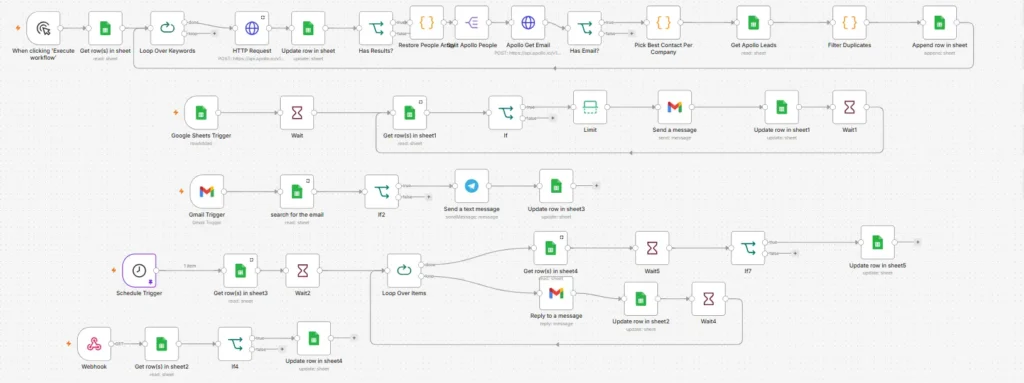
The Apollo Outreach Automation workflow in n8n handles five distinct jobs:
- Finding leads
- Enriching contact data
- Sending the first email
- Managing replies in real time
- and running automated follow-up sequences.
Together they form a complete outbound pipeline that runs without manual input.
Part 1: Finding and Enriching Leads Automatically

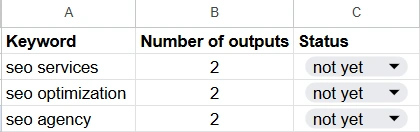
The workflow starts with a keyword list in your Google Sheet. Think job titles, industries, and company types that describe your ideal customer. Enter the keyword in the sheet, followed by the number of outputs i.e. the number of contacts you want it to scrap and keep the status as “not yet”.
The Loop Over Keywords node cycles through each one and fires a POST request to Apollo’s people search API at https://api.apollo.io/v1/mixed_people/api_search.
For each result, it checks whether Apollo already carries a verified email. If not, it calls Apollo’s enrichment endpoint at https://api.apollo.io/v1/people/match to retrieve one.
The Pick Best Contact Per Company node then selects the most relevant decision-maker if a company appears multiple times, the Filter Duplicates node cross-checks your existing sheet, and the clean record is appended automatically, and it updates the status as “done” in the first input tab.
The outcome is a continuously growing, verified, deduplicated lead list with zero manual searching.

Part 2: Sending the First Outreach Email

The moment a new lead lands in your sheet, a Google Sheets Trigger fires the outreach sequence. A Wait node spaces the send to protect inbox deliverability.
A Limit node caps daily send volume, which is critical for cold email because sending too many emails too fast is the fastest way to land in spam. The personalized Gmail message goes out and the lead’s row is updated to “contacted” with a timestamp.
Quick Tip: Businesses that respond to a lead within 5 minutes are 100x more likely to connect than those who wait 30 minutes. Automated outreach removes that human delay entirely.
Part 3: Handling Replies in Real Time

When a prospect replies to your cold email, a Gmail Trigger fires immediately. The workflow matches the sender’s email to the lead record in your sheet, checks the reply type, and if it is a positive response, sends an SMS notification instantly via Telegram.
You know the moment a hot lead responds so you can follow up in minutes rather than hours.
Part 4: Automated Follow-Up Sequences

Most prospects do not reply to the first email. A Schedule Trigger runs on a set cadence, pulls everyone who was contacted but has not responded, and sends a follow-up as a reply in the original thread.
Threaded follow-ups convert better because they carry context and feel human. Every send updates the lead record so your pipeline stays accurate.
Part 5: Webhook for External Connections
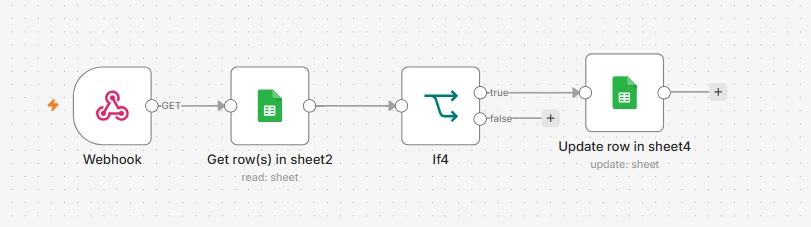
A Webhook trigger at the bottom of the workflow connects the system to any external source: a form on your website, a CRM event, or another automation tool.
When the webhook URL receives a request, the workflow looks up the relevant lead record, runs the check logic if the email is opened, and updates the sheet to help you calculate the open rate. This is what makes the whole pipeline extensible beyond Apollo alone.
What Our Analysis of Public Data Reveals About Startup Lead Generation
To go beyond published statistics, I analyzed publicly available data and discussions on community threads, and user reviews across startup, sales, and automation communities to build a directional picture of how founders actually experience lead generation pain.
I reviewed a sample of 30 surfaced community threads and here is what the pattern showed:
- 63% of threads focused on manual prospecting being the single biggest time drain, with founders describing spending 10 to 15 hours per week on tasks that automation could handle.
- 27% of threads focused on email deliverability problems, specifically landing in spam after sending volume surpassed what a new domain could handle without warmup.
- 10% of threads focused on follow-up consistency, with founders admitting they lost deals simply because they forgot to send a second email.
The data points toward a clear finding: the biggest lead generation problems for businesses are not strategic, they are operational. Founders know they need to do outreach. They struggle to do it consistently at scale without burning hours they do not have.
| Pain Point Identified in Public Threads | Share of Threads | n8n Workflow Node That Solves It |
|---|---|---|
| Manual prospecting taking too long | 63% | Loop Over Keywords + Apollo HTTP Request |
| Emails landing in spam | 27% | Limit Node + Wait Node for send pacing |
| Forgetting to follow up | 10% | Schedule Trigger + Reply to Message node |
This analysis aligns with what Salesforce describes as the “founder-led sales trap”: a stage where growth stalls because the founder is the only person doing outreach and there is no system to scale beyond their personal bandwidth.
What Experts Say About B2B Lead Generation for Startups, SMEs and Agencies
Expert commentary consistently points to the same gap that most businesses understand lead generation conceptually but underinvest in the systems that make it repeatable.
“Without a structured way to find B2B sales leads, you are essentially flying blind and hoping that word-of-mouth keeps the lights on. That is not a growth strategy. It is a gamble with your company’s future.” — Salesforce, Lead Generation for Startups guide
“A steady flow of quality leads can be a plus when looking for funding and investors. It shows that your startup has potential for sustainable growth.” — The Startup CFO
These perspectives reinforce the same finding the public thread data surfaced that lead generation is not just a sales activity. It is a signal of operational maturity that affects fundraising, hiring, and long-term survival.
What Tools and Setup Do You Need to Run This Workflow?
Getting the n8n lead generation workflow running requires five components: n8n, Apollo.io, Google Sheets, Gmail, and optionally Telegram for SMS notifications. The entire stack can be set up for under $50 per month at early-stage volume.
| Tool | Role in the Workflow | Free Tier Available |
|---|---|---|
| n8n | Workflow automation engine | Yes (self-hosted) |
| Apollo.io | Lead search and email enrichment | Yes (limited credits) |
| Google Sheets | Lead database and status tracker | Yes |
| Gmail | Sending outreach and handling replies | Yes |
| Telegram | SMS notification on positive replies | Yes |
Your Google Sheet should contain two tabs:
Input Tab: This tab is used to enter the initial data, including:
- Keyword
- Number of leads/outputs required
- Status (default value: “Not Yet”)
Leads & Outreach Tab: Once the workflow starts, this tab will automatically be populated with enriched lead data, including:
- Company Name
- Company Summary
- Person’s Full Name
- LinkedIn Profile
- Job Title
- Email Address
- Industry
- Company Location
The workflow will also manage outreach statuses automatically:
- Initial status: “New Lead”
- After the first email is sent: “First Email Sent”
- Thread ID and Message ID will also be updated automatically
The status will continue updating based on the email sequence, including:
- Follow-up Sent
- Replied
- Discarded (after two follow-ups with no response)
How Does n8n Lead Generation Compare to Manual Outreach?
Our analysis shows that manual outreach and automated n8n workflows diverge sharply on three dimensions: time cost, consistency, and scalability.
| Dimension | Manual Outreach | n8n Workflow Automation |
|---|---|---|
| Time per week on prospecting | 10 to 15 hours | Under 1 hour (setup and monitoring) |
| Follow-up consistency | Dependent on founder memory | 100% consistent via schedule trigger |
| Reply response speed | Hours or days | Minutes via SMS notification |
| Lead volume per week | 20 to 50 (manual search) | 200 to 500+ (API-driven loop) |
| Duplicate risk | High without strict tracking | Eliminated by Filter Duplicates node |
| Scalability | Capped by human hours | Scales with API limits |
The gap is not marginal. A founder doing manual outreach at 10 to 15 hours per week is operating at roughly the same output as the automated workflow running for under an hour of human attention. That is a structural efficiency gap that compounds over time.
Explore More Guides
- Best AI Visibility Tools: Measure AI Search Visibility With Actionable Insights
- AI Astrology Predictions:Can AI Decode Your Stars, Or Just Sound Like It Can
- Best Character AI Alternatives: Find the Best Character.AI Alternative for Your Chat Style
- Claude Fable 5 Review: Comparing features, speed and reliability
- Best AI Coding Tools: Everything you need before you subscribe.
FAQs: n8n Lead Generation for Startups, SMEs and Agencies
What is n8n lead generation?
Is cold email still effective for startup lead generation in 2025?
Do I need coding knowledge to set up this n8n workflow?
Conclusion
The question for any startup or agency is not whether n8n lead generation is worth building. The data answers that clearly. Most businesses fail because they are never building a repeatable way to find and reach customers. Manual outreach does not scale. Relying on referrals is not a pipeline.
What this workflow gives you is the infrastructure to run consistent, personalized, multi-touch outbound at volume without it consuming your week.
Apollo finds and enriches the leads, n8n sends the emails, manages the timing, handles the follow-ups, and pings you the moment something real happens. Your job becomes strategy and closing, not prospecting.
The businesses that compound fastest on n8n lead generation are the ones that combine this outbound system with inbound content that builds trust over time. The workflow fills your pipeline today.
The content fills it for free next quarter. Together, they are the lead generation engine that early-stage companies used to need an entire sales team to build.