👉 Try MindtrixAI’s Free LLMs.txt Generator, AI Humanizer Tool & AI Paraphrasing Tool Now →
A client asked me to track whether they were showing up in ChatGPT for their money keywords. That one question turned into three weeks testing nine platforms — and genuine confusion about what each tool was actually measuring versus what it claimed to measure.
Every platform calls itself the best AI visibility tool, best GEO platform, or best LLM tracker. After actually using them, I can tell you: they are not the same product. Some are built for agencies. Some for enterprise. Some are SEO suites with AI bolted on.
I tested them the way agencies actually work — setting up prompts, exporting reports, checking citation consistency, and asking one honest question: is this actionable, or just a pretty dashboard? A few surprised me. Most did not.
Key insight: The strongest AI visibility tools are not simply the ones tracking mentions. The real winners explain why AI systems choose certain sources, which competitors are gaining ground, and what authority signals are influencing recommendations.
Quick jump: Go straight to the TL;DR, Quick Picks, 3 Biggest GEO Mistakes, Comparison Matrix, Engine Coverage, Tool Reviews, Direct Comparisons, Personal Picks, FAQs, or Final Verdict.
TL;DR — Best AI Visibility Tools in 2026
AI visibility tools help brands track how often they are cited, recommended, or referenced across platforms like ChatGPT, Gemini, Claude, Perplexity, and Google AI Overviews. The best platforms combine traditional SEO with Generative Engine Optimization (GEO) to measure AI share of voice, citation visibility, sentiment, competitor mentions, and answer-engine positioning.
After testing the major GEO platforms, the market is clearly splitting into three categories:
🏢 Enterprise AI Visibility Platforms — Built for large brands needing AI perception, sentiment, and enterprise-scale monitoring.
- Profound → strongest enterprise AI visibility and answer-engine intelligence platform
- Brandlight → best for AI reputation and narrative analysis
🏪 Agency GEO & Reporting Platforms — Designed for agencies managing multiple clients and AI visibility campaigns.
- RankScale → best agency-focused GEO reporting and white-label platform
- Rankability → best SEO + GEO workflow platform for agencies
- Otterly → easiest lightweight GEO tool for consultants and small teams
🔬 Specialized GEO Analytics Platforms — Focused on citations, prompts, diagnostics, and technical AI visibility.
- Peec AI → best for citation analysis and prompt-level visibility tracking
- Promptwatch → best for AI crawler diagnostics and technical GEO observability
- ZipTie → best lightweight platform for AI Overview and ChatGPT tracking
- AIClicks → best budget option combining visibility tracking and content optimization
Biggest GEO insight after testing these tools: Most GEO platforms still over-focus on visibility scores while under-emphasizing influence mapping. The most valuable tools explain why AI systems chose certain sources, which citations shaped answers, how competitors gained visibility, and how authority signals influence AI recommendations — not just how often your brand appeared.
Quick Picks: Best AI Visibility Tools by Use Case
| Use Case | Best Tool |
|---|---|
| Best AI Search Visibility Platform for Agencies | RankScale |
| Best Enterprise AI Visibility Platform | Profound |
| Best Technical GEO Platform | Promptwatch |
| Best AI Overview Tracking Tool | ZipTie |
| Best Budget AI Visibility Tool | AIClicks |
| Best SEO + GEO Workflow | Rankability |
| Best Prompt & Citation Analytics Tool | Peec AI |
| Best Lightweight AI Visibility Tracker | Otterly |
| Best Enterprise Brand Intelligence Platform | Brandlight |
The 3 Biggest Mistakes Companies Make With GEO
| What Smart GEO Teams Do | What Most Teams Get Wrong |
|---|---|
| ✅ Measure citations, source influence, and competitor visibility instead of only tracking rankings.
✅ Map which third-party sources — Reddit, YouTube, review sites — influence AI recommendations. ✅ Match the platform category to the actual workflow before buying. |
❌ Treat GEO like traditional SEO and only optimize owned webpages.
❌ Measure visibility scores without understanding what’s behind them. ❌ Buy enterprise AI observability before having a repeatable GEO workflow. |
1. Treating GEO Like Traditional SEO
Most brands still optimize for rankings instead of citations. But LLMs increasingly pull information from Reddit, review sites, YouTube, community discussions, comparison pages, media mentions, and forums — not just the highest-ranking webpage. GEO is partially an SEO problem and partially a distributed authority problem. If your strategy only touches on-site content, you’re optimizing for a fraction of the signal.
2. Measuring Visibility Without Measuring Influence
Several GEO tools can tell you whether your brand appeared. Far fewer explain why competitors were cited, which sources influenced the answer, how sentiment shifted, what entity relationships mattered, or which external communities shaped the response. There is a meaningful difference between a tool that gives you a score and a tool that tells you what’s behind it.
3. Buying Enterprise Complexity Too Early
A lot of teams do not need enterprise AI observability. Some just need prompt monitoring, AI Overview tracking, lightweight reporting, and a clean client dashboard. Choosing the wrong category of platform is one of the fastest ways to burn GEO budget before the practice even gets off the ground.
Comparison Matrix
| Tool | Agency Score | Technical Depth | Reporting Quality | Ease of Use | Affordability | Engine Coverage | Overall Score | Expert Take |
|---|---|---|---|---|---|---|---|---|
| Rankability | 9.21/10 | 7.34/10 | 9.08/10 | 8.63/10 | 8.41/10 | 8.47/10 | 8.56/10 | Best all-in-one SEO + GEO operating system for agencies wanting reporting, content workflows, and AI visibility in one platform. |
| Profound | 8.84/10 | 9.43/10 | 9.19/10 | 6.74/10 | 5.92/10 | 9.71/10 | 8.48/10 | The strongest enterprise AI perception and answer-engine intelligence platform I tested. |
| ZipTie | 7.56/10 | 6.87/10 | 7.41/10 | 9.14/10 | 8.83/10 | 7.12/10 | 7.86/10 | Best lightweight platform for AI Overview tracking and practical GEO monitoring without enterprise overhead. |
| Peec AI | 8.16/10 | 8.31/10 | 8.22/10 | 8.76/10 | 8.18/10 | 8.34/10 | 8.28/10 | Strongest citation landscape and source movement analysis for SEO and GEO strategists. |
| Promptwatch | 8.23/10 | 9.72/10 | 8.34/10 | 6.42/10 | 6.81/10 | 9.24/10 | 8.61/10 | Closest thing to a true AI observability platform, with crawler diagnostics and AI traffic attribution. |
| Brandlight | 8.43/10 | 8.67/10 | 8.92/10 | 6.58/10 | 5.81/10 | 8.63/10 | 7.96/10 | Enterprise-grade AI narrative and sentiment intelligence built for reputation-sensitive organizations. |
| Otterly | 7.42/10 | 5.83/10 | 7.31/10 | 9.43/10 | 9.21/10 | 6.91/10 | 7.74/10 | Easiest GEO platform to adopt for consultants and small teams needing credible reporting quickly. |
| AIClicks | 7.96/10 | 7.16/10 | 7.43/10 | 8.57/10 | 9.18/10 | 8.12/10 | 8.14/10 | Excellent value-to-price ratio with AI content workflows and GA-connected visibility tracking. |
| RankScale | 9.84/10 | 8.58/10 | 9.76/10 | 8.44/10 | 7.63/10 | 9.43/10 | 9.14/10 | The most agency-ready GEO reporting infrastructure available right now. |
AI Engine Coverage at a Glance
| Tool | ChatGPT | Gemini | Claude | Perplexity | AI Overviews | Copilot | Grok | DeepSeek |
|---|---|---|---|---|---|---|---|---|
| Rankability | ✓ | ✓ | Partial | ✓ | Partial | ✓ | Partial | ✗ |
| Profound | ✓ | ✓ | ✓ | ✓ | ✓ | ✓ | ✓ | ✓ |
| ZipTie | ✓ | ✗ | ✗ | ✓ | ✓ | ✗ | ✗ | ✗ |
| Peec AI | ✓ | ✓ | Limited | ✓ | Limited | ✗ | ✗ | ✗ |
| Promptwatch | ✓ | ✓ | ✓ | ✓ | ✓ | ✗ | ✓ | ✓ |
| Brandlight | ✓ | ✓ | ✓ | ✓ | ✓ | ✓ | ✓ | Limited |
| Otterly | ✓ | Add-on | ✗ | ✓ | ✓ | ✓ | ✗ | ✗ |
| AIClicks | ✓ | ✓ | ✓ | ✓ | ✓ | ✓ | ✓ | ✓ |
| RankScale | ✓ | ✓ | ✓ | ✓ | ✓ | ✓ | ✓ | ✓ |
Editorial note: Engine coverage changes quickly in this category. Always verify which engines are included at your exact plan level before purchasing — several platforms restrict engines by tier or sell them as paid add-ons.
The Tools: What Each One Actually Masters
1. Rankability
What it actually is: Rankability is an SEO and AI search platform built around agencies. It combines traditional rank tracking with AI search visibility, keyword research, content briefs, content creation, on-page optimization, site audits, and white-label client reporting — all in one workflow.
| Rankability Pros | Rankability Cons |
|---|---|
| ✅ Combines SEO, content workflows, and AI visibility in one platform.
✅ Search Performance Index (SPI) gives agencies a single client-facing score across Google and AI. ✅ Knowledge Base-grounded Copywriter keeps drafts aligned with client USPs and proof points. ✅ White-label reporting is clean and professional out of the box. ✅ Up to 9 AI engines on the Agency plan. |
❌ Not a pure AEO platform — SEO breadth can feel like noise if citations are your only job.
❌ No built-in outreach contact database or email templates. ❌ Credit-based usage requires careful planning at scale. ❌ No free trial advertised — demo or paid entry only. |
What it gives you
- Search Performance Index (SPI) — a single 0–100 composite score rolling together Google rankings, local pack, YouTube, AI mentions, and AI citations. One number for a client meeting.
- Traditional rank tracking across Google, Bing, DuckDuckGo, and Brave
- Local pack tracking (1 location on Solo, up to 25 on Agency)
- Up to 9 AI engines on Agency plan — ChatGPT, Google AI Mode, Gemini, Perplexity, AI Overview, Claude, Grok, Brave Summaries, Bing Deep Answers
- AI-powered content briefs and full drafts (Copywriter) with Knowledge Base grounding
- On-page optimization (Optimizer) and site audits (Auditor)
- White-label client reporting with agency logo, name, and accent color
Pricing
| Plan | Price | Seats | Clients | Credits/month |
|---|---|---|---|---|
| Solo | $79/mo billed annually | 1 | 5 | 10,000 |
| Core | $199/mo billed annually | 3 | 15 | 30,000 |
| Team | $399/mo billed annually | 5 | 30 | 75,000 |
| Agency | Custom | Custom | Custom | Custom |
Realistic scenario: I have 12 B2B SaaS clients. Every one of them wants to know whether they’re showing up in ChatGPT and Google AI Overviews for their category keywords. Half also want traditional SEO reporting. Rankability lets me track all of it, generate content briefs grounded in their actual messaging, and send white-labeled monthly reports — without running four separate subscriptions.
What experienced teams would criticize: Most advanced GEO practitioners say Rankability is stronger operationally than technically. The credit model opacity is the second complaint — usage is harder to predict at scale than flat prompt-based pricing.
💡 Pricing reality check: Before buying, map out your expected usage — clients × prompts × competitors × engines × refresh frequency. That math tells you whether Core covers a real month of monitoring or whether you will be upgrading in week three.
2. Profound
What it actually is: Profound is a full-stack enterprise AEO platform built for large brands that want to understand how AI systems describe, recommend, cite, and compare them across major answer engines. This is not a lightweight tracker. It’s the platform you buy when someone in the boardroom asks “what is AI saying about us?” and you need a credible, defensible answer.
| Profound Pros | Profound Cons |
|---|---|
| ✅ Prompt Volumes data from real double opt-in consumer panels — a different quality of signal.
✅ Tracks Amazon Rufus for AI-powered shopping visibility. ✅ Browser-rendered answer capture across 10 AI engines. ✅ SOC 2, SSO, RBAC, and enterprise-grade onboarding included. |
❌ Enterprise-only pricing — a demo is required before seeing numbers.
❌ Built for intelligence, not hands-on execution. ❌ No self-serve signup or lightweight trial. ❌ Not realistic for small agencies or early-stage brands. |
What it gives you
- Answer Engine Insights across 10 AI platforms: ChatGPT, Google AI Mode, Google AI Overviews, Gemini, Microsoft Copilot, Perplexity, Grok, Meta AI, DeepSeek, and Claude
- Amazon Rufus tracking under a separate Shopping surface — one of the only platforms covering AI-powered product discovery
- Proprietary Prompt Volumes data from double opt-in consumer panels — actual real-world query behavior, not SERP scraping
- Browser-rendered capture of AI answers with daily re-runs on every tracked prompt
- No-code Agent Builder, Agent Analytics, SOC 2 compliance, SSO, and RBAC access controls
Pricing
Customized enterprise pricing only. The client list — LG, Volkswagen, Estée Lauder, Caesars, Aetna — tells you roughly where the floor sits. Come to the demo with a clear scope of brands, engines, and markets to make the conversation productive.
Realistic scenario: I’m head of digital marketing at a cybersecurity vendor. The CEO just asked: “When someone asks ChatGPT to recommend endpoint security tools, do we show up favorably?” I need data credible enough for a board update. That’s a Profound question — not a standard GEO tracker question.
What experienced teams would criticize: The intelligence/execution gap. Profound diagnoses the problem clearly. It does not build the fix. Teams need dedicated content, SEO, and digital PR resources to act on what it finds.
🤔 Did You Know? Profound is one of the only platforms in this category tracking Amazon Rufus — the AI-powered shopping layer inside Amazon. For retail and product brands where AI-driven shopping recommendations affect demand, that surface matters.
3. ZipTie
What it actually is: ZipTie is a focused AI search monitoring tool built around ChatGPT, Perplexity, and Google AI Overviews. It is practical, fast to set up, and honest about AI result variability — which is rarer in this space than it should be.
| ZipTie Pros | ZipTie Cons |
|---|---|
| ✅ Fast setup with no enterprise onboarding required.
✅ AI Success Score prioritizes which prompts are worth tracking. ✅ Multi-country coverage across 14 markets for the price. ✅ Transparent about AI result variability rather than overselling certainty. |
❌ Only tracks three AI engines — no Claude, Gemini, Grok, or Copilot.
❌ No content creation, outreach, or traditional SEO workflows. ❌ Becomes narrow once agency needs expand beyond core engines. ❌ Basic plan checks disappear faster than the number suggests. |
What it gives you
- AI search monitoring across ChatGPT, Perplexity, and Google AI Overviews
- Brand mention tracking, sentiment analysis, and citation tracking
- Full AI response text capture and competitive benchmarking
- AI Success Score for query prioritization
- Content optimization recommendations per prompt
- Multi-country support across 14 countries
Pricing
| Plan | Price | AI Search Checks/month | AI Data Summaries | Content Optimizations |
|---|---|---|---|---|
| Basic | $69/month | 500 | 5 | 10 |
| Standard | $99/month | 1,000 | 50 | 100 |
| Pro | $159/month | 2,000 | 100 | 200 |
| Custom | On request | — | — | — |
Realistic scenario: My SaaS client wants to know if they show up when someone asks ChatGPT “best project management tools for remote teams” or asks Perplexity “Asana alternatives for startups.” ZipTie shows exactly what each engine says, who gets cited, how sentiment looks, and which content gaps to prioritize — for a price point that works on a smaller retainer.
What experienced teams would criticize: The engine ceiling. Agencies who have been doing GEO for six months will start hearing from clients: “What about Gemini? What about Claude?” Plan an upgrade path before you’re having that conversation reactively.
💡 Pricing reality check: Basic looks affordable, but 500 checks disappear quickly when multiplied across prompts × engines × competitors × refresh cadence. Standard at $99/month is the realistic starting point for serious monitoring.
📊 Stat Breather: How AI Systems Actually Choose What to Cite
- Perplexity AI now handles an estimated 100 million queries per week, with particularly strong adoption among research-heavy and technical buyers.
- Only 3% of websites have structured data configurations fully optimized for AI retrieval — most brands are invisible to AI systems not because of bad content, but because of bad structure. (Source: Schema.org adoption audits)
AI systems are not reading your content the way Google does. They are synthesizing from wherever authority lives — and increasingly, that is not your homepage.
4. Peec AI
What it actually is: Peec AI is an AI search analytics platform focused on citation landscape intelligence — not just whether your brand appears, but which sources are getting cited, how those sources shift over time, and what retrieval patterns favor in your category.
| Peec AI Pros | Peec AI Cons |
|---|---|
| ✅ Source movement tracking shows which URLs are gaining or losing citation traction week over week.
✅ Crawlability diagnostics surface AI bot access problems other tools miss. ✅ Unlimited users across all plans — no per-seat penalty. ✅ MCP support for AI-native workflows. |
❌ More analytics-oriented than execution-oriented — no content creation or outreach built in.
❌ Prompt caps become restrictive for agencies tracking multiple clients. ❌ Limited engine count below Enterprise tier. ❌ Pricing requires direct verification — third-party sources vary. |
What it gives you
- AI search analytics across ChatGPT, Perplexity, and Gemini
- Brand visibility tracking with competitor benchmarking
- Citation analysis — which sources LLMs are pulling from and why
- Source movement tracking — which URLs are gaining or losing traction in citation sets week over week
- Crawlability signals and AI bot access diagnostics
- Multi-country support on Advanced plan, Looker Studio integration
- Unlimited users across all plans
- MCP (Model Context Protocol) support for AI-native workflows
Pricing
| Plan | Prompts | Models | Projects | Notable Features |
|---|---|---|---|---|
| Starter | 50 | 3 | 1 | Daily tracking, unlimited users |
| Pro | 150 | 3 | 2 | Daily tracking, unlimited users |
| Advanced | 350 | 3 | 5 | Multi-country, Looker Studio |
| Enterprise | Custom | Custom | Custom | Custom setup |
Third-party sources commonly cite pricing starting around €89/month for Starter. Verify directly before purchase.
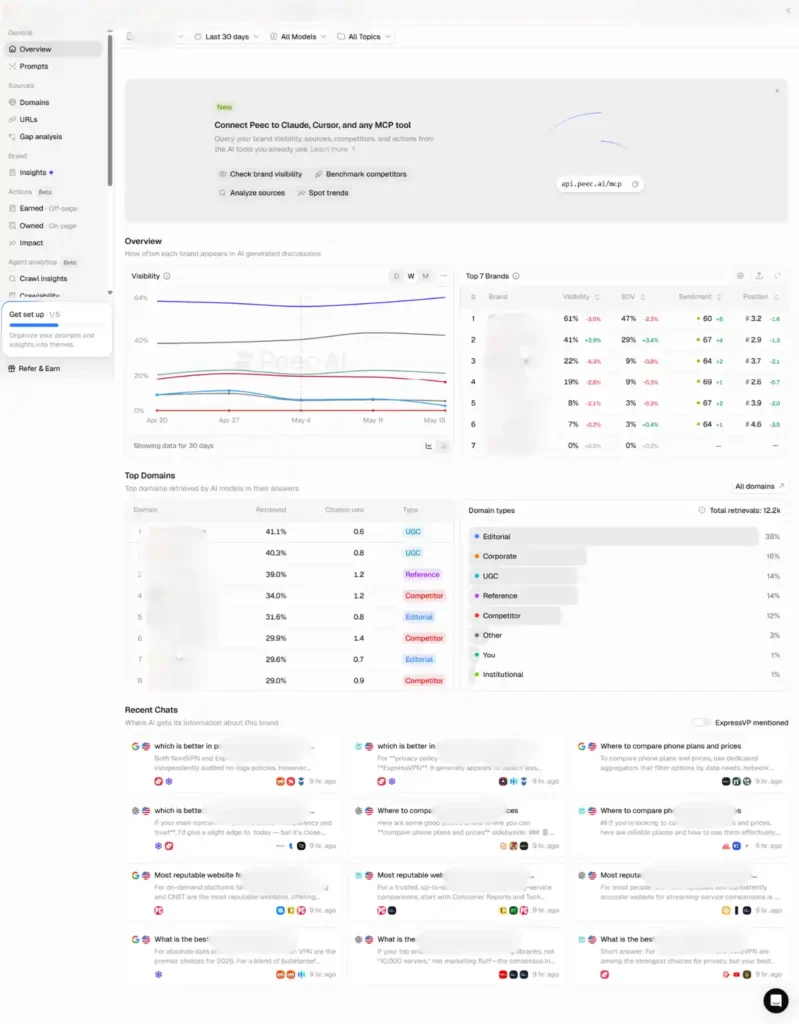
Realistic scenario: My B2B HR software client’s competitors keep showing up in ChatGPT answers for “best HR software for mid-size companies.” I need to understand why — which specific sources are being cited, whether a G2 page or comparison article keeps surfacing, and whether our content is even crawlable by AI bots. Peec AI gives me that diagnostic view so I can fix the right thing.
What experienced teams would criticize: The gap between seeing the problem and having tools to act on it. The intelligence is sharp, but execution capabilities — content briefs, outreach contacts — require a separate tool purchase.
5. Promptwatch
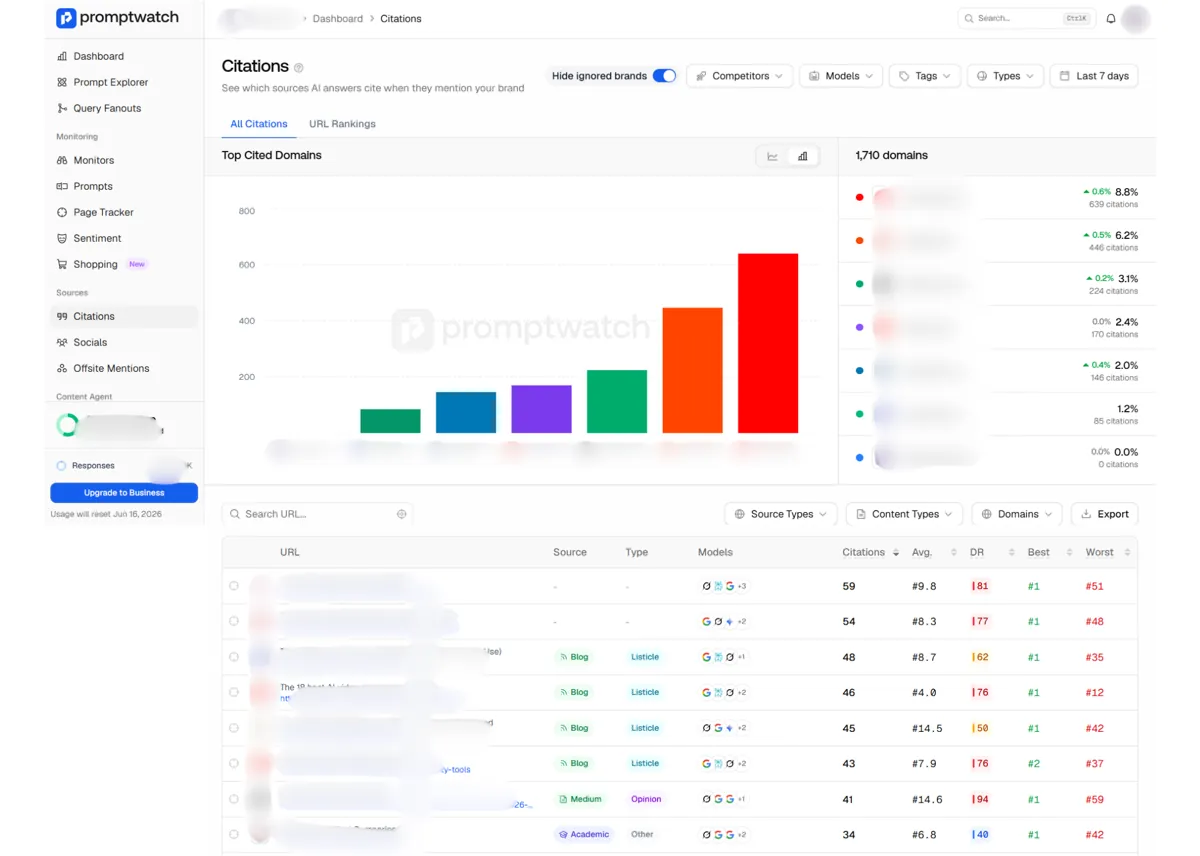
What it actually is: Promptwatch is a technical AI visibility platform that goes beyond mention tracking into crawler logs, visitor analytics, and traffic attribution. Built for teams that want to understand not just whether they’re cited, but whether AI crawlers are actually accessing their content and whether AI search is sending real traffic.
| Promptwatch Pros | Promptwatch Cons |
|---|---|
| ✅ AI crawler log analysis — see which bots are crawling your site and which pages they’re hitting.
✅ Connects AI visibility to actual traffic attribution and session data. ✅ Tracks 8 major AI engines including Claude, Grok, and DeepSeek. ✅ Citation-grounded content generation based on sources LLMs actually trust. |
❌ Not beginner-friendly — full value requires technical SEO comfort.
❌ Price jump from Essential to Professional is steep relative to what changes. ❌ Overkill for teams that only need a visibility snapshot. ❌ ~$99/month for one website and 50 prompts is expensive for the entry tier. |
What it gives you
- AI visibility tracking across ChatGPT, Perplexity, Google AI Overviews, Claude, Gemini, Meta AI, DeepSeek, and Grok
- Prompt monitoring with country-level targeting (state and city level on higher plans)
- AI crawler log analysis — which AI bots are crawling your site, which pages, and when
- Visitor analytics and AI traffic attribution — connects AI visibility to actual sessions
- Citation-grounded content generation with autonomous agent workflow
- Competitor analysis and API access on higher plans
Pricing
| Plan | Price | Websites | Prompts | Generated Articles | Key Features |
|---|---|---|---|---|---|
| Explore | Free | 1 | 10 | 0 | ChatGPT tracking only |
| Essential | ~$99/month | 1 | 50 | 5 | All LLMs, country-level tracking |
| Professional | ~$249/month | 2 | 150 | 15 | Analytics suite, state/city tracking |
| Business | Custom | Custom | Custom | Custom | Full platform |
Realistic scenario: My client ranks well on Google but never shows up in ChatGPT or Perplexity citations. Before I rebuild their content strategy, I want to know if AI crawlers are even accessing the site. Promptwatch shows me the crawler log, confirms whether GPTBot and PerplexityBot are hitting the right pages, and tells me whether AI traffic is coming through. That tells me whether I have a crawl problem or a content problem — two very different fixes.
What experienced teams would criticize: The price-to-feature ratio at Essential. You’re paying ~$99/month for one website and 50 prompts. Platforms like AIClicks or ZipTie deliver comparable monitoring at similar prices with far less complexity.
💡 Tip: Use Promptwatch when you need proof-based technical reporting — crawler logs, AI bot behavior, and traffic attribution. If you only need a visibility snapshot, a lighter tool is more cost-effective.
📊 Stat Breather: The Business Case for GEO Is Getting Harder to Ignore
- Gartner predicts that by 2026, traditional search engine volume will drop by 25% as AI chatbots absorb queries that previously went to Google — the largest structural shift in search since mobile.
- In a HubSpot survey of 1,400 marketers, 63% planned to increase GEO investment in 2026 — but fewer than 30% had measured any GEO results from their current efforts.
The ROI conversation around GEO is shifting from “why should we care” to “why haven’t we started.” The brands building measurement infrastructure now will have the data to defend the investment when the CFO asks.
6. Brandlight
What it actually is: Brandlight is an enterprise AI brand intelligence platform for understanding how AI systems frame, perceive, and recommend your brand at scale. Clients include LG, Volkswagen, Estée Lauder, Caesars, Aetna, Kimberly-Clark, and Humana.
| Brandlight Pros | Brandlight Cons |
|---|---|
| ✅ Deep AI narrative and multi-dimensional sentiment analysis — tracks how AI frames brand positioning, trust, and category associations.
✅ 11-engine coverage among the broadest for a brand-intelligence platform. ✅ Multi-brand governance controls built for Fortune 500 scale. ✅ SOC 2 Type II certified, multi-region, and multi-lingual. |
❌ Enterprise-only, demo-gated pricing.
❌ Intelligence platform, not an execution platform. ❌ No lightweight self-serve trial. ❌ Likely out of budget for most agencies and growth-stage brands. |
What it gives you
- AI brand visibility tracking across 11 AI engines
- Multi-dimensional sentiment analysis — how AI systems frame brand positioning, trust, innovation, and competitive narrative
- Competitive intelligence and AI customer journey insights
- Source impact analysis — which external sources are shaping AI’s perception of your brand
- Multi-brand and multi-market controls
- SOC 2 Type II compliance, white-glove onboarding and ongoing support
Pricing
Enterprise-only, sales-led pricing. Some third-party sources mention plans in the $199–$500+/month range, but official pricing requires a direct conversation. Treat any published number as directional only.
Realistic scenario: I’m the global digital marketing director at a consumer electronics brand. We’ve had signals that AI assistants are describing our products as “older technology.” I need to know which engines have that positioning, which external sources are driving it, how it compares across key markets, and how it’s trending month over month. That’s a Brandlight question — a standard GEO tracker gives me a score; Brandlight gives me a diagnosis I can bring to the CMO.
What experienced teams would criticize: The intelligence/execution gap. Brandlight gives a thorough, sophisticated diagnosis. It does not build the fix. Smaller teams will end up with an expensive dashboard they don’t know how to act on without dedicated SEO and digital PR resources.
7. Otterly
What it actually is: Otterly is an AI search monitoring and reporting platform for tracking brand visibility, citation sources, and domain rankings across ChatGPT, Google AI Overviews, Perplexity, and Microsoft Copilot — notable for being one of the few tools in this category with G2 ratings and Gartner recognition.
| Otterly Pros | Otterly Cons |
|---|---|
| ✅ G2 and Gartner recognition carries real organizational weight for internal tool approvals.
✅ Clean onboarding and reporting — easy for clients to understand. ✅ Agency Partner program offers extra prompts, custom reports, and co-marketing. ✅ Lowest entry price in the category at $29/month. |
❌ Lite plan has only 15 prompts — barely a proof of concept.
❌ Steep price jump from Lite ($29) to Standard ($189) with no middle tier. ❌ Gemini and Google AI Mode are add-ons, not included by default. ❌ Less technical depth than Promptwatch or Peec AI. |
What it gives you
- Search prompt tracking and brand visibility index
- Domain ranking in AI answers, citation and link analysis, GEO audits
- Detailed reports, exports, and multi-country support
- Looker Studio connector on Premium plan
- Agency Partner program — extra prompts, workspace management, custom reports, co-marketing, and simplified billing
Pricing
| Plan | Monthly | Annual | Prompts |
|---|---|---|---|
| Lite | $29/month | $25/month | 15 |
| Standard | $189/month | $160/month | 100 |
| Premium | $489/month | $422/month | 400 |
Google AI Mode and Gemini are add-ons — not included by default in any plan. Factor this into cost comparisons.
Realistic scenario: I’m a freelance SEO consultant pitching a new GEO monitoring service to three clients. I need a credible tool name for the pitch deck. Otterly’s Gartner recognition means I don’t have to defend the tool choice in the first meeting. I start on Standard, set up prompts across the three accounts, and use the Agency Partner program to grow from there.
What experienced teams would criticize: The price-to-prompt ratio at Standard and Premium feels out of step with competitors offering more prompts at similar prices. The add-on structure for engines that should arguably be standard by 2026 comes up regularly in comparison discussions.
💡 Pricing reality check: If Gemini or Google AI Mode matter to your clients, factor in the add-on cost before comparing Otterly’s headline price to competitors. The true monthly cost for full engine coverage may be 20–30% higher than the tier price shown.
8. AIClicks
What it actually is: AIClicks is an AI search analytics and GEO optimization platform that tracks brand mentions, citation sources, and competitor visibility — and connects that data to real business outcomes via Google Analytics integration.
| AIClicks Pros | AIClicks Cons |
|---|---|
| ✅ Google Analytics integration on Pro and above connects AI visibility to actual traffic.
✅ Includes AI-optimized article generation alongside monitoring. ✅ Supports up to 11 LLMs in total across plans. ✅ Strong value-to-price ratio — one of the best budget options that still takes action. |
❌ Starter only includes 3 LLMs — tight for teams tracking multiple engines.
❌ Article generation caps (10/month on Starter) are low for content-heavy agencies. ❌ Agency pricing is custom and opaque — no published rate card. ❌ Not as technically diagnostic as Promptwatch. |
What it gives you
- Brand mention monitoring, citation source tracking, competitor tracking, and visibility scores
- AI-optimized article generation (10–30/month depending on plan)
- Google Analytics integration on Pro and above — connects AI visibility to actual sessions
- Support for up to 11 LLMs: ChatGPT, Gemini, Perplexity, Google AI Overviews, Claude, Copilot, Google AI Mode, Grok, Meta, DeepSeek, Mistral
- API access on Business plan, Agency custom pricing
Pricing
| Plan | Price | Prompts | Websites | LLMs | AI Articles/month |
|---|---|---|---|---|---|
| Starter | $59/month | 30 | 1 | 3 | 10 |
| Pro | $189/month | 150 | Unlimited | 4 | 20 |
| Business | $499/month | 300 | Unlimited | 6 | 30 |
| Enterprise | Custom | Custom | Custom | Custom | Custom |
Realistic scenario: My B2B SaaS client ranks on Google but doesn’t appear in ChatGPT, Gemini, or Perplexity for their key category terms. I set up AIClicks with 30 prompts, connect Google Analytics to baseline traffic, and run AI-optimized article recommendations. In 60 days I can show: citation rate went from 0% to 18% on ChatGPT, and AI referral sessions increased by 340/month. That’s a retainer renewal conversation with actual numbers.
What experienced teams would criticize: The LLM caps per plan feel arbitrary. Teams wanting all major engines from day one will need Business or Enterprise regardless of prompt volume — which makes lower tiers feel more restrictive than the headline counts suggest.
9. RankScale
What it actually is: RankScale is an analytics-first AI visibility platform built for agencies that need multi-engine monitoring, deep citation analysis, white-label client dashboards, and the reporting infrastructure to scale. With 17+ AI engines, hourly monitoring on higher plans, and an entry price of $20/month, it covers more engines for less than anything else I tested.
| RankScale Pros | RankScale Cons |
|---|---|
| ✅ Broadest engine coverage — 17+ AI engines at the lowest entry price in the category.
✅ Most developed white-label agency dashboard infrastructure tested. ✅ Hourly monitoring on higher plans for real-time signal on active campaigns. ✅ Looker Studio integration, shareable client links, and team workspaces. |
❌ Credit model requires careful pre-purchase usage planning.
❌ Analytics-first — no built-in AI writing or outreach workflows. ❌ Starter plan is better for evaluation than real agency scale. ❌ Credits can disappear fast across many clients, engines, and countries. |
What it gives you
- AI visibility tracking across 17+ engines including ChatGPT, Gemini, Perplexity, Claude, DeepSeek, Mistral, Grok, Copilot, Google AI Mode, and AI Overviews
- Hourly monitoring refresh rate on higher plans
- Explicit and implicit citation tracking with source authority analysis
- Sentiment analysis, competitor benchmarking, prompt research, and query fan-out tracking
- White-label dashboards with shareable client links
- Looker Studio integration, team workspaces, data exports, and API access on higher plans
- Agency partner resources and accelerator program
Pricing
| Plan | Price | Credits/month | AI Responses | Brand Dashboards |
|---|---|---|---|---|
| Starter | $20/month | 300 | Up to 1,200 | 3 |
| Pro | $99/month | 1,200 | Up to 4,800 | 10 |
| Growth | $385/month | 5,500 | Up to 22,000 | 50 |
| Enterprise | $780/month | 12,000 | Up to 48,000 | 100 |
Realistic scenario: I run a GEO reporting service for 25 agency clients. Every month I deliver citation rate across ChatGPT, Gemini, Perplexity, Google AI Mode, and Grok, plus month-over-month trends and competitor movement. RankScale’s 50-dashboard Growth plan, white-label links, and Looker Studio export lets me build that reporting infrastructure once and run it at scale without rebuilding every month.
What experienced teams would criticize: Credit consumption planning. Before buying, model: clients × prompts × competitors × engines × countries × refresh frequency. Teams that skip this math regularly upgrade plans mid-campaign and explain an unexpected cost to clients.
💡 Pricing reality check: Treat the $20 Starter as an evaluation tier. For real agency use, Pro at $99/month is the realistic starting point. Before committing to Growth or Enterprise, model your actual credit usage first.
Direct Comparisons: What People Are Actually Searching
RankScale vs Otterly
| Choose RankScale If… | Choose Otterly If… |
|---|---|
| You manage multiple clients and need white-label dashboards, 17+ engine coverage, Looker Studio exports, and scalable agency reporting infrastructure. | You want simpler setup, G2/Gartner credibility for internal approvals, and a lighter tool for early-stage GEO consulting. |
Promptwatch vs Peec AI
| Choose Promptwatch If… | Choose Peec AI If… |
|---|---|
| You need AI crawler logs, traffic attribution, and deep technical diagnostics to debug AI visibility problems at their root. | You need citation landscape analysis, source movement tracking, and marketer-friendly visibility intelligence without technical complexity. |
Profound vs Brandlight
| Choose Profound If… | Choose Brandlight If… |
|---|---|
| Your main question is how AI systems recommend, compare, and cite your brand across answer engines. | Your main question is how AI systems describe, frame, and narrate your brand’s reputation and positioning. |
Rankability vs RankScale
SEO-first agency: Choose Rankability.
GEO-first agency: Choose RankScale.
Rankability is better if you want SEO workflows — content briefs, keyword research, on-page optimization, and traditional rank tracking — combined with AI visibility in one operating system.
RankScale is better if your primary service is AI visibility reporting and you need dashboards, the broadest engine coverage, exports, and a purpose-built agency reporting infrastructure.
AIClicks vs ZipTie
| Choose AIClicks If… | Choose ZipTie If… |
|---|---|
| You want content optimization alongside monitoring, and need Google Analytics to connect AI visibility to real business traffic. | You want lean multi-country monitoring focused on AI Overviews, ChatGPT, and Perplexity without extra workflow complexity. |
What I Would Personally Buy Depending on the Situation
| Situation | Tool I Would Buy | Why |
|---|---|---|
| If I ran a 20-person SEO agency | RankScale | The reporting infrastructure, dashboard breadth, engine coverage, and scalability are significantly ahead of most competitors. |
| If I ran enterprise brand marketing at a large company | Profound | Enterprise AI perception and answer-engine intelligence at a depth no other platform offers. Consumer panel Prompt Volumes data is a class above. |
| If I wanted technical GEO diagnostics | Promptwatch | Crawler visibility and AI referral attribution are foundational diagnostic layers most GEO platforms still lack. |
| If I wanted the best budget GEO option | AIClicks | Visibility tracking, optimization workflows, and Google Analytics integration is difficult to beat at the price. The $59 Starter is a real product. |
| If I were just starting GEO consulting | Otterly | Onboarding is simple, reporting is clean, and Gartner recognition means I don’t have to defend the tool choice in the first client meeting. |
What Most GEO Platforms Still Get Wrong
After testing all of these, I think the category has a consistent blind spot: most platforms still over-focus on visibility scores while under-emphasizing influence mapping.
Visibility is only part of the equation. The harder and more important question is why the AI chose those sources in the first place.
That usually comes down to Reddit authority, review-site trust, YouTube citations, media mentions, community consensus, topical clustering, and entity relationships — not just webpage rankings.
Several GEO tools still treat AI visibility like traditional SEO plus a monitoring dashboard. But AI systems increasingly synthesize from distributed authority signals. The brands consistently appearing in ChatGPT, Perplexity, Gemini, and Google AI Overviews usually have strong topical authority, Reddit presence, review site visibility, YouTube citations, and third-party comparison coverage. Some of these signals are not on your website at all.
Final insight: The tools I trusted most were the ones helping explain source influence, retrieval patterns, and citation behavior — not just telling me “you appeared 14% more this week.” That distinction is going to define the next generation of GEO software.
Explore More Guides & Data Driven Reports!
- How Much Does It Cost to Make an App?: Avoid Costly Budget Mistakes Before You Build
- Best AI Without Filter Chatbots: Unfiltered AI chatbots compared on privacy, safety and features
- AI SEO Statistics: Latest adoption rates and how content teams use AI
- CheaterBuster AI Review: Can you actually catch a cheater?
- AI Astrology Predictions: How accurate are AI Astrology predictions?
- Top Character AI Alternatives: Better memory, fewer limits, real conversations
- AI Smart Glasses vs Privacy: Privacy risks in smart eyewear technology
- Claude Fable 5 Review: Testing capabilities, accuracy and value
Frequently Asked Questions
What is AI visibility?
What is the difference between SEO and GEO?
What is the best AI visibility tool for agencies?
Which AI visibility tools support ChatGPT and Perplexity tracking?
Final Verdict
| Tool | Best For |
|---|---|
| Rankability | SEO-first agencies wanting GEO inside a broader SEO and content workflow |
| Profound | Enterprise AI perception and answer-engine intelligence at scale |
| ZipTie | Focused, practical AI Overview tracking without enterprise complexity |
| Peec AI | Citation landscape and source movement analysis |
| Promptwatch | Technical GEO diagnostics, crawler intelligence, and AI traffic attribution |
| Brandlight | Enterprise reputation intelligence and AI sentiment analysis |
| Otterly | Lightweight entry with third-party credibility for internal approval processes |
| AIClicks | Budget option with content output and GA-connected ROI tracking |
| RankScale | Agency reporting infrastructure across the most engines at any price point |
Bottom line: The best AI visibility platform is not the one with the longest feature list. It is the one that matches your actual workflow — whether that is reporting to 30 clients, diagnosing a technical crawl problem, defending a GEO budget to a CMO, or just finding out why a competitor keeps showing up where you do not.
Pricing verified as of May 2026. This is a fast-moving category and prices shift regularly — verify directly before purchasing.