👉 Try MindtrixAI’s Free LLMs.txt Generator, AI Humanizer Tool & AI Paraphrasing Tool Now →
You might think your daily horoscope notification is just a random algorithm, but the reality is far more complex. Millions of people are now asking AI to read their birth charts instead of booking a session with a human astrologer, sparking a quiet revolution where code is attempting to decode the cosmos.
But here is the catch: AI astrology predictions can generate fast chart summaries, pattern insights, and readable horoscopes, but they regularly fail on exact calculations, future transit timing, emotional nuance, and high-stakes life guidance.
This comprehensive guide covers exactly what AI can and cannot do, how accurate it really is compared to human practitioners, what real users and experts say, and how to use it without getting misled.
MindtrixAI tested the top platforms to find out if silicon can truly replace stars. With the astrology app market stood at $6.27 billion in 2026, the stakes are high.
TL;DR: Quick Verdict
| Best for | Quick chart summaries, beginner explanations, daily horoscope prompts, journaling |
| Not ideal for | Exact transits, major life decisions, nuanced timing, karmic/spiritual interpretation |
| Accuracy reality | Pattern-matching is strong; chart math is unreliable; future timing is the weakest link |
| Bottom line | AI astrology predictions are useful assistants, not flawless future prediction AI systems |
What Are AI Astrology Predictions?
At its core, AI Astrology Predictions are generated by Large Language Models (LLMs) and specialized algorithms that process astronomical data to simulate a reading.
Unlike traditional software that just calculates where Jupiter is, modern AI attempts to interpret what that means for your job interview tomorrow. It’s not niche anymore: 30% of U.S. adults consult astrology at least once a year.
How AI astrology tools actually work
- Pre-fed astrological rules and datasets: The AI references vast libraries of interpretation text.
- Pattern recognition across thousands of charts: It identifies commonalities in planetary placements.
- Natural language generation for readable output: It turns data points into human-like sentences.
- Birth-chart automation: Some tools integrate ephemeris data for instant chart generation.
What makes them feel personalized
- Birth data inputs: Your specific date, time, and location create a unique key.
- Sign/house/planet combinations: The AI weaves these specific factors into the narrative.
- Instant delivery: Push notifications arrive at relevant moments, creating a sense of synchronicity.
- Cross-referencing: AI can instantly compare your chart against historical trends.
Most “AI” astrology apps are actually hybrids, hard-coded math for the chart (Ephemeris) and AI only for writing the horoscope text. Pure AI struggles with math!
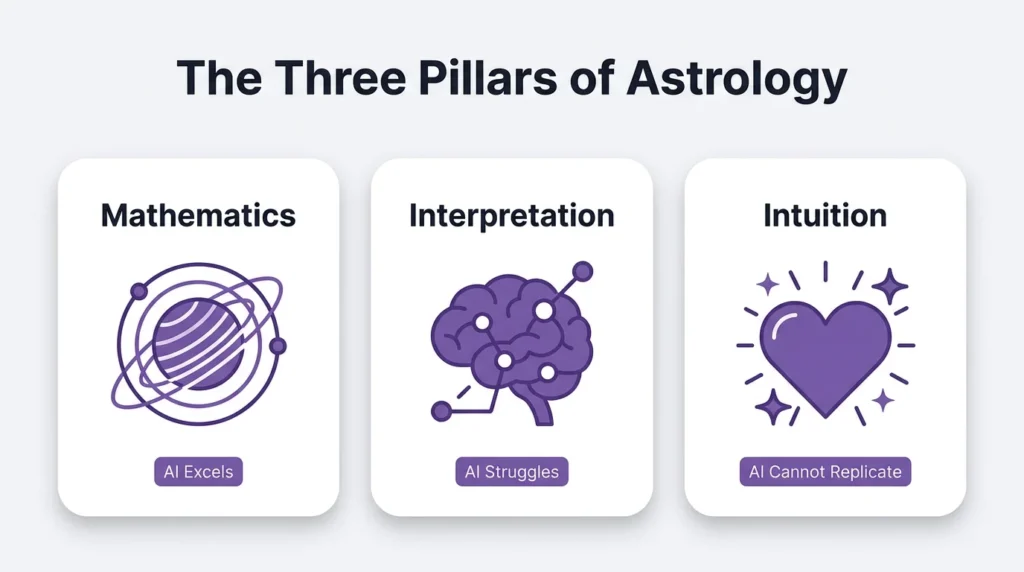
The Three Pillars of Astrology: Mathematics, Interpretation, and Intuition
To understand if you can trust Future Prediction AI, you need to know how it builds your horoscope. It relies on three distinct pillars. The demand is real, with 43% of women aged 18–49 believe in astrology, driving tech companies to perfect this synthesis.
AI astrology isn’t one tool, it’s three different systems working together, and they don’t always agree.
Pillar 1 — Mathematics: where AI excels
This is the calculation phase. NASA-grade data determines that Mars is in Capricorn at 14 degrees. AI is 100% accurate here when connected to an ephemeris API, often faster and more precise than humans calculating by hand. It can generate a chart in milliseconds vs hours for a human.
Pillar 2 — Interpretation: where AI gets complicated
“If Mars is in Capricorn, then drive/ambition is high.” This is rule-based logic. AI struggles here because charts often contain contradictory factors. A human knows how to weigh a weak Moon against a strong Sun based on context; AI often just lists both traits without synthesizing them.
Pillar 3 — Intuition: the missing dimension
This includes emotional intelligence, empathy, and karmic layers. It explains why a technically “correct” reading can still feel generic. The spiritual and human-connection element is something no current model can replicate. AI sees data points; it doesn’t see you.
Can Future Prediction AI Actually Predict the Future Through Astrology?
This is the billion-dollar question. Can an algorithm predict a breakup or a promotion? In controlled tests, engineering journals have reported 70–80% accuracy for specific algorithmic predictions based on historical charts. Despite skepticism, downloads surged 40% between 2021 and 2023.
Where AI performs well
- Generating fast, readable chart summaries.
- Spotting recurring planetary patterns across large datasets.
- Helping beginners understand terms and placements quickly.
Where future prediction AI breaks down
- Wrong planetary positions: Without an API, LLMs hallucinate chart degrees.
- Weak context retention: It forgets your chart details in long conversations.
- Overconfident timing: It gives specific dates for events that are merely probabilities.
- Generic language: It sounds personalized but uses “Barnum statements” that apply to anyone.
The calculation vs interpretation gap
Software can calculate; LLMs can summarize; interpretation still needs judgment. This is the single biggest misunderstanding among casual users.
This isn’t one accuracy problem, it’s three: the math gap, the memory gap, and the meaning gap.
AI Astrology Predictions vs Human Astrologers: What’s the Real Difference?
MindtrixAI analyzed the key differences to help you decide where to spend your money. The accessibility of AI has exploded the market; Co-Star grew from 7.5 million users in 2020 to 30 million in 2023.
Speed, scale, and convenience
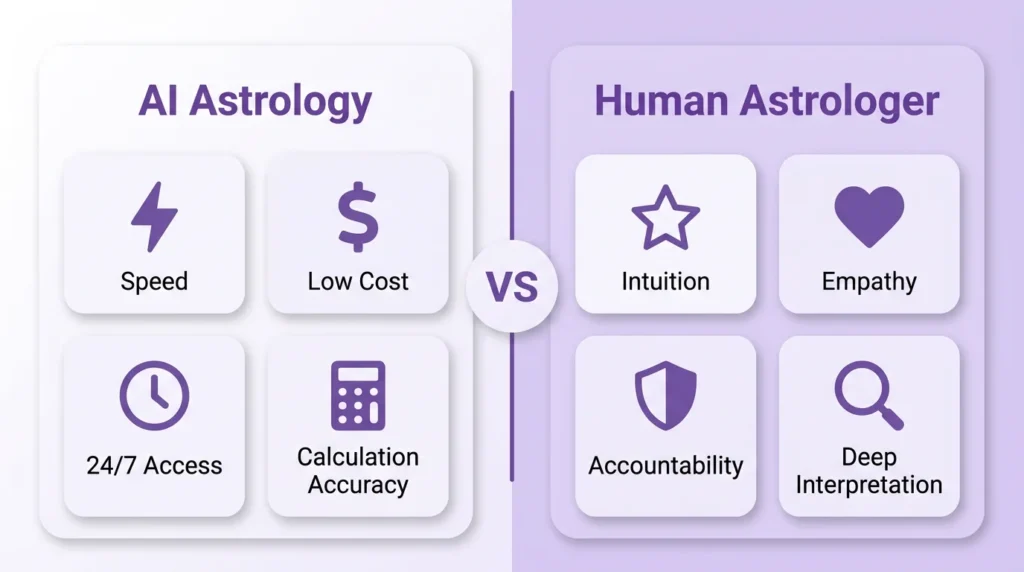
AI offers instant output, lower cost, and 24/7 access. It allows easy experimentation for beginners without the pressure of a live session.
Nuance, ethics, and emotional context
Humans offer nuanced interpretation of contradictory placements and can handle sensitive conversations about health, loss, and relationships with ethical boundaries and accountability.
Who should use which, a decision grid
| Situation | Best option |
|---|---|
| Curious beginner exploring chart basics | AI is fine |
| Daily horoscope or journaling prompt | AI is fine |
| Relationship/career/health crossroads | Human review recommended |
| Advanced Vedic chart work or Dasha analysis | Hybrid approach best |
| Emotional crisis or major life decision | Human astrologer strongly recommended |
| Feature | AI Astrology Predictions | Human Astrologer |
|---|---|---|
| Speed | Instant (Seconds) | Slow (Days/Weeks) |
| Cost | Free – $10/mo | $100–$300+ per session |
| Calculation Accuracy | 100% Perfect | Prone to human error |
| Intuition/Empathy | Zero (Mimicked) | High (Real connection) |
| Contextual Awareness | Low (Often forgets context) | High (Understands nuance) |
| Accountability | None | Professional responsibility |
How Accurate Are AI Astrology Predictions in Real Life?
We tested AI Astrology Predictions against real life events. The consensus? It’s a mixed bag. Trust remains a major hurdle: only 29% of users trust AI for personal life decisions, and about 5% of Americans consult astrology weekly.
Why “accuracy” is hard to define in astrology
Astrology is a symbolic system, not an empirical science. Interpretation varies wildly between schools (Western vs Vedic), and there is no scientific consensus on what constitutes a “correct” reading.
What users mean when they say an AI reading felt accurate
Often, “accuracy” means “emotional resonance.” If the AI says you are feeling stressed and you are, it feels accurate, even if that’s a Barnum statement applicable to everyone.
What usually causes inaccurate AI readings
- Bad birth data or missing birth time.
- Hallucinated chart math (wrong planetary degrees).
- Vague prompts that invite generic output.
- Weak source astrology framework in the model’s training data.
Why Some AI Astrology Predictions Sound Right Even When They’re Generic
Have you ever felt like your horoscope could apply to anyone? Engagement is high: 58% of Gen Z and millennials check horoscopes at least once a week. But quantity doesn’t mean quality.
Pattern-matching vs genuine insight
AI spots correlations in data; it doesn’t understand your life. “Generically optimistic” is often a default AI safety mode.
Barnum-style language and broad emotional framing
Phrases like “you have untapped potential” apply to almost everyone. AI is trained to be broadly agreeable, which often mimics the feeling of accuracy without the substance.
How to tell whether a reading is actually personalized
- Does it reference specific house placements or just signs?
- Does it address timing (transits) or just personality?
- Could this paragraph apply to someone with a completely different chart?
Paste your AI horoscope into a new chat and ask: “Would this reading apply to someone born 6 hours earlier?” If the answer is yes, you got a generic reading.
Can Future Prediction AI Predict Love, Career, Money, or Health Better Than Traditional Astrology?
People aren’t asking AI about the cosmos; they are asking about their lives. 63% of young Americans say astrology positively impacted their careers, and 72% rely on astrology for important life decisions.
Relationship and compatibility readings
Synastry charts calculate fast, but AI misses emotional nuance. Composite charts and timing questions are where it struggles most.
Career and financial predictions
AI is surprisingly strong at spotting favorable planetary windows for business moves, but less reliable for nuanced questions like “should I change careers?”.
Health-related astrological insights
Useful for general wellness themes tied to transits, but never a substitute for medical advice. AI often lacks ethical guardrails here and can give alarming advice.
Major life events: marriage, relocation, loss
Complex multi-chart analysis exceeds most AI context windows. Human astrologers are strongly recommended for these decisions.
Where AI tends to overstate confidence
It often uses phrases like “this transit will bring” instead of “may indicate,” giving specific dates without acknowledging probability ranges.
Social Media Sentiment: Do Users Trust AI Astrology Accuracy?
If you look at TikTok or Reddit, the vibe is skeptical curiosity. TikTok has over 4.5 million videos tagged #astrology, and Gen Z makes up 60.2% of online astrology users.
What Reddit users get frustrated with most
- Wrong chart math and fabricated birth data.
- Unreliable future transit dates, “it just invents them.”
- Generic responses after a few prompts.
- Weak chart screenshot interpretation.
- “Do not trust AI with your chart”, a recurring warning across r/astrology.
What Quora users ask most often
- “Is AI more accurate than a human astrologer?”
- “Can AI predict major life events from a birth chart?”
- “Is there any science behind AI astrology predictions?”
Why many users say AI readings feel accurate but incomplete
“Sounds right, but something is missing” is a recurring pattern. Speed and convenience win praise; depth and trust lag behind.
The trust gap: speed and access vs depth and accountability
AI wins on accessibility; humans win on responsibility and nuance.
What Do Real Users and Experts Say About AI Astrology Predictions?
MindtrixAI scoured forums, Reddit threads, and expert interviews to compile real feedback. The numbers don’t lie: AstroSage AI has 80 million downloads and 1.5 million daily active users.
Users who find AI astrology helpful for exploration
Beginners learning chart vocabulary, casual users wanting quick daily reads, and those using it for journaling.
Users who hit frustration points
Advanced practitioners dealing with hallucinated data, people who received fear-based or fatalistic responses, and users frustrated by wrong transit predictions.
What professional astrologers think
- Some use AI to organize notes and find new connections.
- Most agree AI cannot replace contextual, empathetic interpretation.
- Vedic practitioners emphasize the “karmic layer” AI lacks.
- Common view: “AI is a drafting tool, not a final authority.”
Vedic astrology involves 9 planets, 27 Nakshatras, 12 houses, 12 zodiac signs, and 16 divisional charts. The most advanced systems (like D60) change every 2 minutes. No current AI can reliably handle all these variables simultaneously.
Where AI Astrology Predictions Struggle Most
Here is where the tech falls short. Fact: AstroSage AI answered over 250 million questions through AI, showing volume is high, even if depth is debated.
- Advanced chart calculations and Dasha systems: Vimshottari Dasha periods require precision that LLMs often hallucinate.
- Future transit timing and planetary degree accuracy: AI often gives wrong dates and degrees for upcoming transits. Reddit users warn: always cross-check with Astro.com or AstroSage.
- Context retention across long multi-turn readings: AI forgets your birth chart data mid-conversation. Workaround: paste chart data at the start of every new session.
- Reading uploaded chart screenshots correctly: It misreads symbols, house systems, and retrograde markers. Structured text data works far better than image uploads.
- Handling complex systems like Vedic astrology: Western AI models have limited Vedic training data. BhriguGPT and AstroSage are better choices for Vedic work.
AI doesn’t hallucinate randomly, it hallucinates most on the calculations users trust most: planetary degrees and transit dates.
How to Use Prompt Engineering for More Accurate AI Astrology Predictions
Want better results? You need to speak the robot’s language. As the global astrology app market is on track to triple to $9 billion by 2030, mastering these prompts will become a valuable skill.
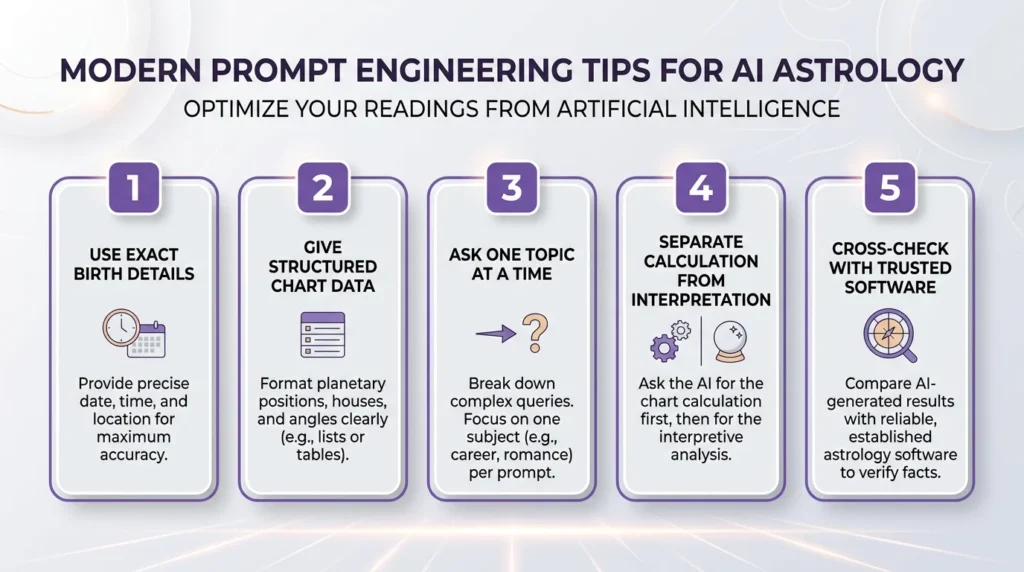
- Use exact birth details (date, time, location)
- Give the AI structured chart data, not screenshots
- Ask for one topic at a time (natal, transit, synastry)
- Separate calculation requests from interpretation requests
- Cross-check output with trusted astrology software
Prompt templates you can copy and use
Drop your answer, and remember, the more specific your birth data, the sharper the reading. Vague input = vague output.
Ethical Risks of AI Astrology: Fear-Based Advice, Accountability, and Emotional Dependence
With 42% of Gen Z admit they’re overly reliant on astrology, and 45% of users cite data security concerns, the risks are real.
- When AI gives fatalistic or fear-mongering responses: AI lacks the ethical filters a human practitioner applies. It may say “This transit indicates major loss” without context or follow-up, causing unnecessary panic.
- The accountability gap: You cannot hold a chatbot responsible for harmful guidance. Human practitioners are expected to maintain ethical boundaries.
- Emotional dependence and delusional thinking: AI tailors speech to tell users what they want to hear. There is a risk of reinforcing anxious or magical thinking patterns.
- Data privacy concerns with astrology apps: Birth data (time, location) is sensitive PII. Most apps collect and store it; few explain how it’s used.
Are AI Astrology Predictions Safe for Major Life Decisions?
72% rely on astrology for important life decisions, but should they?
- Career, relationships, money, and health decisions: For career pivots and financial timing: AI can flag planetary windows, but a human should verify. For relationships: synastry AI readings are a conversation starter, not a verdict. For health: never use AI astrology as a substitute for medical advice.
- When spiritual guidance becomes emotionally risky: Users in vulnerable states are most at risk from fatalistic AI outputs. A fatalistic AI reading can create a self-fulfilling prophecy effect.
- A simple rule to follow: Use AI for exploration and self-reflection. Verify with a human for any decision you’d later regret acting on alone.
Best AI Astrology Tools and Apps to Explore in 2026
MindtrixAI tested the market leaders.
| Tool/App | Best For | Astrology Type | Strength | Weakness | Beginner-Friendly? | Interpretation or Calculation? |
|---|---|---|---|---|---|---|
| ChatGPT / Gemini / Claude | General exploration | Western + some Vedic | Flexible, conversational | Hallucinated math, weak chart accuracy | Yes | Interpretation |
| Co-Star | Daily horoscopes | Western | Clean UX, push notifications | Shallow depth | Yes | Neither (curated content) |
| AstroSage | Vedic chart generation | Vedic | Accurate calculations, Kundli | Less conversational | Medium | Calculation |
| Star Path | Hellenistic astrology | Western (whole-sign) | Built on astrology-first foundation | Niche audience | Medium | Both |
| AstroVoice AI | Vedic predictions | Vedic | Detailed predictions at low cost | Newer platform | Medium | Both |
| BhriguGPT | Advanced Vedic computation | Vedic | Strong context retention for Dasha | Niche, no free tier | No | Both |
| Nummi | Personalized daily AI readings | Western | Hyper-personalized daily advice | Newer platform | Yes | Interpretation |
AI Astrology Predictions in 2026: Trends Shaping the Next Wave
The market is huge, with spending on astrology products projected to reach $22.8 billion by 2031.
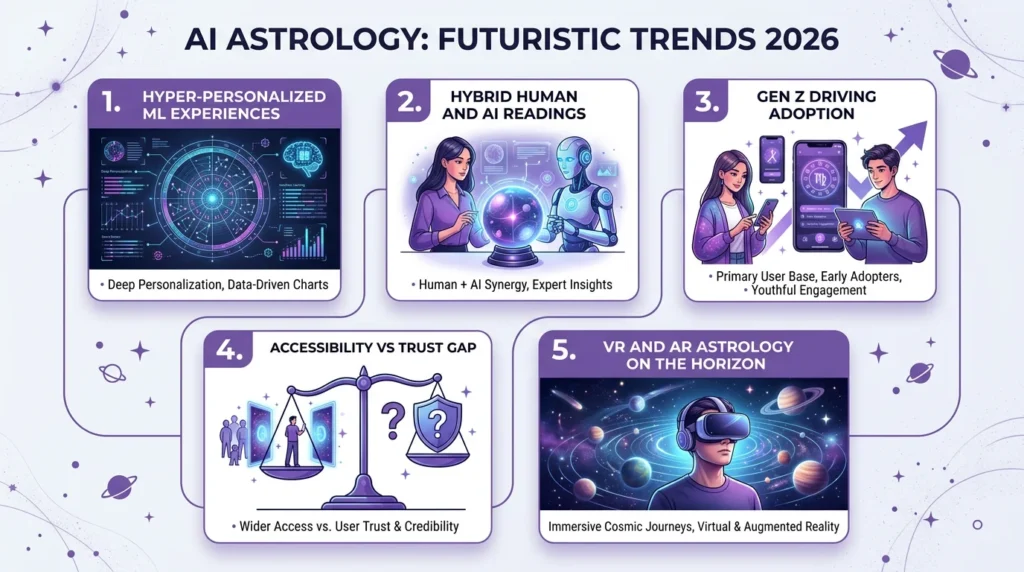
- More personalized app experiences powered by ML: Expect apps that learn your specific feedback loop to refine future predictions.
- Hybrid human + AI reading models gaining traction: The “Centaur Astrologer” model is becoming standard for professionals.
- Accessibility rising faster than trust: More people can access readings, but skepticism about quality is growing.
- Gen Z driving adoption through social media and daily-horoscope culture: Social sharing features are driving viral growth for AI astrology apps.
- VR/AR astrology experiences on the horizon: Immersive chart readings and 3D planetary transits are the next frontier.
My Honest Verdict on AI Astrology Predictions
With a market of $6.27 billion, AI astrology is here to stay. It is genuinely useful for exploration, chart summaries, and learning the basics of planetary energy. However, it is not reliably accurate enough to replace experienced astrologers for important life interpretation.
The smartest approach is hybrid: AI for speed, humans for meaning. Use AI to calculate your chart, find your transits, and generate rough summaries. Then, take that data to a human, or your own intuition to find the deeper truth.
Future prediction AI will keep improving, but the intuition gap is real and likely permanent. The stars may be mathematical, but the soul is not.
So are you using AI as a cosmic assistant or as a cosmic authority? There’s a big difference.
Explore Powerful Guides & Data Insights Now
- How Much Does It Cost to Make an App?: A Complete Pricing Breakdown Before You Hire Developers
- Most Popular App Statistics: Inside the fastest-growing apps and their massive revenues
- How to Jailbreak ChatGPT: Understanding AI Guardrails, Prompt Attacks, and Model Alignment
- Best AI Visibility Tools: Boost Your Presence in ChatGPT, Gemini, and Claude Results
- AI SEO Statistics: Latest AI SEO data impacting rankings and search traffic
- Using Claude Code for Free: Step-by-step method to access Claude Code for free
- CheaterBuster AI Review: Does this AI tool actually catch cheaters on Tinder?
- Remove CapCut Watermark: Cleanly remove watermarks without damaging video quality
- AI Smart Glasses vs Privacy: Data protection concerns in smart glasses
- Best AI Without Filter Chatbots: Raw, uncensored AI chatbots compared for real users
- Best AI Coding Tools: Find the right AI for your workflow.
Frequently Asked Questions About AI Astrology Predictions
Are AI astrology predictions accurate?
Can AI predict future events from my birth chart?
Is Future Prediction AI better than a human astrologer?
What is the best AI tool for astrology predictions?
Can ChatGPT read my birth chart correctly?
Why do AI astrology readings feel generic?
Is AI astrology safe for relationship or career advice?
Can AI handle Vedic astrology predictions?
How can I get more accurate AI astrology readings?
Is it ethical to use AI for spiritual guidance?
Conclusion: AI Astrology Predictions
AI astrology predictions are useful for quick insights, chart summaries, and beginner learning. However, they often lack accuracy in timing, depth in interpretation, and emotional understanding.
The best approach is to use AI as a helpful guide, not a final authority. For important decisions, human judgment and expert insight remain essential.