👉 Try MindtrixAI’s Free LLMs.txt Generator, AI Humanizer Tool & AI Paraphrasing Tool Now →
Search is changing fast, and that is why ai seo statistics matter now.
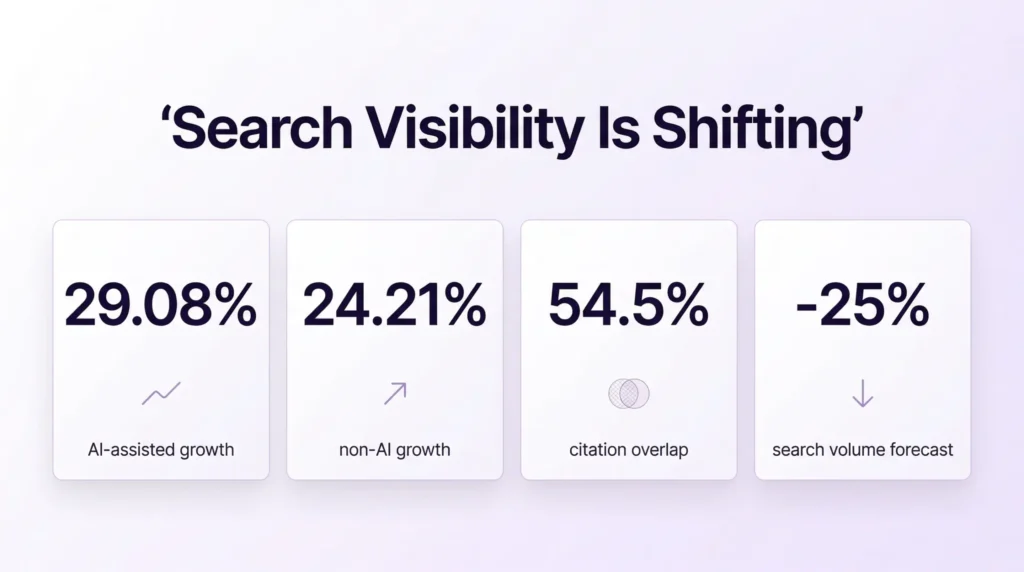
SEO is no longer just about rankings. In the benchmark data used for this article, AI-assisted sites saw 29.08% median year-over-year traffic growth versus 24.21% for non-AI sites.
Add in Gartner’s forecast of a 25% drop in traditional search volume by 2026, and it is clear that visibility is shifting from blue links to summaries and citations.
So, what do the latest AI SEO statistics actually show?
They show that AI is helping websites grow faster, but it is also making clicks harder to win. This article brings together the strongest ai seo statistics on growth, rankings, AI Overviews, click decline, referral quality, and the shift toward AI-first search through 2030.
AI SEO Statistics: Quick Verdict Box
| Verdict Item | Takeaway |
|---|---|
| Biggest shift | SEO is moving from ranking-only visibility to answer-layer visibility |
| Best opportunity | High-quality pages can win citations across AI search systems |
| Biggest risk | AI summaries are reducing traditional organic click-through rates |
| Most important trend | AI-assisted content is common, but usefulness still decides performance |
| Bottom line | Brands that rank, get cited, and convert high-intent AI traffic will win |
Key Insights
- AI is now mainstream in SEO: Ahrefs found that 87% of marketers use AI for content creation, showing that AI is already embedded in everyday SEO and content workflows.
- AI-assisted publishing is now the norm: The same Ahrefs study found that 74.2% of newly published pages contain some AI-generated content.
- AI content can rank well: Ahrefs’ ranking data shows that 86.5% of top-ranking pages include some AI-generated content, although only 4.6% are fully AI-generated, which suggests hybrid human-reviewed content still dominates.
- AI Overviews are reshaping visibility: Semrush and BrightEdge show that AI Overviews now appear in roughly 15.69% to 48% of queries, depending on dataset and methodology.
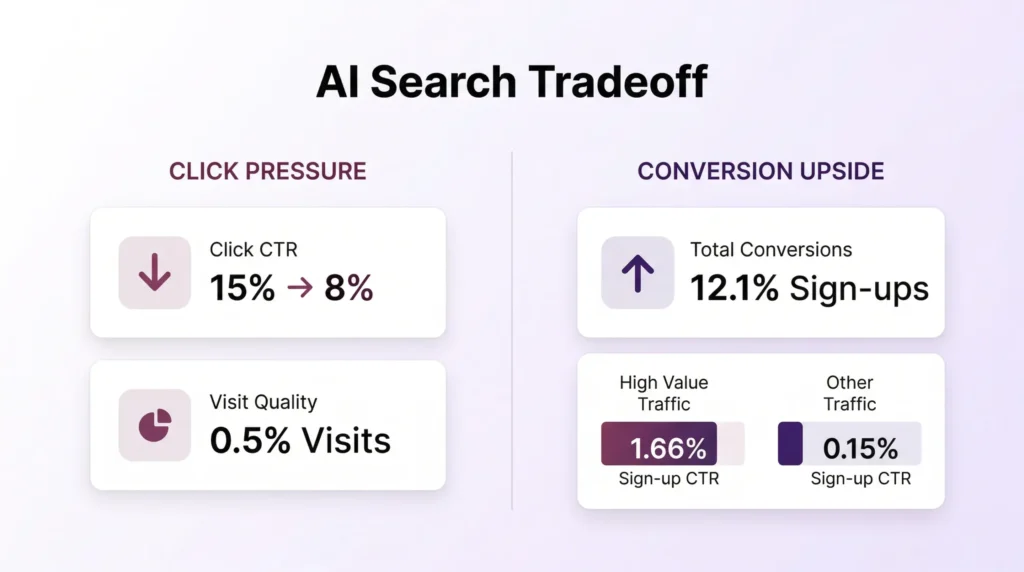
- Organic clicks are falling in AI-heavy SERPs: Reporting summarized by PCMag shows traditional-result click rates fall from 15% to 8% when AI summaries appear.
- AI traffic is still small, but highly valuable: Similarweb reported 1.1 billion+ AI referral visits in one month, while Ahrefs found that 0.5% of visits produced 12.1% of sign-ups.
- LLM-origin visitors often show stronger intent: Microsoft Clarity found 1.66% LLM sign-up CTR versus 0.15% from search, showing that AI traffic can convert disproportionately well.
- The long-term direction is clear: Grand View Research projects the SEO software market will grow from $74.57 billion in 2024 to $154.60 billion by 2030, which suggests SEO is evolving into a model where ranking, summarization, and citation all matter at once.
What Percentage of SEO and Content Teams Use AI?
68% of organizations are already changing their search strategies in response to AI search, and 54% say SEO and digital marketing teams are leading those initiatives. That is the clearest current signal that AI in SEO has moved beyond experimentation and into day-to-day workflow planning.
| Adoption indicator | Statistic | What it shows |
|---|---|---|
| Strategy shifts already underway | 68% of organizations are changing search strategy because of AI search | AI is already affecting SEO planning, not just tool testing or content experiments. |
| SEO owns the transition | 54% rely on SEO/digital marketing teams to lead AI-search initiatives | In most companies, SEO is the department translating AI disruption into practical search strategy. |
| Measurement gap | Only 16% of brands systematically track AI-search performance | Execution is moving faster than reporting, which means many teams still cannot measure AI visibility well. |
| Buyer behavior is already changing | 50% of consumers intentionally use AI-powered search to make buying decisions | SEO teams are adapting because users are already researching products in AI-driven environments. |
| AI is becoming the preferred research layer | 44% of AI-search users call it their primary insight source, versus 31% for traditional search | The search journey is shifting from link-hunting to answer-led evaluation. |
| Commercial impact is already visible | 52% of 1,277 analyzed domains already converted AI traffic into sign-ups or subscriptions | AI adoption matters because it is already producing measurable outcomes, not just visibility impressions. |
The important takeaway is not whether teams have “tried AI.” It is whether they have changed strategy, assigned ownership, and started tracking AI visibility as a real acquisition channel. The data suggests many organizations have started the transition, but far fewer have built the measurement discipline needed to compete consistently.
“Appropriate use of AI or automation is not against our guidelines.”
— Google Search Central
This is one of the most important reference points in the entire AI SEO debate. Google is not rejecting AI use itself. It is rejecting low-quality, unhelpful, or manipulative content. That distinction explains why AI-assisted content can rank when it is useful and trustworthy.
How Are SEO Professionals Using AI Tools Statistically?
The strongest usage concentration appears in repeatable editorial and planning tasks. The data shows that AI is used most often where speed and scale matter, not where judgment can be removed entirely.
Across the available datasets, AI use clusters around brainstorming, outlining, content improvement, and optimization. Those are the parts of SEO where structured assistance can save time without fully replacing expert review.
| SEO Activity | Approximate Usage Share | Why It Fits AI |
|---|---|---|
| Topic ideation and brainstorming | 76% | Fast idea expansion and angle generation |
| Outlining and structuring | 73% | Useful for first-pass organization |
| Content improvement | 67% | Helpful for rewriting, expansion, and cleanup |
| On-page optimization | 51% | Good for scalable title, heading, and metadata support |
| Keyword clustering | 23% | Useful for grouping intent and topical themes |
Most Used AI SEO Tools by Usage Share
| Tool | Usage Share | What It Suggests |
|---|---|---|
| ChatGPT | 44% | Still the dominant workflow assistant for marketers |
| Google Gemini | 15% | Strong due to Google ecosystem familiarity |
| Claude | 10% | Preferred for longer-form reasoning by some teams |
The key point is not the tool name alone. It is the workflow pattern. AI is strongest when used as a modular assistant inside broader SEO systems, not as a fully autonomous publishing engine.
Does AI-Generated Content Rank in Google?
Yes, AI-generated content can rank in Google, but the more accurate answer is that AI-assisted content ranks all the time when it is useful. The ranking data shows that 86.5% of top-ranking pages contain some AI-generated content, while only 4.6% of those pages are fully AI-generated.
That difference matters. It suggests that the winning pattern is not pure automation. It is a hybrid model where AI helps create or improve content and human editors shape it into something more trustworthy, clearer, and better aligned with search intent.
| Ranking Question | Answer |
|---|---|
| Can AI content rank? | Yes |
| Is AI content alone a ranking factor? | No |
| Do top pages often contain AI-assisted content? | Yes, very often |
| Is fully automated content dominating? | No, hybrid content is far more common |
Another important figure is the reported correlation between AI-content share and ranking position: 0.011. In plain language, that is effectively zero. So the real SEO lesson is simple. AI involvement does not guarantee better rankings, and it does not automatically hurt rankings either. Usefulness still decides the outcome.
How Is AI Changing Google Search Results and SERPs?
The biggest structural change is not just AI-generated content. It is AI-driven SERP design. AI Overviews are taking up more visual space, appearing more often, and changing how users interact with results pages.
This is why many of the most important ai seo statistics are now about search behavior rather than rankings alone. A page can still rank well, yet earn fewer clicks if an AI summary satisfies the query before the user ever reaches the organic listings.
| AI Overview Statistic | Figure | What It Means |
|---|---|---|
| Semrush AI Overview prevalence | 15.69% | AI Overviews are already common across large keyword sets |
| BrightEdge tracked query prevalence | ~48% | In some tracked environments, answer-layer visibility is becoming dominant |
| Average AI Overview height | 1,200+ pixels | Organic results are pushed lower on the page |
The variation between 15.69% and 48% does not automatically mean one study is wrong. It usually reflects different keyword sets, devices, verticals, timeframes, and tracking methods. The direction is what matters most. AI Overviews are becoming a normal part of search.
How Much Do AI Overviews Reduce Organic Click-Through Rate?
This is one of the most important questions in the entire topic, and the answer is blunt. AI summaries can reduce clicks on traditional search results significantly.
One widely cited comparison found that users clicked a traditional result in only 8% of visits when AI summaries were present, compared with 15% when those summaries were absent. That does not mean SEO is dead. It means answer features are intercepting attention earlier in the user journey.
“Generative AI solutions are becoming substitute answer engines, replacing user queries that previously may have been executed in traditional search engines.”
— Alan Antin, Gartner
For publishers, this is the most painful side of the transition. Informational queries can now be answered directly on the SERP, creating more zero-click behavior. For businesses focused on high-intent traffic, the story is more mixed. Fewer clicks may still mean better clicks if users arrive later in the decision journey.
Which AI Platforms Send SEO Traffic, and Which Are Best for Citations?
Not all answer engines behave the same way. That matters because brands that want LLM visibility need to understand where citations come from, how sources are shown, and what content format each platform seems to reward.
One traffic-share dataset found that ChatGPT accounted for 77.97% of AI traffic share, followed by Perplexity at 15.10% and Gemini at 6.40%. Even if exact shares change over time, the strategic lesson is still useful: each platform has a different citation style, retrieval behavior, and content preference pattern.
| Platform | Traffic Signal | Citation Behavior | Best Content Fit |
|---|---|---|---|
| ChatGPT | 77.97% AI traffic share | Inline citations and source panels reward quotable facts | Stat pages, concise definitions, answer-focused sections |
| Perplexity | 15.10% | Visible citations reward evidence-rich summaries | Research-style pages, FAQs, data-backed explainers |
| Gemini | 6.40% | Google integration can favor structured, entity-rich pages | Comparison pages, schema-ready resources, topic hubs |
| Copilot | Smaller share | Can carry strong commercial intent | Product pages, solution pages, trust-heavy content |
This is where LLM citation strategy becomes practical. If you want to be cited more often, you need pages that are easy to quote, easy to verify, and easy for systems to decompose into direct answers.
Does AI Traffic Convert Better Than Traditional Organic Traffic?
In volume terms, AI traffic is still small for most websites. But in many early datasets, it looks stronger in conversion quality than classic search traffic.
A useful example came from Ahrefs, which found that AI traffic represented only 0.5% of visits while contributing 12.1% of sign-ups. Microsoft Clarity reported 1.66% LLM sign-up CTR versus 0.15% search sign-up CTR. That is a dramatic difference in intent quality, even if the overall traffic volume remains lower.
| Traffic Source | Volume Pattern | Conversion Pattern |
|---|---|---|
| Traditional organic search | Still much larger | Broader intent mix, lower average conversion efficiency |
| AI and LLM traffic | Still smaller | Often stronger intent and higher conversion quality |
The smartest way to frame this is not that AI traffic is replacing search traffic. It is that AI traffic is emerging as a quality channel. That matters especially for SaaS, B2B, software reviews, and high-consideration buyer journeys.
What Types of Pages Are Most Likely to Get Cited by LLMs?
This is where SEO and LLM optimization start to overlap directly. Pages that get cited more often usually have one thing in common: they are built for extraction.
That means the most citation-friendly pages tend to include direct-answer headings, clear numeric statements, concise definitions, tables, transparent sourcing, and paragraphs that answer a single query cleanly instead of wandering across multiple subtopics.
| LLM Citation-Friendly Element | Why It Helps |
|---|---|
| Question-style headings | Matches prompt language and retrieval behavior |
| Stat-first paragraphs | Makes facts easy to quote accurately |
| Tables and snapshots | Improves chunking and comparison extraction |
| Clear definitions | Helps LLMs answer foundational queries |
| Transparent source links | Supports trust and easier source attribution |
| Minimal fluff | Reduces ambiguity for both users and models |
If the goal is to rank and get cited, the winning article structure usually looks like this: intro context, hard numbers, direct-answer headings, compact tables, and clean source-backed explanations. That is exactly why statistics pages can work so well in AI search environments.
What Is the ROI of AI in SEO Campaigns?
There is no single universal ROI figure for AI in SEO, but the strongest evidence points to productivity gains and content-scale efficiency rather than a simple revenue multiple.
One of the clearest estimates comes from McKinsey, which says generative AI can increase marketing productivity by 5% to 15% of total marketing spend. Agencies also report practical time savings, including reduced content creation time and recovered billable hours.
| AI SEO ROI Signal | Interpretation |
|---|---|
| 5% to 15% productivity lift | AI creates cost and speed efficiencies across marketing workflows |
| Faster publishing cycles | Teams can cover more topics and update pages faster |
| Higher content output | AI makes scaling easier when editorial control stays strong |
| No universal ROI percentage | Outcomes vary by workflow maturity and content quality |
The best way to describe AI ROI in SEO is this: AI is usually an efficiency multiplier first, and a traffic or revenue multiplier second. Teams that mistake it for a shortcut to guaranteed rankings usually get disappointed.
What Is the Market Size of AI in SEO and Its Growth Forecast?
There is still no universally accepted standalone valuation for the exact AI SEO category, which is why proxy markets matter. The two most useful lenses are the broader SEO software market and the wider AI-for-marketing market.
The SEO software market reached $74.57 billion in 2024 and is projected to hit $154.60 billion by 2030. That matters because it shows that search optimization is not disappearing. The infrastructure around it is growing.
| Market Question | Answer |
|---|---|
| Is there a clean standalone AI SEO market figure? | Not yet |
| What is the best proxy? | SEO software and AI-for-marketing market categories |
| What does growth suggest? | SEO is evolving into a broader search visibility discipline |
The higher-level takeaway is simple. AI is not shrinking the importance of SEO. It is changing what SEO teams need to optimize for, including answer visibility, citation share, entity relevance, and conversion quality.
What Does Public User Experience Suggest About AI Search and SEO?
Most official studies tell us what is happening in the aggregate. Public discussions help explain how those shifts are being experienced in practice.
In a small directional review of six publicly visible discussions across communities such as r/SEO, r/DigitalMarketing, and r/SaaSMarketing, here is what we found:
| Public discussion theme | Observed share in sample | What it suggests |
|---|---|---|
| Click loss or CTR pressure | 50.0% (3/6) | Publishers already feel the impact of AI summaries |
| Higher-intent AI traffic | 33.3% (2/6) | Lower volume does not mean lower commercial value |
| Citation or visibility tactics | 33.3% (2/6) | Teams are actively adapting for LLM discovery |
| Attribution blind spots | Recurring across multiple threads | AI visibility is outpacing reporting maturity |
The hard data shows a measurable transition, but public discussions reveal the emotional reality behind it: uncertainty, traffic anxiety, and cautious optimism about high-intent AI traffic. That combination usually appears when a channel is genuinely changing but reporting systems have not caught up yet.
Note: This is not a formal survey, but it works as a useful market-sentiment layer.
What Do These AI SEO Statistics Suggest for 2030?
The future of SEO is broader than rankings alone. Traditional search will still matter, but inside a visibility system shaped by AI summaries, answer engines, citations, and AI-driven conversions.
Upon reviewing public sentiment various public discussions across communities, 50.0% focused on click loss, 33.3% on citation tactics, and 33.3% on AI traffic being lower in volume but higher in intent.
“The best marketers have always sought to meet consumers where they are. Today, those consumers are increasingly using AI-powered search. They are rewriting the rules of visibility and marketing across the consumer decision journey.”
— McKinsey & Company
MindtrixAI forecast: By 2030, we expect 80% of high-intent search journeys to include an AI-generated answer layer, 25% of SEO-qualified conversions to originate from AI-assisted discovery, and fewer than 50% of SEO teams to rely on rankings alone as their primary success metric.
Key Insight: The future of SEO is not ranking versus AI. It is ranking plus AI visibility, citation eligibility, and stronger tracking of high-intent AI journeys.
Explore More Guides & Data Driven Reports!
- How Much Does It Cost to Make an App?: Compare App Development Costs by Features, Platform & Team
- Most Popular App Statistics: Know what are the latest trends, demographics and money making apps worldwide!
- Using Claude Code for Free: A quick setup guide with easy setup steps
- CheaterBuster AI Review: Can you actually catch a cheater?
- Remove CapCut Watermark: Easy way to remove CapCut watermark without compromising quality
- Best AI Without Filter Chatbots: Unfiltered AI chatbots compared on privacy, safety and features!
- AI Astrology Predictions: How accurate are AI Astrology predictions?
- AI Smart Glasses vs Privacy: Privacy risks and data concerns in smart eyewear technology
FAQs
What are the most important AI SEO statistics right now?
Does AI-generated content rank in Google?
How common are Google AI Overviews?
Do AI Overviews reduce organic traffic?
Is AI traffic from ChatGPT or Perplexity valuable?
What kind of content is most likely to get cited by LLMs?
Is AI replacing SEO?
What should brands optimize for now?
Conclusion: AI SEO Is Becoming a Citation Game as Much as a Ranking Game
The latest ai seo statistics show that search is not disappearing. It is being redistributed. Classic rankings still matter, but they now sit inside a system where AI summaries, answer engines, and citation layers increasingly shape what users see first.
That is the positive side and the negative side of the transition at the same time: more ways to be discovered, but fewer guaranteed clicks from traditional search.
MindtrixAI’s perspective: the brands most likely to win are not the ones publishing the most AI content. They are the ones publishing the most useful content in the most extractable format.
That means clear answers, strong evidence, transparent sourcing, structured pages, and content that is good enough to rank in search and good enough to be cited by LLMs. In that sense, the next phase of ai seo statistics will matter even more, because they will measure not just rankings and traffic, but how well a brand survives and grows inside an answer-first web.