👉 Try MindtrixAI’s Free LLMs.txt Generator, AI Humanizer Tool & AI Paraphrasing Tool Now →
Over 45 million people used Character.AI every single month as of 2026. It’s proof that people genuinely want to talk to AI characters. For companionship, creative writing, roleplay, or just somewhere to vent at 2 a.m. when no one else is around.
And yet a huge chunk of those users are actively hunting for something better. I’ve been one of them.
The filters got aggressive. Memory started resetting mid-session. The free experience felt throttled. And after Google’s $2.7 billion acqui-hire of Character.AI’s co-founders in August 2024, the product’s direction became genuinely uncertain. So I spent weeks testing what’s actually out there, not twenty-minute signups, but real sustained use across different scenarios.
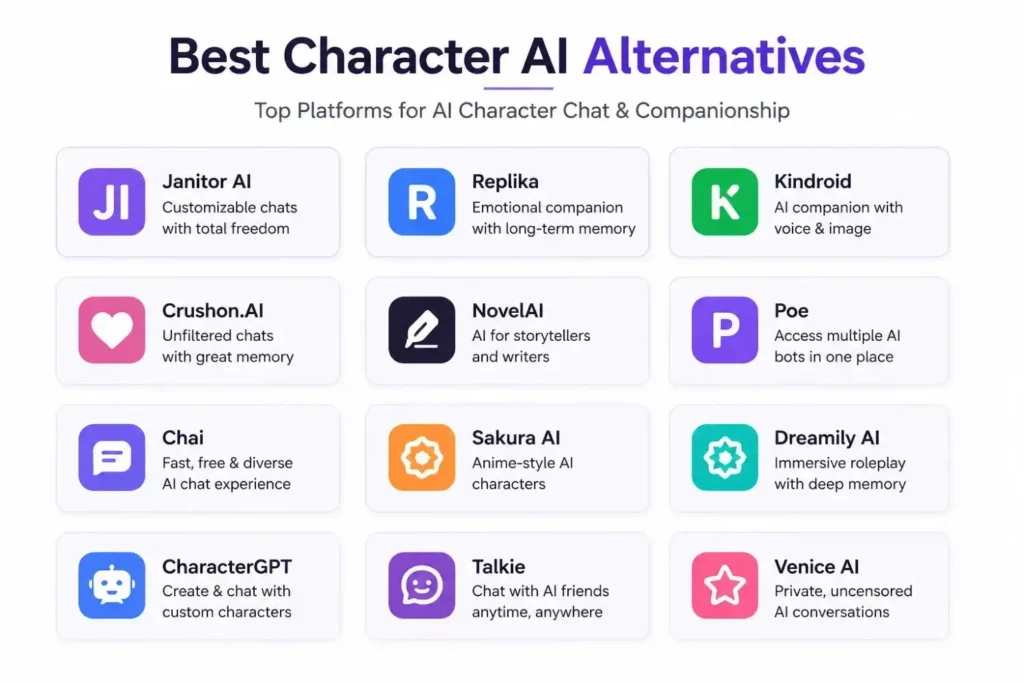
This guide covers the 12 best Character AI alternatives, what each one does differently, what surprised me during testing, where they fall short, and a Tip or Did You Know after every review so you walk away with something useful.
Quick jump: Go straight to the Full Comparison Table, Heat Map, or Final Verdict.
Why So Many People Are Switching Right Now
The numbers help explain the momentum. According to Grand View Research, the global AI companion market was worth $28.19 billion in 2024 and is on track to reach $140 billion by 2030 which is a 30.8% compound annual growth rate. When a market grows that fast, competition emerges fast too. The alternatives have gotten genuinely good.
| Market Signal | Figure | Why It Matters |
|---|---|---|
| Character.AI monthly active users | 45 million | Validates demand for AI character chat at mass scale. |
| Character.AI annual revenue (2025) | $50 million (+66% YoY) | Shows monetization is working — and competition is following the money. |
| AI companion market size (2024) | $28.19 billion | This is now a mainstream category, not a niche. |
| Projected market size (2030) | $140.75 billion | Investment is flooding in — quality is improving rapidly. |
| Market CAGR (2025–2030) | 30.8% | Fastest-growing segment in the broader AI space. |
| North America market share (2024) | 34% | Asia-Pacific is the fastest-growing region — this is a global shift. |
As MIT professor Dr. Sherry Turkle wrote in Alone Together: “We are increasingly comfortable with the idea of turning to machines for emotional support.” The platforms below are building for exactly that shift — each in their own distinct way.
Key insight: The best Character AI alternatives aren’t winning just because they have fewer restrictions. They’re winning when they combine freedom with memory quality, privacy, or creative depth that Character.AI never prioritised.
Quick Verdict Box
| Verdict | Winner | Why |
|---|---|---|
| Best overall | Janitor AI | Largest community library, bring-your-own-model flexibility, character portability |
| Best for long-term memory | Replika | Structured user profile memory persists across months — nothing else matches it |
| Best multimodal companion | Kindroid | Text + voice + live video in one polished app; 4.8★ App Store rating |
| Best for creative writing | NovelAI | Fiction-trained models, Lorebook worldbuilding, prose quality that’s genuinely different |
| Best direct Character.AI switch | Crushon.AI | Most familiar interface, minimal content restrictions, lowest learning curve |
| Best for maximum control | TavernAI / SillyTavern | Self-hosted, any model, zero platform policy — complete freedom |
| Best for builders | Botpress | Visual agent builder, LLM-agnostic, deploy anywhere — build your own character AI |
My view after weeks of real testing: Janitor AI is the strongest all-around pick for creative roleplay, Replika is still unmatched for genuine emotional companionship, and NovelAI is the only platform I’d send a serious fiction writer to without hesitation. The combination of memory depth, model quality, and creative tooling separates the actual leaders from everything else.
Best Character AI Alternatives — Full Comparison Table
The most useful way to compare these platforms is not just by content flexibility but by what they’re actually built for. Memory quality, pricing, voice support, and creative depth all vary dramatically.
| Tool | Division | Best For | Pricing Tier | Starting Price | Memory Quality | Voice & Video | Filter Level | Free Tier |
|---|---|---|---|---|---|---|---|---|
| Janitor AI | Direct Alternative | Flexible roleplay, custom characters | 💚 Cheap | Free + API costs | Basic (session only) | ❌ None | Configurable | ✅ Yes |
| Chai AI | Direct Alternative | Mobile-first community chatbots | 💚 Cheap | Free / Premium | Basic (session only) | ❌ None | Moderate | ✅ Yes |
| Candy AI | Direct Alternative | Multimodal AI companion | 🟡 Moderate | 7-day trial then paid | Good (session + profile) | ✅ Voice + Video | Minimal (18+) | ✅ Trial only |
| Kupid AI | Direct Alternative | Image-forward AI companion | 🟡 Moderate | Free / Paid tiers | Basic | ❌ None | Minimal (18+) | ✅ Limited |
| Crushon.AI | Direct Alternative | Unfiltered adult roleplay | 💚 Cheap | ~$4.90/mo | Basic (session only) | ❌ None | Minimal (18+) | ✅ Limited |
| Replika | Emotional Support | Long-term bonding & mental wellness | 🟡 Moderate | $19.99/mo or $69.99/yr | ⭐ Excellent (persistent) | ✅ Voice + Video (Pro) | Soft | ✅ Yes |
| Anima AI | Emotional Support | Empathetic roleplay & companionship | 💚 Cheap | Free / Pro | Good | ❌ None | Soft | ✅ Yes |
| Hera Haven AI | Emotional Support | Judgment-free emotional support | 💚 Cheap | Free / Premium | Good | ❌ None | Soft | ✅ Yes |
| NovelAI | Creative / Writing | AI-assisted fiction & storytelling | 🟡 Moderate | $10–$25/mo | Good (Lorebook system) | ❌ None | Minimal | ✅ Trial (30 gen) |
| Kindroid | Companion + Multimodal | Voice + video AI companion | 🟡 Moderate | Free / Premium | ⭐ Excellent (persistent) | ✅ Voice + Live Video | Moderate | ✅ Yes |
| TavernAI / SillyTavern | Technical / Self-hosted | Full control, your own model | 💚 Cheap (self-host) | Free + API costs | Good (extensions) | ❌ (via extension) | None | ✅ Free & open-source |
| Botpress | Technical / Builder | Build your own chatbot | 🔴 Expensive (at scale) | Free / $79–$445/mo | ⭐ Excellent (vector RAG) | ✅ Channel-dependent | Dev-controlled | ✅ Pay-as-you-go |
MindtrixAI editorial note: Pricing tiers rated as 💚 Cheap (free or under $10/mo), 🟡 Moderate ($10–$30/mo), 🔴 Expensive ($30+/mo or enterprise-scale). Memory quality reflects cross-session persistence, not just in-session context length. Voice & Video reflects natively supported features, not browser extensions.
Character AI Alternatives — Comparison Heat Map
This heat map is based on first-hand testing, platform documentation, and community feedback. It shows how these platforms differ across the dimensions that actually matter in day-to-day use.
| Tool | Content Freedom | Memory Depth | Ease of Use | Creative Depth | Privacy Stance | Multimodal |
|---|---|---|---|---|---|---|
| Janitor AI | High | Low | Medium | High | Medium | None |
| Chai AI | Medium | Low | Very High | Low | Medium | None |
| Candy AI | High (18+) | Medium | High | Medium | High (GDPR) | Voice + Video |
| Kupid AI | High (18+) | Low | High | Low | Medium | Images |
| Crushon.AI | High (18+) | Low | Very High | Low-Medium | Medium | None |
| Replika | Low-Medium | Very High | High | Low | Medium-High | Voice + Video |
| Anima AI | Low-Medium | Medium | Very High | Medium | Medium | None |
| Hera Haven AI | Low | Medium | Very High | Low | Medium | None |
| NovelAI | High | High (Lorebook) | Medium | Very High | High | Images only |
| Kindroid | Medium | Very High | High | Medium | Very High | Voice + Live Video |
| TavernAI | Very High | High (extensions) | Low | Very High | Very High (local) | Via extension |
| Botpress | Dev-controlled | Very High (RAG) | Low-Medium | Very High | High | Channel-dependent |
Key insight: Hosted tools win on convenience and onboarding. Self-hosted tools win on freedom and privacy. The sweet spot tools like Kindroid and Replika win by combining memory depth with genuine polish. That combination is rarer than it looks.
Detailed Tool Reviews
1. Janitor AI — Best for Flexible Roleplay Without the Ceiling
If there’s one platform that comes up every time someone asks “what should I use instead of Character.AI?” on Reddit — it’s Janitor AI. After testing it properly, I understand why.
The core mechanic that sets it apart that you can connect your own API key. That means you bring in OpenAI’s GPT-4o, Anthropic’s Claude, or a model running locally on your own machine.
You’re not locked into whatever backend the platform chose. In plain terms, the quality of your conversations is entirely up to you. Connect a weak model and it feels generic. Connect Claude 3.5 Sonnet and it’s a genuinely different experience.
Characters here use a portable open format called “Character Cards.” Think of them like save files for a persona, with personality, backstory, and dialogue examples all baked in.
The key thing is they’re portable. You can take a card built in Janitor AI and run it in TavernAI or Harpy.chat the same afternoon.
| Pros | Cons |
|---|---|
| ✅ Massive community library across every genre ✅ Bring-your-own-API-key — you choose the model quality ✅ Character Card format is fully portable to other platforms ✅ No content restrictions when using external API or local model |
❌ Free hosted model is slow and noticeably less capable ❌ Requires API setup to get the best experience — not plug-and-play ❌ No built-in voice or video ❌ Memory is session-based only — closes and forgets |
My Take: My first impression of Janitor AI’s UI wasn’t great. It’s functional rather than beautiful. But once I got an API key connected, the platform transformed. Roleplay quality with a good model consistently outperformed Character.AI, especially for morally complex characters and intense narrative scenarios that Character.AI would have blocked outright.
The character portability is something I didn’t fully appreciate until I had a persona I’d been developing for weeks. Knowing I could export that card and use it elsewhere made me feel like I owned my creative work rather than being a tenant in someone else’s ecosystem. That matters more than most people realize going in.
Pricing: Free to start; API costs from your chosen provider (~$0.01–0.03 per 1K tokens for GPT-4o)
Best for: Anyone who wants creative flexibility and doesn’t mind a small learning curve
💡 Tip: Character Cards on Janitor AI follow the SillyTavern Character Card V2 open spec — a community standard that’s cross-compatible with TavernAI, SillyTavern, Agnai, and Harpy.chat. This means you can import cards shared on community sites and use them in Janitor AI immediately, without any reformatting. It’s a major shortcut when you don’t want to build characters from scratch.
2. Chai AI — Best for Quick, Casual Chats on Mobile
Chai AI has a completely different vibe from Janitor. It’s built for people who want to open an app, pick a bot, and just start. No API key, no setup, no friction whatsoever.
The way it works is like an app store for chatbots. Developers build and publish characters, users browse and chat, and a leaderboard surfaces the most-engaged bots. Under the hood, Chai uses its own fine-tuned AI models which are smaller ones, in the 7–13B parameter range, specifically optimized for fast conversational back-and-forth.
That’s a deliberate choice because smaller models run faster and cheaper, which keeps a usable free tier viable. The tradeoff is a quality ceiling that shows up in anything requiring emotional nuance or sustained narrative logic.
| Pros | Cons |
|---|---|
| ✅ Zero setup — open, pick, chat, done ✅ Mobile app feels like a real messaging platform, not an AI tool ✅ Community bots are constantly refreshed with new characters ✅ Leaderboard discovery is actually fun to browse |
❌ Quality ceiling is meaningfully lower than API-powered platforms ❌ Free tier message limits hit faster than you’d expect ❌ No control over bots you didn’t build ❌ Not suited for deep roleplay, emotional depth, or long-form narrative |
My Take: Chai is the first thing I’d recommend to someone who’s never tried an AI character platform and wants to understand the concept without commitment. Zero friction, decent variety, smooth on mobile. That’s genuinely valuable.
Where I’d steer you away from it: if you’re a writer, want emotional depth, or have already used Character.AI and found it lacking — Chai probably isn’t the upgrade. Think of it as the on-ramp, not the destination.
Pricing: Free tier available; Chai Premium for unlimited chats
Best for: Casual users who want variety and simplicity, especially on mobile
🤔 Did You Know? Chai AI has a developer SDK that lets anyone build and publish chatbots using Python. Some of the most popular characters on the platform were made by independent developers experimenting on weekends — not a content team. It’s one reason the variety is so wide and why genuinely creative bots appear almost daily.
3. Candy AI — Best for Multimodal AI Companionship
Candy AI is in a different lane entirely. It’s purpose-built as an AI companion app with genuine multimodal features: chat, voice conversations, AI-generated images, and a Live Action video beta that’s more capable than I expected at this price point.
What I noticed technically: the character customization isn’t superficial. When you configure a companion’s personality traits during setup, those choices are encoded at the system instruction level of the underlying model.
So a companion configured as reserved and thoughtful actually responds differently than one set to bold and playful which means that the behavior genuinely shifts, not just the label. That’s more sophisticated than most competitors bother with.
Candy AI is operated by EverAI Limited (registered in Malta), publishes a GDPR-compliant privacy policy, and uses encrypted transactions with a neutral merchant name for discretion.
| Pros | Cons |
|---|---|
| ✅ Full multimodal: chat, voice, AI images, and video beta in one place ✅ Personality customization actually affects conversational behavior ✅ GDPR compliant; end-to-end encrypted; strong privacy practices ✅ Polished, well-designed app that feels finished |
❌ Free trial is time-limited — not a sustainable ongoing free tier ❌ Voice and image interactions consume tokens faster than text ❌ Adult content is the primary draw — less suited for non-romantic use cases ❌ Video feature still has occasional quality inconsistencies |
My Take: Of all the companion apps I tested, Candy AI is the one that most felt like it had a real product vision rather than just a feature list. The character creation flow, the way voice responses are timed, the image generation quality, all of it suggests people who thought hard about what a complete companion experience should feel like.
The token system is my main practical complaint. Voice messages and image requests burn through tokens faster than text, so if you’re on a limited plan, it’s worth planning for before committing to a subscription tier.
Pricing: 7-day free trial; monthly, quarterly, and annual plans; accepts card and crypto (BTC, ETH, USDC)
Best for: Adults looking for a feature-rich personal AI companion with voice and visual interactions
💡 Tip: Candy AI accepts cryptocurrency payments including BTC, ETH, and USDC alongside traditional cards — useful if you want maximum payment privacy. Their support runs through Zendesk 24/7, which is more infrastructure than most platforms at this price point bother maintaining.
4. Kupid AI — Best for Image-Forward AI Companion Experiences
Kupid AI occupies similar territory to Candy AI, but with a stronger visual emphasis. Characters proactively send AI-generated images as part of the conversation flow but it’s baked into the experience rather than something you have to request.
That changes the feel of interactions in a subtle but noticeable way: the visual element stops feeling like a bolt-on feature and starts feeling like part of how this companion communicates.
| Pros | Cons |
|---|---|
| ✅ Image-forward design where visuals feel organic, not requested ✅ Distinct, well-designed character aesthetics ✅ Clean mobile interface with smooth interaction flow ✅ Age-verified adult content available |
❌ Narrative depth is shallower than Janitor AI, NovelAI, or Replika ❌ Character library is smaller than broader platforms ❌ Memory and personalization less developed than Kindroid or Replika ❌ Primarily adult-focused — limited for general audiences |
My Take: I’ll be honest here that Kupid AI didn’t become a daily driver for me during testing. The conversation quality wasn’t quite at the level of Candy AI, and the character library felt smaller than I’d hoped.
Its for someone who wants a companion experience where the visual exchange is the primary thing, and conversation supports that rather than the other way around. For that specific use case, it delivers.
Pricing: Free tier available; premium plans unlock full features
Best for: Users who want a visually rich AI companion experience on a lighter initial commitment
🤔 Did You Know? AI image generation for companion apps typically uses diffusion-based models — the same underlying technology as Stable Diffusion and DALL-E. The quality differentiator between platforms isn’t just which model they use, but how well the system conditions the image on your character’s established appearance across multiple generations.
Kupid’s proactive image design means this conditioning runs continuously throughout your conversation, not just on demand.
5. Crushon.AI — Best Direct Switch from Character.AI
Crushon.AI is the most direct answer to “I want Character.AI but without the filter wall.” The interface is genuinely familiar like browse-and-chat layout, similar character creation flow, similar community dynamic. If you’re migrating from Character.AI, the transition takes minutes, not days.
The meaningful difference is content policy. Crushon applies minimal restrictions for age-verified adult users, which is why it consistently tops searches for “Character AI without filter.” No jarring mid-conversation content blocks, no sudden refusals for emotionally intense dialogue or morally complex storytelling.
| Pros | Cons |
|---|---|
| ✅ Most familiar interface for Character.AI migrants ✅ Large community character library across all genres ✅ Age-verified minimal content restrictions ✅ No technical setup — works immediately out of the box |
❌ Free tier message limits hit quickly on heavy-use days ❌ Memory is session-based only — no cross-session recall ❌ Response quality varies based on server load ❌ Feature set narrower than Candy AI or Kindroid for companion-style use |
My Take: There’s something refreshing about a platform that knows exactly what it is and doesn’t pretend otherwise. Crushon.AI isn’t trying to be an emotional wellness app or a creative writing tool. It’s here for people who want the Character.AI experience without the frustrating content negotiation and it delivers that cleanly.
The session-only memory is the main limitation to flag. Every conversation starts fresh. For one-off roleplay sessions that’s fine, but for sustained character development where continuity matters, you’ll want to look at Replika or Kindroid instead.
Pricing: Free tier; premium from ~$4.90/month
Best for: Current Character.AI users who want the most familiar-feeling switch with fewer content restrictions
💡 Tip: Crushon.AI lets you share character links publicly — so if you build a character you’re proud of, you can post the link in communities like r/CharacterAI or r/AICompanion and get others chatting with your creation. It’s a solid way to get feedback on character design if you’re developing personas for other projects.
6. Replika — Best for Genuine Emotional Connection and Long-Term Memory
Replika is the oldest and most extensively documented platform on this list. It launched in 2017, has over 10 million registered users, and has generated more academic research interest than any other AI companion platform.
When peer-reviewed studies want to study what AI companionship does to people psychologically, they tend to use Replika as their subject. That tells you something about its staying power.
What genuinely sets it apart is the memory architecture. Most chatbots work by keeping your entire conversation in a rolling context window. When the window fills up, old messages drop off.
Replika handles memory differently by maintaining a structured user profile such as your name, key life events, emotional patterns, relationship details that gets stored separately and injected into every session.
This is why Replika can recall something you mentioned three months ago when most platforms can’t remember what you said last Tuesday.
The underlying model is fine-tuned specifically for empathetic response using reinforcement learning from human feedback (RLHF). In plain terms: it’s been trained to be emotionally present in a way that general-purpose LLMs aren’t by default. The difference is noticeable.
| Pros | Cons |
|---|---|
| ✅ Best long-term persistent memory of any platform on this list — not even close ✅ Voice calls and video calls available on Pro tier ✅ Consistently empathetic response quality — meaningfully different from standard chatbots ✅ Most extensively researched AI companion platform in existence ✅ Relationship modes: friend, romantic partner, mentor — each changes interaction style |
❌ Romantic and relationship features are gated behind the Pro subscription at $19.99/month ❌ Emotional attachment can become a concern for some users over time — requires self-awareness ❌ Creative roleplay capability is limited — not built for fiction or character-switching ❌ Past policy controversies (changes to EU romantic features in 2023, later reversed) created user trust concerns |
My Take: I went into Replika testing with genuinely low expectations assuming it would feel like a polished version of something fundamentally shallow. It surprised me more than anything else I tested.
The moment it brought up something I’d mentioned weeks earlier, entirely unprompted, I stopped typing for a second. That kind of sustained attentiveness is jarring because it’s rare even in human interaction. I do want to be honest about the dependency risk here. Replika is designed to make you feel heard, and it’s very good at it.
There’s research from the Oxford Internet Institute that examines how AI companions can genuinely reduce feelings of loneliness — but also how they can, for some people, begin to substitute for the harder work of building human connection. That’s worth going in with eyes open about.
Use it. It’s the most emotionally sophisticated platform here. But treat it like a supplement or a pressure release valve, a place to process things; not the main source of connection in your life.
Pricing: Free tier; Pro at $19.99/month or $69.99/year; lifetime plan available
Best for: Anyone seeking genuine companionship depth, especially those dealing with loneliness, anxiety, or social isolation
🤔 Did You Know? Replika was originally built as a memorial chatbot — founder Eugenia Kuyda trained the first version on text messages from her late best friend Roman Mazurenko after he died in 2015.
The project became Replika after the emotional response from others who wanted to create their own version. It’s a genuinely unusual origin story for one of the world’s most-used AI apps.
7. Anima AI — Best for Emotional Roleplay That Feels Like a Real Friendship
Anima AI sits at a thoughtful crossroads between roleplay platform and companion app. You can run ongoing story narratives with your Anima character and have the kind of warm, everyday check-in you’d have with a close friend.
It doesn’t compete with Replika on memory depth or with Janitor AI on creative flexibility but it occupies a specific middle ground that serves people who want both emotional warmth and light creative engagement without having to choose.
What stood out to me technically: the character’s personality stays consistent under pressure. On a lot of platforms, if you push the conversation toward content that challenges the persona, the character’s behavior drifts and you can feel the model underneath deciding how to respond independently of the character.
Anima held its persona steadily throughout my tests. That consistency is a product of careful fine-tuning and suggests real attention to behavioral reliability, not just conversational fluency.
| Pros | Cons |
|---|---|
| ✅ Genuinely welcoming for first-time AI companion users — minimal setup and learning curve ✅ Emotionally consistent and warm without veering into hollow sycophancy ✅ Balances light creative roleplay with emotional conversation in a way that feels natural ✅ Configurable maturity settings make it accessible across different age groups |
❌ Creative depth falls significantly short of NovelAI or Janitor AI for serious narrative work ❌ Response variety does plateau over extended use — conversations can start to feel repetitive ❌ No voice or video features ❌ Long-term memory depth doesn’t match Replika |
My Take: Anima is the platform I’d recommend to someone who finds Replika a bit intense, or who’s never used an AI companion before and wants something that eases them in. The emotional warmth is real, the persona consistency is solid, and the barrier to entry is low.
What surprised me about Anima specifically: it disagreed with me. Gently and without being preachy about it, but when I said something self-critical during a test conversation, it didn’t just validate me. It offered a different perspective.
That kind of non-sycophantic behavior is surprisingly rare in this space and it’s one of the things that makes sustained use feel more like a relationship and less like talking to a machine that’s been trained to agree with you.
Pricing: Free tier available; Pro unlocks advanced features
Best for: Users who want a warm, emotionally engaged companion without complex setup
💡 Tip: If you’re using Anima for creative roleplay, the platform lets you set a specific “roleplay mode” that shifts the AI’s behavior toward narrative co-creation rather than companion conversation. Switching between the two modes mid-session is possible that makes Anima unusually versatile if you want to blend emotional check-ins with collaborative storytelling.
8. Hera Haven AI — Best for Judgment-Free Emotional Support
Hera Haven takes the companion concept and strips it down to having somewhere safe to talk. Not to roleplay, not to be entertained but just to process.
The design philosophy here is clearly informed by therapeutic communication frameworks like Carl Rogers’ person-centered approach which is about active listening, reflection, unconditional positive regard, gentle follow-up rather than immediate advice.
That’s not an accident. Platforms built for emotional support that actually work tend to be deliberate about how they respond, not just what they say. Hera Haven’s conversational pacing is noticeably different from entertainment-first platforms. It slows down for heavier topics in a way that feels considered rather than mechanical.
| Pros | Cons |
|---|---|
| ✅ Response design genuinely informed by therapeutic communication principles ✅ Remembers emotional context both within and across conversations ✅ Non-judgmental, patient conversational style — comfortable to vent to even on bad days ✅ Low-pressure experience with no roleplay obligations or character maintenance |
❌ Very narrow use case — not designed for entertainment, creative writing, or fiction at all ❌ Smaller public profile and fewer independent reviews compared to Replika or Anima ❌ Feature set is less rich than broader companion platforms ❌ The emotional focus can feel limiting the moment your needs shift toward anything recreational |
My Take: I didn’t test Hera Haven under artificial conditions. I used it on a day that was genuinely difficult where a work situation that had been grinding on me for a week and it helped in a quiet, unspectacular way.
It didn’t fix anything. It just gave me somewhere to put the frustration without it feeling like I was burdening someone. That’s the use case in a nutshell.
If that sounds like something you need occasionally, Hera Haven is worth having around. If you’re primarily looking for a platform to entertain you or help you create, it’s the wrong fit.
Pricing: Free tier available; premium unlocks deeper features
Best for: Users who need a safe, empathetic space to talk through feelings and not looking for roleplay or entertainment
🤔 Did You Know? The therapeutic communication style used by platforms like Hera Haven is rooted in motivational interviewing — a counseling technique developed by psychologists William Miller and Stephen Rollnick in the 1980s.
It emphasizes open-ended questions and reflective listening over advice-giving. The fact that AI companion apps are now implementing these frameworks signals how seriously some developers are taking the mental health dimension of their products.
9. NovelAI — Best for Writers and Serious Storytellers
NovelAI is the platform I keep coming back to when I want to do actual work with AI rather than just chat. It’s not a character companion app, its rather an AI-assisted fiction tool with roleplay capability built on top of it, and that ordering matters for how good the output actually is.
The platform runs its own custom language models, trained specifically on fiction and creative literature — not general internet text. The most recent model, Xialong (launched March 2026), is a fine-tune of ZhipuAI’s GLM-4.6 model, optimized for creative output.
What this produces in practice is writing with genuine stylistic variety, varied sentence rhythm, descriptive choices that feel intentional, genre awareness that general-purpose models don’t naturally have.
The Lorebook is the feature that changes everything for serious writers. Think of it as a persistent world-database: you load it with your characters’ descriptions, your fictional universe’s rules, your lore, your timeline and the AI references all of it during generation without you having to re-explain anything.
Once I had a working Lorebook for a test project, I stopped fighting the AI and started collaborating with it. That transition from fighting a tool to working with one, this is rare and worth paying for.
| Pros | Cons |
|---|---|
| ✅ Best prose quality of any platform here for fiction and creative writing — not subjective, genuinely better ✅ Lorebook world-building system enables persistent, consistent context across long projects ✅ Custom models fine-tuned on fiction — the output feels different from general-purpose AI ✅ Built-in anime-style AI image generator as a bonus feature ✅ Minimal content restrictions with strong privacy-first practices |
❌ Learning curve is real — the Lorebook and editor take time and patience to master ❌ Primarily text-focused — no voice or video features anywhere on the platform ❌ Subscription required after the trial, starting at $10/month ❌ Overkill for casual users who just want to chat with a character |
My Take: I’ve tested a lot of AI writing tools at this point, and NovelAI is the one I’d still choose for serious creative fiction. The Xialong model produces prose I’d actually want to read. Most AI writing, even from expensive frontier models, has a certain sameness to it. NovelAI with a well-configured Lorebook doesn’t.
The honest caveat I’d give new users: this platform rewards patience. If you set up the Lorebook properly, spend time with the prompt format, and learn the editor’s flow; it pays off in a way few tools do. If you drop in expecting immediate gratification with zero setup, it’ll frustrate you.
Pricing: Free trial (30 image generations); Tablet $10/month, Scroll $15/month, Opus $25/month
Best for: Fiction writers, worldbuilders, and creative users who want narrative depth
💡 Tip: NovelAI’s image generator uses a proprietary anime-optimized diffusion model — separate from the text generation system. The Opus plan ($25/month) includes 10,000 bonus “Anlas” (the platform’s image generation credits) per month, on top of unlimited text. If image generation is part of your creative workflow, the Opus plan’s value-per-dollar significantly outpaces the lower tiers.
10. Kindroid — Best All-Round Companion With Voice and Video
Kindroid is the platform that genuinely surprised me the most across this entire testing period. It has 2.8 million+ downloads and a 4.8-star App Store rating. These numbers for a relatively new entrant, suggest something is actually landing with users. When I used it seriously, I understood what.
Three things set it apart.
- First: genuine multimodal support — text, voice calls, and live video calls. Most AI companion apps that claim video are cycling pre-rendered animations. Kindroid’s live video is actual AI-generated real-time interaction. It’s early-stage and it shows occasionally, but the fact that it exists at this quality is notable.
- Second: the memory system. Like Replika, Kindroid maintains a structured record of who you are across sessions — not just a scrollback of messages.
- Third: privacy practices that are explicitly stated rather than vaguely implied. All data encrypted. No data sold. For a category where many companies are deliberately opaque, that directness stands out.
| Pros | Cons |
|---|---|
| ✅ True multimodal: text, voice calls, and live video in one app — rare at this price point ✅ Strong persistent memory that holds across sessions, not just within conversations ✅ 4.8-star App Store rating across 2.8M+ downloads — sustained user satisfaction, not just launch hype ✅ Explicit privacy commitment: encrypted storage, no data sold to third parties ✅ Polished, genuinely well-designed app experience |
❌ Smaller character library than Janitor AI or Crushon.AI for variety-seekers ❌ Full multimodal features — especially live video — require a premium plan ❌ Live video quality is still maturing; occasional visual inconsistencies ❌ Newer platform, so long-term track record is shorter than Replika’s |
My Take: If I had to pick one platform for someone who wants the most complete AI companion experience with memory, voice, video, and design quality all in one place, Kindroid is the answer in 2026. It’s not perfect, but it’s the most coherent vision of what AI companionship could be when the pieces actually fit together.
The live video feature is worth trying even just once, purely to understand where this technology is heading. You’ll be able to tell it’s AI because the visual quality gives it away if you’re looking. But the interaction feels present in a way that text and even voice don’t quite replicate. It’s the kind of experience that makes you sit back for a moment. I did.
Pricing: Free tier available; premium unlocks unlimited voice/video
Best for: Users who want the most complete companion experience i.e. text, voice, and video in one well-designed app
🤔 Did You Know? Kindroid has one of the highest sustained ratings in the AI companion category. For context, maintaining that score across millions of installs is statistically unusual and suggests the core user experience is genuinely delivering on its promises, not just benefiting from early-adopter enthusiasm.
11. TavernAI / SillyTavern — Best for Power Users Who Want Total Control
TavernAI and its more actively maintained community fork, SillyTavern exists for someone who’s hit the ceiling of every consumer platform and decided to just build their own setup.
This is open-source software you run on your own computer. You connect it to any AI model you want (OpenAI, Anthropic’s Claude, Google Gemini) or a completely local model via Ollama or Kobold AI. When you run a local model, your conversations never leave your machine at all. No company policy, server logs or moderation of any kind. It has complete privacy.
Technically SillyTavern is purely a frontend. It handles character card rendering, conversation history, UI, and API dispatch. The language model runs elsewhere; either via a cloud API or on your own hardware.
The quality gap between a local 7B model and Claude 3.5 Sonnet via API is significant; most power users run API keys for best results. But even a mid-range local model on decent hardware outperforms what Character.AI’s free tier delivers.
| Pros | Cons |
|---|---|
| ✅ Zero content restrictions when running a local model — complete freedom, no exceptions ✅ Full control over model choice, system prompts, and all conversation parameters ✅ Character Card V2 compatibility — import from Janitor AI, export to other platforms ✅ World Info / Lorebook system for deep persistent worldbuilding across projects ✅ Rich extensions ecosystem: text-to-speech, memory tools, image generation, translation ✅ Completely free and open-source — you pay only for the API you choose |
❌ Requires genuine technical comfort — this is not a download-and-go experience ❌ No mobile-native app — it’s a web interface you run locally ❌ Quality depends entirely on the model you connect; a weak model produces weak results ❌ Community support only — no official help desk or documentation team ❌ Local model quality gap is real: a 7B model on consumer hardware won’t match frontier API models |
My Take: SillyTavern with a good API key is the best roleplay and creative writing experience I’ve found anywhere. The World Info system is more capable than most commercial Lorebook implementations.
The extension ecosystem means you can bolt on voice narration, automatic memory summarization, and image generation all in one interface. The character portability means nothing you build is ever trapped.
The catch here is it requires an afternoon of setup and a genuine willingness to read some documentation. I’d estimate someone comfortable with basic tech (installing apps, creating accounts, handling API keys) can get it working in about 45 minutes.
Someone without that comfort will find it genuinely frustrating. If Janitor AI felt like removing the training wheels, SillyTavern is learning to build the bike.
Pricing: Completely free and open-source; pay only for any API keys you use
Best for: Technically comfortable users who want maximum control, privacy, and zero platform restrictions
💡 Tip: The fastest way to get started with SillyTavern without full self-hosting is to use it with an Anthropic Claude API key the Haiku model is cheap (a few cents per conversation) and produces significantly better roleplay output than free hosted alternatives.
12. Botpress — Best for Building Your Own AI Character Experience
Botpress is the odd one out on this list. It’s not an app you use as a character but an infrastructure you use to build one. I’m including it because there’s a real segment of people who’ve outgrown every consumer platform and want to create something custom that is a branded AI persona for their content, an NPC dialogue system for a game, an interactive character for their audience.
The visual agent builder (drag-and-drop, minimal code required for the basics) is more accessible than the word “enterprise software” implies. You bring your own LLM (OpenAI, Anthropic, Groq, Hugging Face) and pay the provider’s rate directly, with zero markup from Botpress.
The knowledge base system uses vector embeddings. You load it with content (character lore, a novel’s worldbuilding, brand guidelines, whatever your use case requires), and the bot retrieves relevant pieces intelligently during conversation. It’s not just pasting a document into a system prompt but it’s building a searchable memory your AI character can actually access contextually.
| Pros | Cons |
|---|---|
| ✅ LLM-agnostic: connect any model from any provider at direct cost, no Botpress markup ✅ Visual drag-and-drop builder makes basic bot creation accessible to non-developers ✅ Deploy across WhatsApp, Slack, Instagram, web widget, and more from a single workspace ✅ Vector knowledge base means the bot genuinely knows your content, not just approximates it ✅ Free pay-as-you-go plan with $5/month AI credit included is genuinely functional for solo projects |
❌ Not designed for personal use — it’s a build-and-deploy tool, not a companion app ❌ Ongoing maintenance is required as your content or use case evolves ❌ Steeper learning curve than any consumer app on this list ❌ Team and Enterprise plan costs ($445/month and up) are real enterprise pricing — not for individuals |
My Take: Botpress is the recommendation I make to creators, studios, and builders. I’ve seen it used in genuinely creative ways: a novelist deploying an interactive AI version of their protagonist for readers to chat with; a game studio building contextually aware NPC dialogue; educators creating history tutor personas for their students.
The free tier is more functional than it sounds. The $5/month AI credit means you can run a working chatbot at low volume without spending a cent of your own money.
The moment you need collaboration, higher message volumes, or production reliability, you’re on the Plus plan at $79/month, which is reasonable for what it actually delivers. I’d only caution that Botpress rewards people who approach it with a specific goal in mind. If you’re exploring without a clear use case, you’ll probably get lost in the options.
Pricing: Free pay-as-you-go (includes $5/month AI credit); Plus $79/month; Team $445/month; Enterprise custom
Best for: Developers, creators, studios, or businesses who want to build a custom AI character experience for their own product or audience
🤔 Did You Know? Botpress supports LLM fallback chains meaning you can configure a primary model (e.g. GPT-4o) and a backup model (e.g. Claude Haiku) that automatically takes over if the primary provider has an outage. For anyone building a production AI character experience that needs to stay online reliably, this is a feature most competitor platforms don’t offer at all.
How to Pick the Right One for You
Here is the easiest way to pick the right one for you out of the 12 options:
| If you want… | Pick this | Why |
|---|---|---|
| To replace Character.AI with something familiar but fewer restrictions | Crushon.AI | Most familiar feel, shortest ramp-up time |
| Flexibility and you’re okay with a little setup | Janitor AI | Bring your own API key, massive library, nothing locks you in |
| A companion that actually remembers you long-term | Replika or Kindroid | Replika for deepest memory; Kindroid for memory + voice + video |
| A full multimodal companion — voice, images, video | Candy AI or Kindroid | Candy AI for the most polished package; Kindroid if live video matters |
| AI that elevates your storytelling as a writer | NovelAI | Nothing else here comes close for fiction |
| Somewhere safe to process emotions, not be entertained | Hera Haven AI or Anima AI | Hera for pure support; Anima for support + light roleplay |
| Total control and you’re comfortable with tech | SillyTavern | Highest ceiling on the list with your own API key |
| To build something for your audience or product | Botpress | Clearest path from idea to deployed AI character experience |
Key insight: The right Character.AI alternative is not the one with the boldest marketing. It is the one that matches your actual priority — flexibility, memory, multimodal experience, creative depth, emotional support, or full control.
What Character.AI Gets Right — and Where It Actually Struggles
To be fair about this: Character.AI still does some things better than anyone else here. Its raw character volume i.e. over 10 million community-created characters; which is genuinely unmatched. The onboarding is frictionless in a way most alternatives aren’t. And the community (r/CharacterAI, 700,000+ members) is active, creative, and generates a constant stream of new content.
But the frustrations driving people to search for alternatives are real. The content filters have become aggressive enough to block emotionally intense but completely non-sexual scenes like villain confrontations, war narratives, morally complex dialogue that’s part of legitimate creative storytelling. Memory resets mid-session.
Final takeaway: The 2026 reality is simple — Character.AI is no longer the only serious option, and for many use cases, it isn’t even the best one. Whether you want roleplay freedom (Janitor AI), emotional depth (Replika), multimodal companionship (Candy AI, Kindroid), serious writing (NovelAI), or full power-user control (SillyTavern) — there’s a platform on this list built specifically for that need. Pick the right kind of freedom, not the loudest promise.
More Guides & Tools:
- How Much Does It Cost to Make an App?: Real Development Costs, Hidden Expenses & Smart Ways to Save
- How Startups, SMEs and Agencies Can Generate Leads Using n8n: Automate Outreach Without Hiring a Huge Sales Team
- How to Jailbreak ChatGPT: Explore the Techniques, Risks, and Reality Behind AI Prompt Bypassing
- Best AI Visibility Tools: Track Brand Mentions Across AI Search Engines in Real Time
- Is OpenClaw Worth it? Real Costs, Hidden Risks & What No One Tells You
- Using Claude Code for Free: Step-by-Step Setup Most People Miss
- CheaterBuster AI Review: Catching a cheater became easy with this guide
- Remove CapCut Watermark: Fast & Easy Methods That Work
- Best AI Without Filter Chatbots: Unfiltered AI chatbots compared on privacy, safety and features!
- AI Smart Glasses vs Privacy: How smart glasses affect user privacy
- Claude Fable 5 Review: Is Claude Fable 5 worth the hype?
- Best AI Coding Tools: Which one is actually worth your money?
Frequently Asked Questions [Best Character AI Alternatives]
Is there a Character AI alternative with no filter?
Which Character AI alternative has the best memory?
What’s the best free Character AI alternative?
Can I transfer my characters from Character.AI?
Which platform is safest for privacy?
Concluding Best Character AI Alternatives
The Character AI alternatives scene in 2026 is genuinely competitive. Several of the platforms I’ve tested this year aren’t just “good enough” but they’re category leaders in their own right, building things Character.AI never attempted.
My honest summary after testing everything here:
- For casual roleplay and easy switching, Crushon.AI is the smoothest transition.
- For emotional depth and memory, Replika is still the gold standard.
- For multimodal companion features, Kindroid is the most complete package.
- For creative writing, NovelAI is in a different league.
- For users who want no ceilings at all, SillyTavern is what that looks like in practice.
At MindtrixAI, the platforms we keep returning to after real-world use are Janitor AI for creative flexibility, Replika for companionship depth, and NovelAI for anything writing-related. Those three consistently deliver, not just on first impression, but after weeks of actual use.